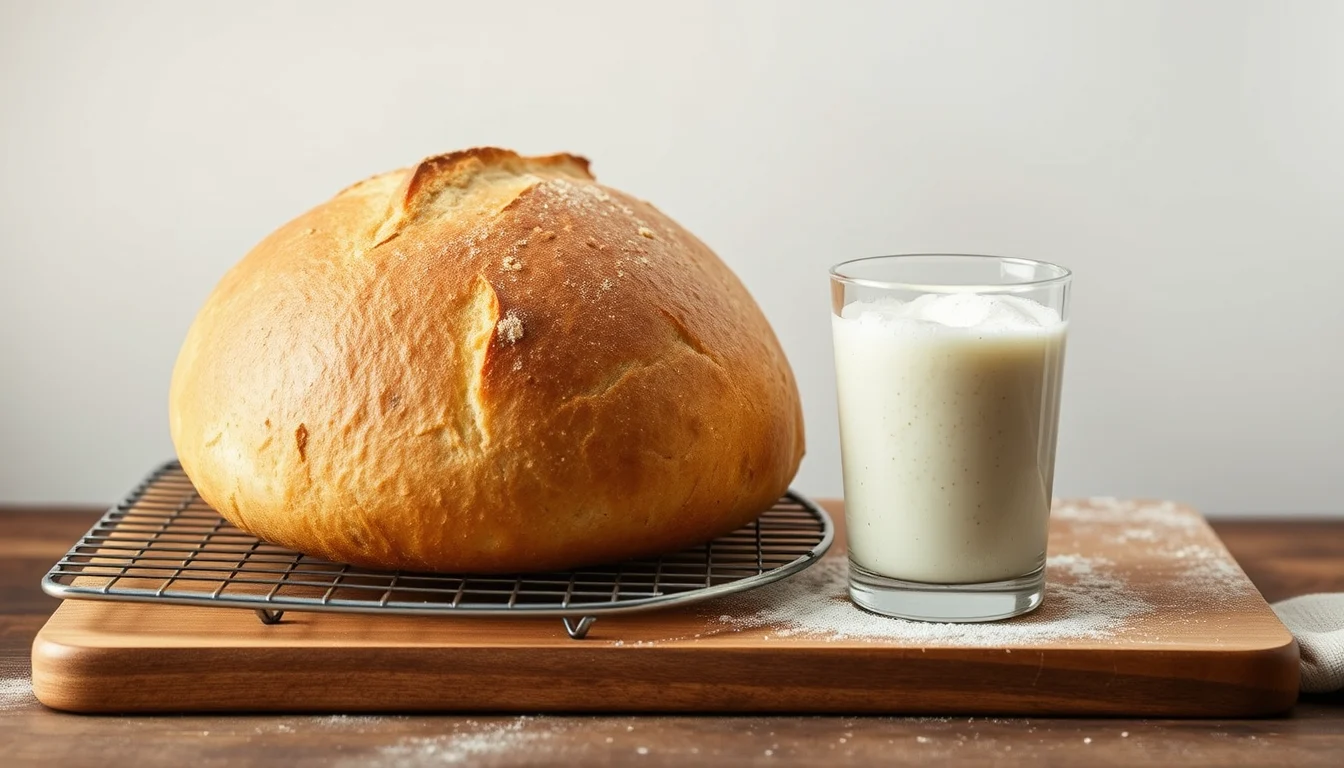
Most dense sourdough is underfermented. Either the starter wasn’t at its peak when you mixed, or bulk fermentation ended before the dough had grown enough for its temperature, usually because the kitchen was cooler than the recipe writer’s. The less common causes are too little water for the flour, weak gluten or loose shaping, a high share of whole grain or rye, a loaf that overproofed and collapsed, and a loaf cut while still hot, which feels heavy and gummy even when fermentation went well.
The good news is that density is one of the easiest faults to track down, because each cause leaves clues. Work through the questions below in order, since the first two explain the large majority of heavy loaves.
Three questions to ask first
- Was the starter at its peak when you mixed? Doubled, domed and bubbly, not flat or still climbing.
- How warm was the dough, and how much did it rise in bulk? A measured number beats a guess on both counts.
- Was the loaf fully baked and completely cool before you cut it?
If you can’t answer the first two, that is the place to start. A thermometer and a straight-sided container with a strip of tape at the starting level will answer them on your next bake.
Cause 1: the starter wasn’t ready
A starter used before its peak has fewer active yeast cells than the recipe expects, and one used long after its peak has spent its food and turned acidic. Either way, the dough starts slowly and often never catches up within the recipe’s timings.
Timing is the usual culprit. A recipe might say to use the starter four hours after a 1:1:1 feed. With 100 g needed and a 20 g reserve, the sourdough starter feeding calculator puts that feed’s peak at about 4 h to 6 h at 24 °C (75 °F), so four hours is reasonable in a warm kitchen. When the kitchen is 20 °C (68 °F), the peak moves out to about 6 h to 9 h, and the four-hour starter is still only part of the way up.
- Check before you mix. Look for a domed top, roughly doubled volume and bubbles through the whole jar.
- Wake up a fridge starter properly. A feed or two on the counter before baking day makes a big difference; how to store a sourdough starter shows a two-feed plan.
- If it never doubles, the starter itself needs attention first; the guide to a starter that won’t rise works through the reasons.
Cause 2: bulk fermentation ended too early
This is the most common cause of all. During bulk, the dough needs to fill with enough gas to open the crumb, and it needs time for the gluten to become stretchy enough to expand in the oven. End it early and the loaf has neither.
Suppose your kitchen sits at 20 °C, the dough uses 15% starter with mostly white flour, and your recipe says bulk takes four to five hours. For that dough, the bulk fermentation estimator gives a window of about 7 h 45 min to 10 h 30 min and suggests waiting for a rise of about 75% to 100%. Stopping at five hours means stopping at around half the time it needed. The same dough at 24 °C would take about 5 h 15 min to 7 h, still longer than the recipe suggests.
Enter your own dough temperature and starter percentage to see the window and the rise to wait for:
Measure the dough, not the air. A dough mixed with cool water in a cool kitchen can sit a couple of degrees below the room for hours, and that alone adds an hour or more. Warmer mixing water is the simplest correction, and why dough temperature matters more than time has the short sum for choosing it.
Cause 3: not enough water for the flour
A dough that is too stiff resists expanding, both in bulk and in the oven. This often happens with whole wheat, which absorbs much more water than white flour, or with a recipe written for a different flour from the one in your cupboard.
Take a mostly whole wheat loaf made with 400 g of flour, 260 g of water, 80 g of starter at 100% and 8 g of salt. The sourdough hydration calculator gives a true hydration of 68.2%, which feels moderate for white flour and distinctly stiff for whole wheat. Set a target of 75% and it asks for 290 g of water, 30 g more than the recipe. Add the extra gradually during mixing, and let the dough rest for 20 to 30 minutes before the first fold so the bran can soak it up.
Flour protein plays a part as well. A weaker flour holds less water and less gas; bread flour vs all-purpose flour explains when that matters.
Cause 4: weak gluten or loose shaping
A loaf can ferment perfectly and still come out heavy if the dough lacked the strength to hold its gas. Signs include a loaf that spreads sideways, a dense layer along the bottom and a crumb that looks compressed rather than tight.
- Give wetter doughs enough sets of folds that they hold a rounded shape between sessions. Stretch and folds vs kneading covers how many and when.
- Shape with enough surface tension that the loaf holds itself up on the counter.
- Use a banneton or a floured, towel-lined bowl for the final proof, so the loaf has support until it goes in the oven.
Cause 5: it went too far
Overproofed dough can also bake up dense. Once the gluten weakens, the gas escapes during shaping or scoring, and the loaf bakes flat and compact, often with a sour smell and a pale crust. If your loaf was low, wide and tight rather than tall and tight, overfermentation is the more likely story. How to read your crumb: underproofed vs overproofed shows how to tell the two apart from a slice.
Cause 6: the flour or add-ins
Some breads are naturally close-textured. A high share of rye gives a dense, moist crumb by design, and 100% whole wheat loaves are always heavier than white ones. Seeds, grains, dried fruit and cheese add weight and cut through the gluten network. Judge these loaves against their own style, and increase the share of whole grain or inclusions gradually if a lighter crumb is the goal.
Cause 7: underbaked, or cut too soon
A loaf that looks done on the outside can still be damp inside. Bake until the crust is deep brown and the base sounds hollow, or until the centre reads about 96 °C (205 °F) or a little more on a probe thermometer. Then wait. The crumb keeps setting for at least an hour as steam leaves the loaf, and cutting it early leaves a gummy, compressed texture that looks exactly like underfermentation.
Habits that lead to heavy loaves
- Following recipe times in a different kitchen. Treat every time as a starting estimate for your own temperature.
- Using a starter by the clock. Mix when it peaks, not when the alarm goes off.
- Changing several things at once. Swap one variable per bake so you can see what helped.
- Adding flour while shaping. Extra flour worked in stiffens the dough and can leave dense streaks.
- Slicing straight from the oven. The loaf isn’t finished until it has cooled.
Dense loaf questions
Can I rescue a loaf that came out dense?
Not the texture, but the bread is still useful. Slice it thinly and toast it, turn it into croutons or breadcrumbs, or use it for bread pudding or French toast, where a firm crumb holds together well.
Why is only the bottom of my loaf dense?
A dense band along the base usually means the loaf was slightly underfermented, since the bottom is where gas escapes first and the weight of the dough sits. Too little heat from below, such as a pot or stone that wasn’t fully preheated, can add to it.
My loaf is dense but has a few big holes. Which problem is that?
That combination points to underfermentation rather than low hydration. The few big holes are pockets of gas that the tight dough couldn’t spread evenly. A longer or warmer bulk usually fixes both.