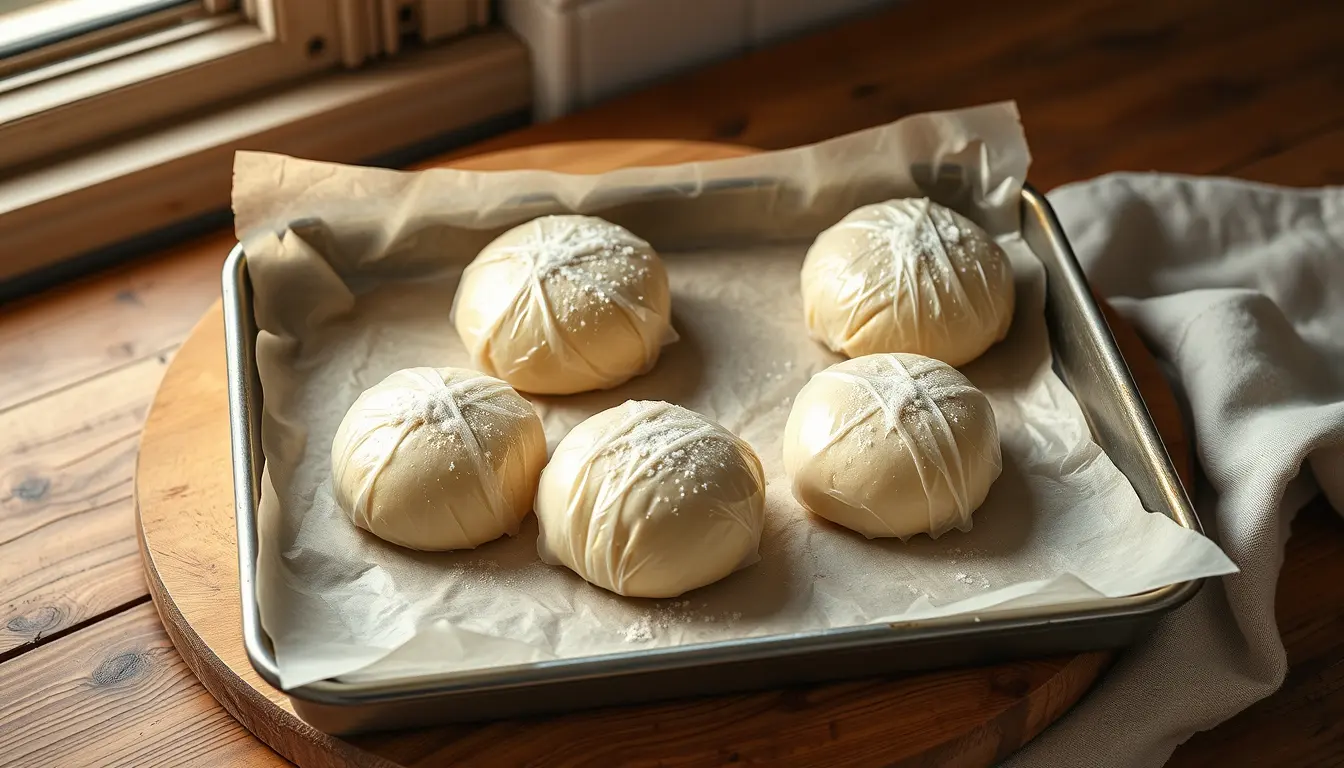
Pizza dough freezes very well, and yeasted bread dough freezes well enough to be worth doing. The best moment is after the first rise, once the dough has been divided and shaped: coat it lightly with oil, wrap it airtight and freeze it flat. Use it within about a month for the liveliest rise, thaw it slowly in the fridge, then give it its normal final rise at room temperature before baking.
Sourdough is the exception. A frozen sourdough loaf often rises slowly and unevenly, so most bakers freeze the baked bread rather than the dough. More on that below.
What freezing does to dough
Freezing doesn’t kill all the yeast, but it does kill some of it. As water in the dough turns to ice, sharp crystals damage a share of the yeast cells and nick the gluten network. The surviving yeast restarts once the dough thaws, just more slowly, and the gluten is a little weaker than before.
That explains the usual advice. Freeze the dough quickly and cold so the ice crystals stay small, keep the freezing time short, and expect the thawed dough to need a little longer to rise than fresh dough would.
When to freeze each kind of dough
| Dough | Best point to freeze | Thaw and finish |
|---|---|---|
| Pizza dough | After balling; a day or two of cold fermentation first is fine | Overnight in the fridge, then 1 to 3 hours on the counter |
| Yeasted sandwich or tin loaf | After the first rise, shaped and in the tin | Overnight in the fridge, then rise at room temperature until it crowns |
| Rolls and cinnamon buns | Shaped but not yet risen, frozen on a tray | Overnight in the fridge, then rise for 1 to 2 hours |
| Sourdough loaf | Not ideal; freeze the baked bread instead | Thaw the bread wrapped, then crisp it in a hot oven |
Freezing pizza dough balls
- Mix and ferment the dough as your recipe says. A batch that has had a day or two in the fridge freezes as well as one fresh from bulk.
- Divide it and shape each piece into a tight ball.
- Rub each ball with a thin coat of olive oil. It stops the surface drying and keeps the wrap from sticking.
- Wrap each ball in cling film or seal it in a small freezer bag, pressing out the air.
- Lay the balls on a tray in the freezer until solid, then gather them into a larger bag.
- Write the date on the bag.
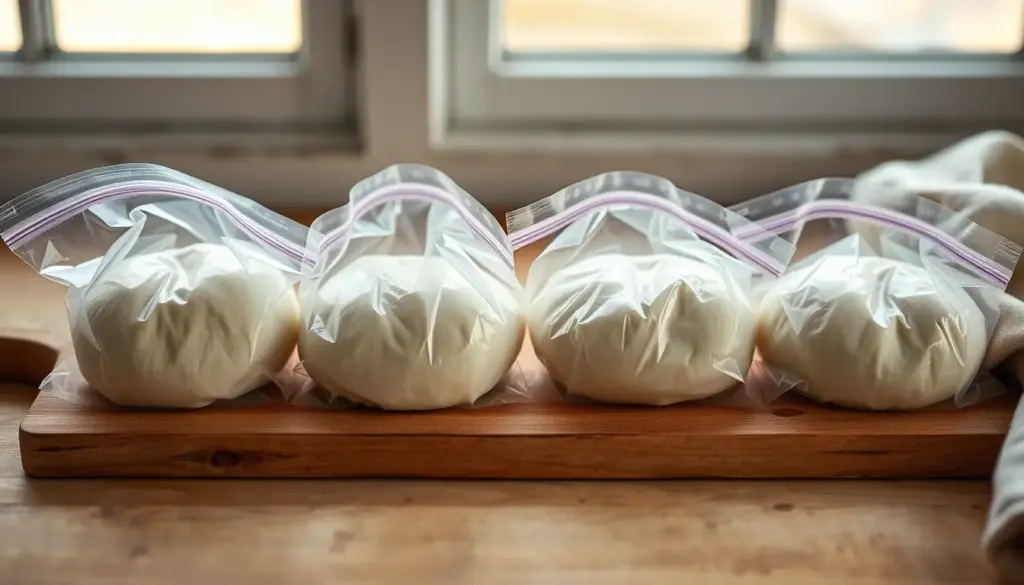
Individual wrapping means you can take out one ball for a quick supper without thawing the whole batch. Cold fermentation for pizza dough covers the fridge part of the process if you’d like to build flavour before freezing.
A batch made for the freezer
Making one large batch and freezing most of it saves a lot of weeknight effort. The pizza dough calculator scales a recipe to any number of balls. For six 260 g balls at 62% hydration, with 2.5% salt, 2% oil, 0.4% instant yeast and 2% extra for losses, it gives:
- 953 g of flour
- 591 g of water
- 24 g of salt
- 3.81 g of instant yeast, about 1¼ teaspoons
- 19 g of oil
That’s 1,591 g of dough, or 265 g per ball. Bake two that day and freeze four.
Some bakers raise the yeast slightly for dough they plan to freeze, to make up for the cells that won’t survive. Others leave it as it is and simply allow more time after thawing. Both work. If you’d like to try it, setting the yeast to 0.5% in the calculator gives 4.76 g for the same batch.
Freezing yeasted bread dough
For a tin loaf, let the dough finish its first rise, shape it and set it in a greased tin. Cover it and put the tin straight in the freezer. Once the dough is solid, after a few hours, you can lift it out, wrap it tightly in cling film and a freezer bag, and free up the tin. When it’s time to bake, unwrap it, return it to the greased tin, cover it and thaw it overnight in the fridge.
Rolls and buns are easiest of all. Shape them, freeze them apart on a lined tray, then bag them. Thaw them on a lined tray in the fridge overnight, leaving space for them to rise.
If you’re working from a recipe with cups or packets, weigh the yeast so you can repeat the batch exactly. Instant vs active dry vs fresh yeast gives the conversions.
Why sourdough is harder
A sourdough loaf rises slowly to begin with, and the damage from freezing seems to hit it harder than a yeasted dough. Thawed shaped loaves often take many hours to recover and bake up flatter. Cold retard: proofing sourdough in the fridge is the better way to hold a sourdough loaf for a day or two. For longer, bake it and freeze the bread.
How long it keeps
Dough kept frozen at −18 °C (0 °F) stays safe indefinitely. The time limits here are about quality. Pizza and lean bread dough are at their best within about a month. Up to three months works, but the rise gets slower and weaker the longer the dough sits. Enriched doughs such as cinnamon rolls follow similar limits, and most bakers aim to use them within one to two months.
Signs that dough has been frozen too long include dry, pale patches from freezer burn, a grey tinge, and a dough that stays slack and barely rises after a full thaw.
Thawing it safely
Thaw dough in the fridge, still wrapped, for 12 to 24 hours. Slow thawing keeps the dough evenly cold while the yeast wakes up, and it’s the safest method for doughs with milk or eggs. Leaving dough on the counter to thaw for many hours lets the outside overproof while the middle is still frozen.
After the fridge, give the dough its usual final rise at room temperature. Pizza balls need 1 to 3 hours to warm through and relax. A thawed tin loaf usually takes longer than a fresh one to crown above the rim. Judge it by the dough, not the clock.
Freezing mistakes
- Freezing a fully proofed loaf. It has little rise left to give after thawing and often collapses in the oven.
- Loose wrapping. Air in the bag means freezer burn and a dry skin.
- Thawing on a warm counter. The outside races ahead while the centre is still icy.
- Skipping the oil on pizza balls. The surface dries out, and the wrap sticks and tears the dough.
- Forgetting the date. Old dough rises poorly, and it’s easy to lose track.
Frozen dough questions
Can I thaw pizza dough in the microwave?
It isn’t a good idea. Microwaves heat unevenly, so parts of the dough can start to cook or get hot enough to kill the yeast while other parts stay frozen. If you’re short on time, put the sealed ball in a bowl of cool water for an hour or two instead.
Can I refreeze dough that has thawed?
It’s best not to. Each freeze kills more yeast, so a refrozen dough rises poorly. Doughs with milk or eggs that have sat out at room temperature shouldn’t go back in at all. Bake the dough instead, then freeze the bread or pizza.
Can I freeze part-baked pizza bases instead?
Yes, and they’re very handy. Stretch the dough, bake the plain base on a hot steel or stone for two or three minutes until just set, then cool, wrap and freeze it. Add the toppings to the frozen base and bake it in a hot oven until the cheese bubbles.