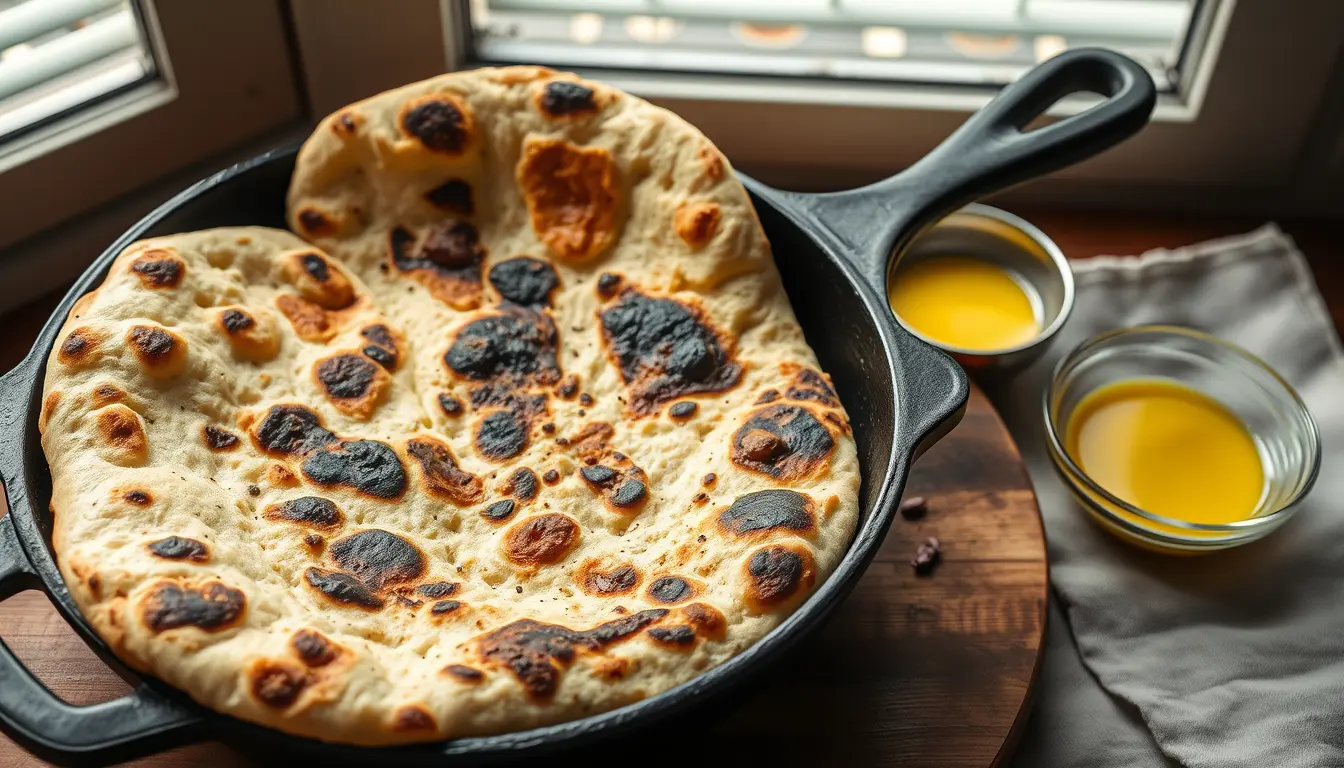
You can make soft, blistered naan at home without a tandoor by cooking it in a very hot cast iron pan over high heat, covered with a lid for part of the time. The pan’s base gives the bottom its charred spots, and the lid traps heat and steam so the top puffs and cooks through. The dough matters too: a soft, yogurt-enriched dough rolled to about 5 mm thick gives the tender, chewy result you get at a good restaurant. Brush it with ghee or butter as soon as it comes off the heat.
What a tandoor does, and how to copy it
A tandoor is a clay oven that runs several hundred degrees hotter than a home oven. Naan is slapped onto its inner wall, where it cooks in a minute or two. The intense heat from the wall sets the bottom immediately and creates the charred blisters, while the hot air inside puffs and browns the top.
A home oven can’t reach those temperatures, but a heavy pan on a strong burner comes surprisingly close for the bottom of the bread. What’s missing is heat on top. Covering the pan, or finishing the naan under a hot grill (broiler), fills that gap. Either way, the key is speed: naan cooked slowly turns out dry and cracker-like.
The dough
Naan dough is soft and slightly enriched. Yogurt adds tang and tenderness, a little fat keeps the bread supple, and a small amount of sugar helps it brown quickly. Here’s a batch for six naan:
- 300 g all-purpose flour
- 100 g plain yogurt
- 90 g warm milk
- 15 g melted ghee or neutral oil
- 5 g sugar
- 6 g salt
- 3 g instant yeast
With the yogurt and milk marked as liquids, the baker’s percentage calculator lays the batch out like this:
| Ingredient | Weight | Baker’s % |
|---|---|---|
| All-purpose flour | 300 g | 100% |
| Plain yogurt | 100 g | 33.3% |
| Warm milk | 90 g | 30% |
| Melted ghee or oil | 15 g | 5% |
| Sugar | 5 g | 1.7% |
| Salt | 6 g | 2% |
| Instant yeast | 3 g | 1% |
| Total | 519 g | 173% |
The calculator reads 63.3% hydration, counting yogurt and milk fully as liquid. Both contain solids as well as water, so the dough feels firmer than a plain water dough at 63%. That’s intended: the result is soft and slightly tacky, easy to stretch without tearing.
All-purpose flour gives the most tender naan. Bread flour works but makes it chewier. Thick Greek-style yogurt absorbs more liquid than thin yogurt, so if your dough feels stiff, add milk a spoonful at a time.
Only have active dry yeast? The yeast converter matches 3 g of instant with 3.6 g of active dry, about 1⅛ tsp. Instant vs active dry vs fresh yeast explains the difference.
Why yogurt matters
Yogurt does more than add flavour. Its acidity and milk proteins soften the gluten slightly, which is why naan stretches easily and stays tender after cooking instead of turning chewy like pizza. It also adds a gentle tang that balances the richness of ghee. Plain, unsweetened, full-fat yogurt works best. Low-fat yogurt works but makes a slightly drier bread, and flavoured yogurt adds sugar that burns in a hot pan.
Mixing and rising
Mix everything into a shaggy dough, then knead for about 5 to 6 minutes until smooth. The dough should feel soft and a little sticky; resist adding much flour. Cover and let it rise in a warm spot until roughly doubled, usually 1½ to 2 hours.
Divide the dough into six pieces of about 85 g. Round them, cover, and rest for 15 minutes before shaping.
Shaping
Naan is traditionally teardrop-shaped, but any shape cooks well. Flatten each ball and roll or stretch it to about 5 mm thick and around 20 cm (8 in) long. Keep the thickness fairly even, with slightly thicker edges if you like a soft rim. Thin spots burn and thick spots stay doughy.
Shape each naan just before it goes in the pan rather than all at once, so the rounds don’t stick together or dry out while they wait.

Cooking in a cast iron pan
- Heat a cast iron pan over medium-high to high heat for about 5 minutes, until a drop of water sizzles away almost instantly.
- Lay the naan in the dry pan. Within 30 to 60 seconds, bubbles will rise across the surface.
- Cover the pan with a lid for about 1 minute. The trapped heat cooks the top and helps it puff.
- Turn the naan over and cook for another 30 to 60 seconds, until charred spots appear.
- Lift it out and brush immediately with melted ghee or butter.
Adjust the heat as you go. If the naan scorches black before bubbles appear, the pan is too hot; if it takes more than 2 minutes to blister, turn the heat up.

The oven method
If you’d like to cook several at once, put a baking stone or steel on the top rack, just under the grill, and heat the oven at its top setting for 45 minutes. Switch the grill on for the last few minutes. Lay the naan on the hot surface and cook for 2 to 3 minutes, until puffed and spotted brown. This gives good colour on top but slightly less char underneath than the pan.
Flavours and toppings
Garlic naan is the most popular variation: press finely chopped garlic and coriander into the top before cooking, or stir them into the melted butter for brushing. Nigella seeds, sesame seeds or a little flaky salt work well too. For a cheese-filled naan, wrap a small amount of grated cheese inside a ball of dough, seal it, and roll it out gently.
Naan mistakes
- A pan that isn’t hot enough. The naan dries out before it blisters and turns stiff.
- Rolling too thin. Very thin naan becomes crisp, like a cracker.
- Too much flour while shaping. It burns in the pan and makes the surface dry.
- Skipping the lid. The top stays pale and undercooked.
- Letting it cool uncovered. Stack cooked naan in a towel so it stays soft.
Planning ahead
Naan dough can be made in the morning and kept in the fridge until evening; the cold slows the rise and adds flavour. Take it out about 30 minutes before shaping. If you’re serving a crowd, cook all the naan a little ahead, wrap the stack tightly in foil, and warm it in a low oven for 10 minutes just before serving. How to freeze bread dough and pizza dough balls covers freezing portioned dough if you want to make it further ahead.
If your naan comes out pale and puffy rather than blistered, the cause is usually the heat, not the recipe. For more on what high heat does to flatbreads, pizza stone vs pizza steel covers how stored heat changes browning.
Naan questions
Can I make naan without yeast?
Yes. Quick versions use baking powder and yogurt instead and can be cooked within 30 minutes. They’re a little denser but still good.
Can I use a non-stick pan?
You can, but most non-stick coatings shouldn’t be heated as high as naan needs. A cast iron or carbon steel pan gives better blistering and is safe at high heat.
How do I reheat leftover naan?
Sprinkle it with a few drops of water and warm it in a hot pan for 30 seconds per side, or wrap it in foil and heat it in the oven.
Can I freeze naan?
Yes. Freeze cooked naan between sheets of baking paper. Reheat from frozen in a hot pan or oven.