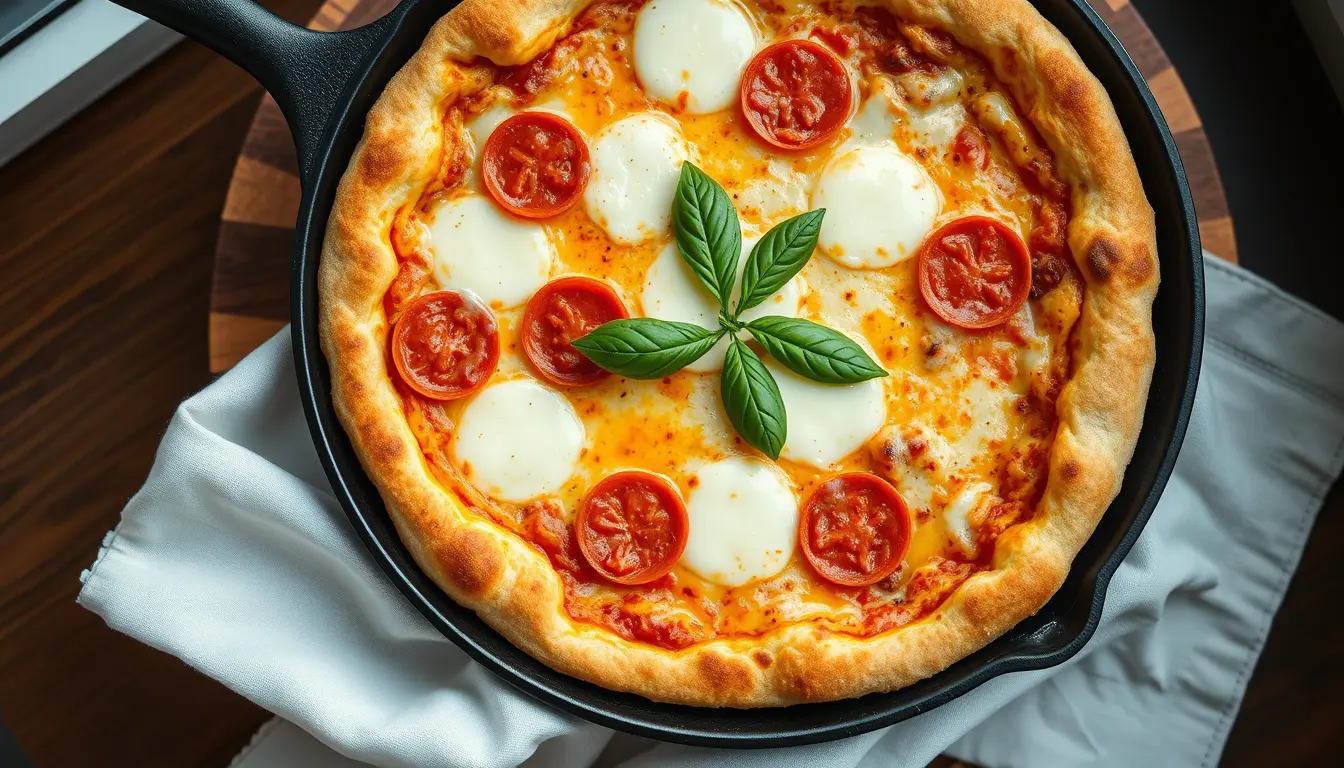
Cast iron skillet pizza is made by pressing pizza dough into a well-oiled cast iron pan, letting it rise there for an hour or two, then topping it and baking it hot, around 250 °C (480 °F), on a lower rack. The heavy iron holds heat and the oil fries the base, so you get a thick, airy crust with a crisp, golden underside, and cheese that melts into a lacy, caramelised edge against the pan. For a 25 cm (10 in) skillet, about 280 g of dough is a good starting point. It’s one of the most forgiving ways to make pizza in a home oven, because it doesn’t need a stone, a steel or a peel.
Why cast iron works so well
A thin pizza needs a blazing hot surface underneath to cook in a few minutes. A pan pizza works differently. The dough proofs in the pan, gets thicker and airier, and cooks for longer at a slightly lower temperature. Cast iron suits this because it’s heavy: once hot, it holds and spreads heat evenly, so the base browns all over rather than in patches.
The oil is the other half of the trick. A generous layer under the dough fries the base as it bakes, giving a crunchy, golden crust that stays crisp under sauce and cheese. That’s the texture a thin pizza on a stone can’t give you, and it’s why pan pizza has its own fans. If you want the classic thin style instead, pizza stone vs pizza steel covers that route.
How much dough for your skillet
Skillets are usually sold by the diameter across the top rim, while the base is a little smaller. Pan pizza is thick, so it takes more dough for its size than a regular pizza. As an approximate guide:
- 20 cm (8 in) skillet: about 180 to 200 g of dough
- 25 cm (10 in) skillet: about 260 to 300 g
- 30 cm (12 in) skillet: about 380 to 420 g
Go toward the lower end for a lighter crust and the upper end for a thick, bready one. For regular, flat pizzas, what size dough ball for a 10, 12 or 14 inch pizza gives much lighter weights, since that crust is far thinner.
The dough
Pan pizza dough benefits from a little more water than a standard New York dough, plus some oil and sugar for softness and browning. In the pizza dough calculator, two pans’ worth at 280 g each, 65% hydration, 2% salt, 2% oil, 1% sugar and 0.5% instant yeast, with the default 2% extra for dough loss, gives:
| Ingredient | Amount |
|---|---|
| Flour | 335 g |
| Water | 218 g |
| Salt | 6.7 g |
| Instant yeast | 1.68 g (about 0.54 tsp) |
| Olive oil | 6.7 g |
| Sugar | 3.4 g |
| Total dough | 571 g |
That’s about 286 g per ball. For one 30 cm skillet, a single ball of 400 g with the same settings needs 239 g flour, 156 g water, 4.8 g salt, 1.2 g yeast, 4.8 g oil and 2.4 g sugar.
Bread flour gives a chewier, more structured crust; all-purpose a softer one. If you’d like more flavour, mix the dough a day ahead and leave it in the fridge, as cold fermentation for pizza dough explains.
Pressing the dough into the pan
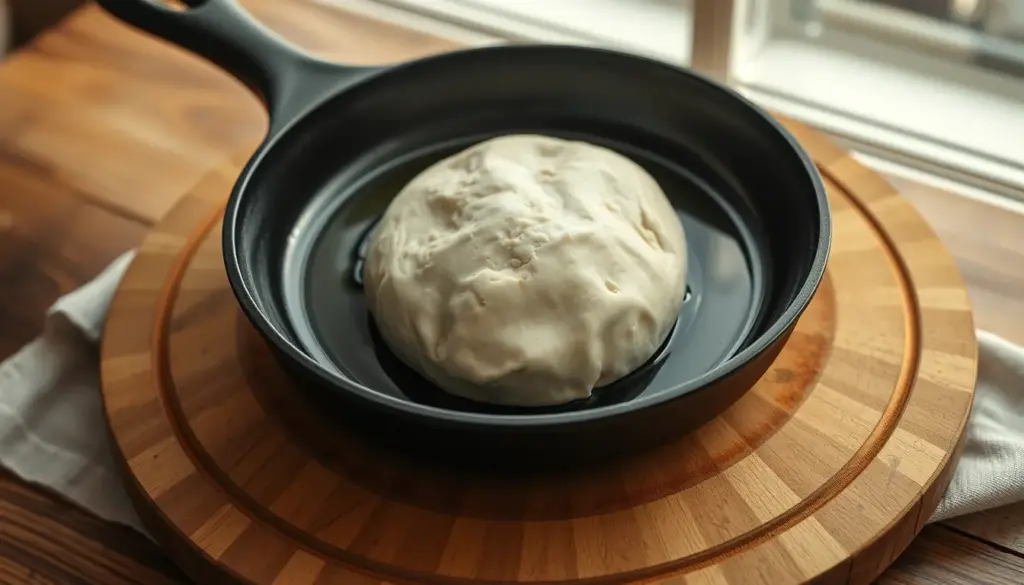
Pour about 2 tablespoons of olive oil into a cold skillet and spread it over the base and a little way up the sides. Put the dough ball in, turn it over once to coat it in oil, then press it outward with your fingertips. It won’t reach the edges straight away. Cover the pan and let the dough rest for 15 to 20 minutes, then press again. It relaxes each time and soon fills the pan.
Then leave it, covered, to proof in the pan for about 1 to 2 hours at room temperature, until it looks puffy and has risen noticeably. The longer the rise, the airier the crust.
Topping
Heat the oven to 250 °C (480 °F) or as high as it goes, with a rack in the lower third. Spread sauce over the dough, keeping it light; pan pizza is thick, but a heavy layer of sauce still makes the middle soggy. Scatter cheese right to the edges so it touches the hot iron. That’s what creates the crisp, browned cheese edge. Low-moisture mozzarella works best; fresh mozzarella releases water.
Keep wet toppings, such as fresh tomatoes, mushrooms or peppers, to a modest amount, or cook them first to drive off some moisture.
Baking
Bake on the lower rack for about 15 to 20 minutes, until the cheese is bubbling and browned at the edges. Lift one side of the pizza gently with a thin spatula and check the bottom: it should be deep golden. If the top is done but the base is pale, set the skillet on the stovetop over medium heat for 1 to 3 minutes to crisp it. If the base is browning too fast, move the pan up a rack.
Use oven gloves to handle the pan. The handle gets as hot as the rest of the skillet and stays hot for a long time. Leave the pizza in the pan for 2 to 3 minutes, then slide it out onto a rack or board so the base doesn’t steam.
Toppings that suit a thick crust
A pan pizza can carry more than a thin one, but the same moisture rules apply. Cured meats like pepperoni curl and crisp beautifully, and their fat runs into the cheese. Caramelised onions, roasted peppers, olives and cooked sausage all work well because they’ve already lost most of their water. Add delicate toppings such as fresh basil, rocket or a drizzle of good olive oil after baking.
One popular trick is to lay the cheese directly on the dough and spoon the sauce over the top in stripes or dollops. The cheese shields the crust from the sauce’s moisture, and the sauce on top concentrates as it bakes. It’s a good option if your pan pizzas have been coming out soft in the middle.
Starting on the stovetop
Some bakers start the pizza on the hob. After topping, they set the skillet over medium heat for 2 to 3 minutes before moving it to the oven. This heats the iron quickly and gives an extra-crisp base. It’s especially useful if your oven runs cool, but watch closely: oil and cast iron get very hot, very fast.
Skillet pizza mistakes
- Too little oil. The dough sticks and the base stays pale instead of frying.
- Skipping the rise in the pan. The crust turns out dense and flat.
- Overloading with sauce. The thick crust under it stays gummy.
- Baking on the top rack. The cheese burns before the base browns.
- Leaving the pizza in the hot pan. Steam softens the crisp base.
For other ways dough can misbehave when stretched, see why pizza dough tears or shrinks back.
Skillet pizza questions
Can I use an enamelled cast iron pan?
Yes, as long as it’s oven-safe at high temperatures. Check that the knob or handle is rated for the heat too.
Will this damage my skillet’s seasoning?
No. Baking with oil actually helps maintain seasoning. Wipe the pan clean after use and dry it well.
Can I use store-bought pizza dough?
Yes. Bring it to room temperature first, then press it into the oiled pan and let it rise there for at least an hour.
Can I use a different heavy pan?
A thick, oven-safe steel pan or a heavy cake tin works too. Thin pans heat unevenly, so the base may brown in patches.