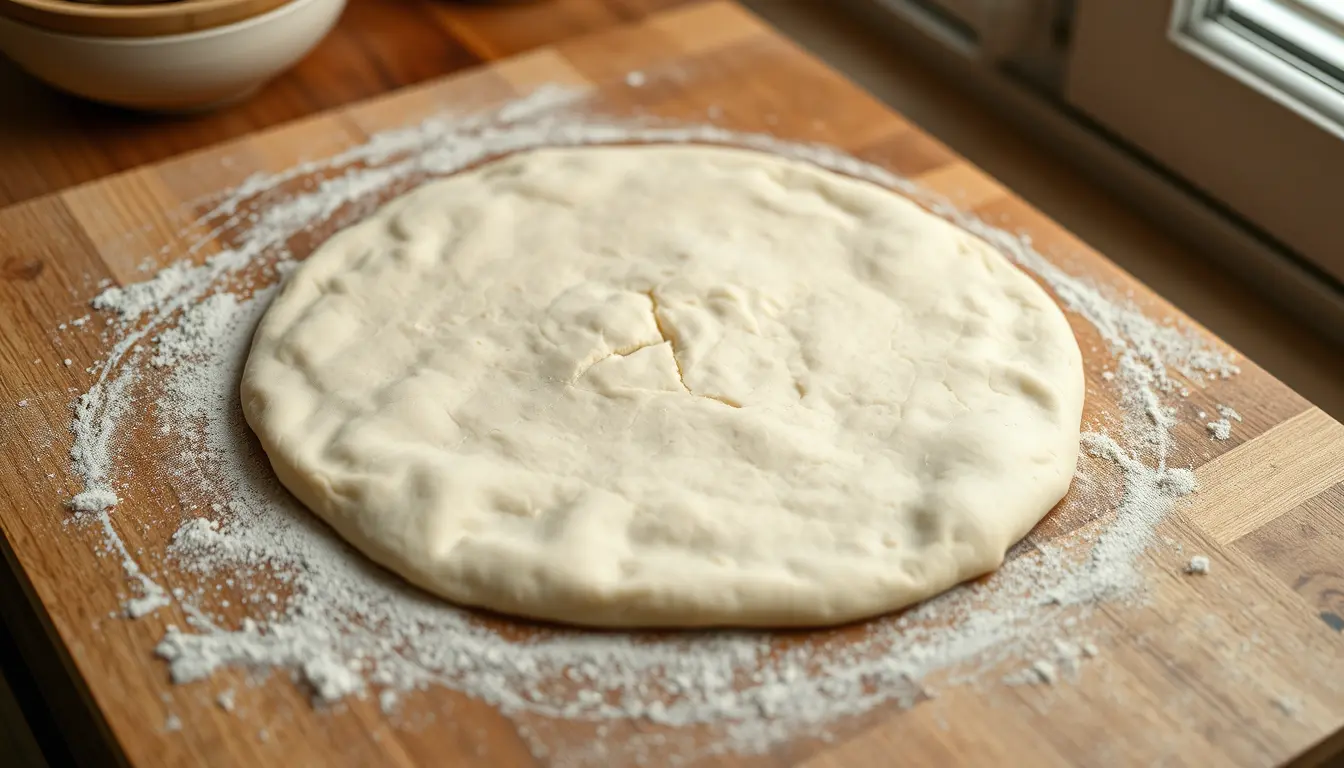
Pizza dough that shrinks back has gluten that is too tight to stay stretched. The usual causes are dough that is still cold, a ball that hasn’t rested long enough since it was shaped, or dough that hasn’t fermented enough. Dough that tears has the opposite problem: gluten that is too weak, or stretched much thinner in one spot than the rest. That usually means overfermented dough, a dough too wet for its flour, or a stretching technique that pokes through the centre. The quickest fix for shrinking is simple: cover the dough, leave it 15 to 20 minutes, and try again.
Both problems are about balance. Gluten needs to be strong enough to stretch thin without breaking, but relaxed enough to stay where you put it.
Two properties: elastic and extensible
Gluten has two personalities. Elasticity is its tendency to spring back, like a rubber band. Extensibility is its willingness to stretch and stay stretched. A good pizza dough has some of both, with extensibility winning by the time you shape it.
- A dough that shrinks has too much elasticity for the moment.
- A dough that tears has too little strength to match how far you’re stretching it.
Most of the fixes come down to moving that balance with time, temperature and formula.
Quick diagnosis
| What happens | Likely cause | What to try |
|---|---|---|
| Springs back as you stretch | Gluten still tight after balling | Rest 15 to 20 minutes, covered |
| Stiff and springy, cool to the touch | Dough too cold | Let it warm to room temperature |
| Tight, few bubbles, hardly risen | Underfermented | Give it more time before stretching |
| Thin spots and holes in the middle | Uneven stretching, or dough too weak | Stretch from the rim, use knuckles |
| Slack, sticky, tears everywhere | Overfermented | Use sooner next time, less yeast or a cooler spot |
| Tears and feels very wet | Too much water for the flour | Lower the hydration or use stronger flour |
Causes of shrinking
The dough is cold
Gluten tightens when it is cold. A ball straight from the fridge feels firm and fights every stretch. Give it time on the counter, usually one to three hours depending on your kitchen, until it feels soft all the way through. Cold fermentation for pizza dough covers timing that step.
It was balled too recently
Shaping a ball tightens the gluten, just like kneading. If you ball the dough and try to stretch it 20 minutes later, it will resist. Allow at least an hour after balling at room temperature, and longer for firm or cold dough.
It hasn’t fermented enough
Fermentation softens gluten as acids and enzymes go to work. A dough mixed only a short time ago, with little sign of gas, is still tight. Look for a ball that has puffed, feels soft and shows small bubbles underneath.
The formula is stiff
A low-hydration dough made with very strong flour can stay springy even when well rested. Some doughs simply have more elasticity than suits hand stretching.
The pizza dough calculator makes it easy to test a softer formula without changing anything else. Four 260 g balls at 58% hydration, 2.5% salt, 0.3% instant yeast and 2% extra need 660 g of flour and 383 g of water. Move the hydration to 64% and it becomes 636 g of flour and 407 g of water, with the same 1,061 g of dough and 265 g per ball. That small shift makes a dough noticeably easier to open.
Causes of tearing
Overfermentation
A dough left too long, or in too warm a spot, gets slack and sticky as the gluten breaks down. It stretches easily at first, then rips with little warning. Large bubbles on the surface and a strong alcohol smell are warning signs. Next time, use less yeast, a cooler spot or a shorter rest. Once a dough reaches this stage, it can’t be strengthened again, so stretch it gently and keep the pizza a little smaller.
Too wet for the flour
Higher hydration makes dough more extensible, but only up to the point the flour can support. All-purpose flour at 70% will tear where bread flour copes. Protein content is the key difference, as bread flour vs all-purpose flour shows. Pizza dough hydration: which percentage fits your oven helps match hydration to how you bake.
Underdeveloped gluten
A dough mixed only briefly and never folded has weak, patchy gluten. A few extra minutes of kneading, or a couple of sets of folds during the first rise, solves it.
Stretching technique
Even a good dough tears if one area is pulled much thinner than the rest. The centre is the usual victim.
- Press the ball into a disc with your fingertips, working from the centre outwards and leaving a 1 to 2 cm rim untouched.
- Lift the disc onto the backs of your hands, knuckles up, and let gravity stretch it as you turn it.
- Move your hands outwards towards the rim, not the middle.
- Hold it up to the light. If the centre looks thin, stop stretching there and work the outer ring instead.
A routine that prevents both
Most tearing and shrinking disappears with a consistent routine. Mix the dough with enough water for your flour, usually 60 to 65% for all-purpose and bread flour, and knead or fold it until it’s smooth. Ferment it long enough to soften, at room temperature or in the fridge, and ball it at least an hour before stretching, longer if it has been cold.
Before you stretch, press a finger gently into the side of a ball. It should feel soft and leave a dent that springs back slowly. If it springs back fast, wait. If it barely springs back and feels loose, stretch it now and handle it gently.
Then stretch with the same method each time, working from the rim and letting gravity help. Over a few bakes, you’ll learn what ready dough feels like in your kitchen, and both problems become rare.
Mistakes that make it worse
- Fighting a shrinking dough. Pulling harder tightens it more. Rest it instead.
- Adding lots of flour to the bench. It dries the surface and makes tears more likely. Use just enough to stop sticking.
- Reballing a torn dough. It needs another long rest before it will stretch again. Patch it if you can.
- Using a dough straight from the fridge. Cold gluten springs back every time.
Tearing and shrinking questions
Can I patch a hole in stretched pizza dough?
Yes. Pinch the edges together, or press a small piece of dough from the rim over the hole. Toppings hide a patch well. Keep sauce away from the spot until it’s sealed, or it will leak onto the peel.
Does a little oil in the dough help it stretch?
It helps a bit. Oil at around 2 to 3% of the flour makes a dough more extensible and easier to open, which is part of why New York-style recipes include it. It won’t fix a cold or underfermented dough, though.
Should I just use a rolling pin?
You can, especially for thin, crisp styles. A rolling pin flattens the bubbles, so the rim won’t puff as much. If hand stretching keeps failing, rolling the centre and leaving the rim alone is a reasonable compromise.
Why does my dough tear only when I move it onto the peel?
Lifting a large, thin round puts all its weight on the thinnest part, usually the centre. Finish the last bit of stretching on a lightly floured counter, slide the peel underneath rather than lifting the dough, and top the pizza quickly. A dusting of semolina on the peel helps it slide off without dragging.