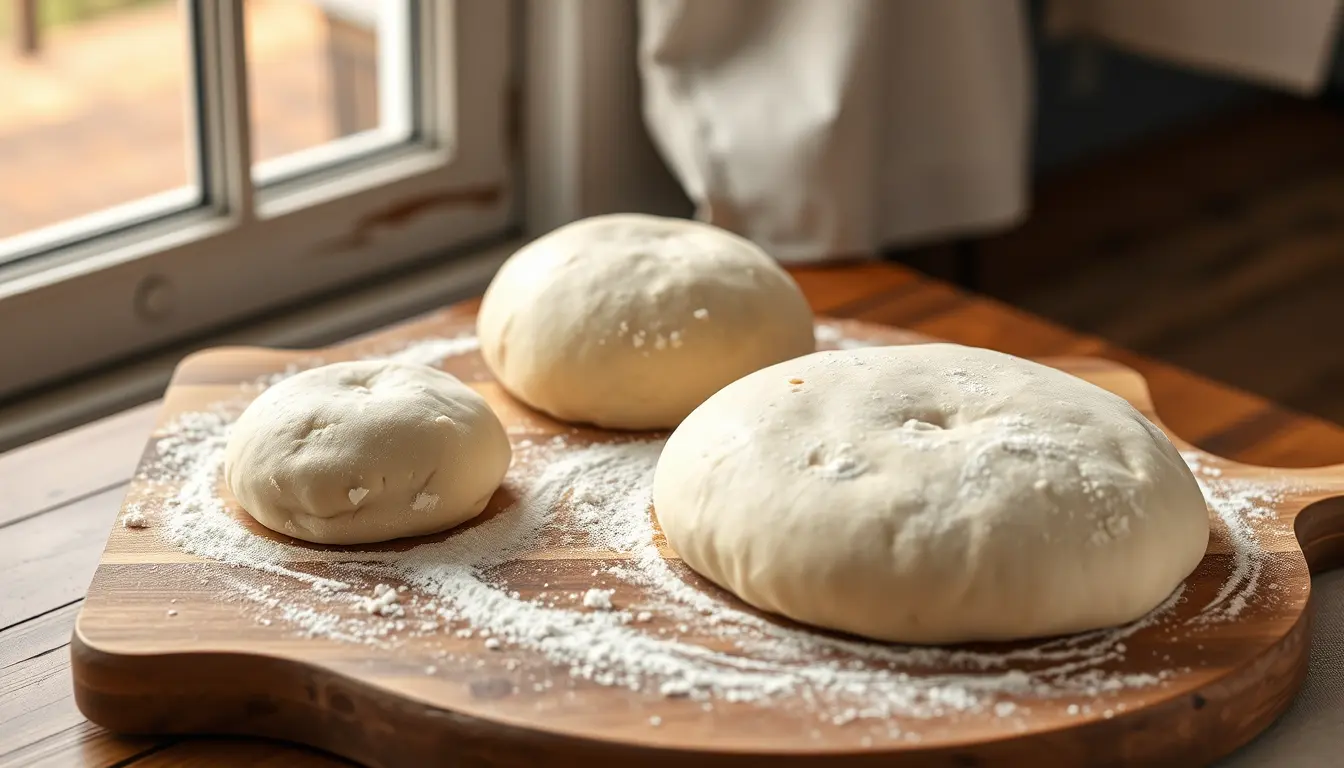
For a medium-thin crust, use about 180 g of dough for a 10 inch (25 cm) pizza, 255 g for a 12 inch (30 cm) pizza and 350 g for a 14 inch (35 cm) pizza. For a thinner base, go down to roughly 155 g, 225 g and 305 g. For a thicker, sturdier crust, go up to about 200 g, 290 g and 390 g. The numbers jump more than you might expect between sizes because the dough has to cover an area, and area grows with the square of the width. A 14 inch pizza has almost twice the surface of a 10 inch one.
Why weight follows area
A pizza’s diameter is the number on the menu, but the dough spreads over the whole circle. The area of a circle is π times the radius squared, so:
- A 10 inch pizza covers about 78.5 square inches.
- A 12 inch pizza covers about 113.1 square inches.
- A 14 inch pizza covers about 153.9 square inches.
Going from 10 to 14 inches is a 40% wider pizza but nearly double the area. If you used the same ball for both, the 14 inch base would be half as thick.
Pizzerias handle this with a “thickness factor”: the weight of dough per square inch. Multiply the area by the factor and you get the ball weight. Thin, New York-style crusts sit around 0.07 ounces per square inch, a typical medium crust near 0.08, and a sturdier, thicker crust near 0.09.
Dough ball weights by size
Here are the results, converted to grams. They describe the finished ball you stretch, before baking.
| Pizza size | Area | Thin (0.07) | Medium (0.08) | Thick (0.09) |
|---|---|---|---|---|
| 10 in (25 cm) | 78.5 in² | 156 g | 178 g | 200 g |
| 12 in (30 cm) | 113.1 in² | 224 g | 257 g | 289 g |
| 14 in (35 cm) | 153.9 in² | 305 g | 349 g | 393 g |
| 16 in (40 cm) | 201.1 in² | 399 g | 456 g | 513 g |
The rim changes things too. A Neapolitan pizza with a tall, puffy edge puts more of its dough into the rim, so its centre is thinner than the table suggests. That is why a 250 g Neapolitan ball, close to the medium figure, still gives a very thin centre at about 30 cm. A New York pie stretches more evenly to the edge, so a 300 g ball covers about 14 inches as a thin crust. The two styles are compared side by side in Neapolitan vs New York pizza dough.
From ball weight to a full recipe
Once you know the ball weight, the pizza dough calculator turns it into a recipe. Choose Custom, enter the number of balls and the weight of each, and set the hydration, salt and yeast. It also adds a little extra so every ball reaches full weight after some dough clings to the bowl.
Four 10 inch pizzas at 180 g each, with 63% hydration, 2.5% salt, 0.3% instant yeast and the default 2% extra, come to:
- Flour: 443 g
- Water: 279 g
- Salt: 11 g
- Instant yeast: 1.33 g, about 0.43 tsp
- Total dough: 734 g, or 184 g per ball
For two 14 inch pizzas at 330 g each with the same settings, it gives 406 g of flour, 256 g of water, 10 g of salt and 1.22 g of instant yeast, about 0.39 tsp, for 673 g of dough, or 337 g per ball.
Mixing sizes in one batch
If you want two 12 inch pizzas at 250 g and two 10 inch at 180 g, add the weights together: 860 g. Enter four balls at the average weight, 215 g, and the calculator gives 529 g of flour, 333 g of water, 13 g of salt and 1.59 g of instant yeast, for 877 g of dough. After mixing, weigh the dough out into two pieces of about 255 g and two of about 184 g. The proportions are identical either way, so only the division changes.
Fitting your oven
Before you settle on a size, check what your oven can actually take. Most home pizza stones and steels are around 35 to 40 cm (14 to 16 in) across, and a pizza needs a few centimetres of space at the edge so you can launch and turn it. Many portable pizza ovens are built for 12 inch pizzas, with larger models taking 16 inches. A pizza that hangs over the edge of the stone bakes unevenly. Pizza stone vs pizza steel in a home oven goes into setting up the oven for the best base.
Matching thickness to the bake
Thickness affects more than the bite. A thin base bakes in a few minutes at high heat, which suits a pizza oven or a steel at full temperature. A thicker base needs a slightly lower temperature or longer bake so the middle cooks through before the edge burns. If your home oven tops out around 250 °C (480 °F), the medium column is a safe start. Pizza dough hydration: which percentage fits your oven covers how hydration and heat work together.
Checking a recipe you already use
Many recipes say something like “makes two 12 inch pizzas” without giving a ball weight. Weigh the finished dough and divide it to see what you’re really working with. If a recipe makes 600 g of dough for two 12 inch pizzas, each ball is 300 g, which sits above the thick column in the table. That explains a pizza that always comes out bready, and it also tells you the same batch would make two 14 inch pizzas at a medium thickness.
Going the other way, if your 12 inch pizzas keep tearing in the middle, weigh a ball. Anything near the thin column leaves little margin for uneven stretching, so adding 20 to 30 g per ball can make shaping much easier while you practise.
If you work in centimetres, the same rule applies with different units. A medium crust works out to roughly 0.35 g of dough per square centimetre, so a 30 cm pizza, at about 707 cm², needs close to 250 g.
Sizing mistakes
- Scaling by diameter. Doubling the width needs four times the dough, not twice.
- Forgetting the dough left in the bowl. Every batch loses a little. The calculator’s extra allowance covers it.
- Stretching wider than the stone. The overhanging edge stays pale and the pizza is hard to launch.
- Using one ball weight for every style. A puffy-rimmed pizza needs more dough than a flat-edged one of the same size.
- Guessing the division. Balls that differ by 30 g give pizzas of different thickness. Weigh each one as you divide.
Pizza ball size questions
Does a heavier ball need a longer bake?
A little, if it is stretched to the same size, because the base is thicker. In a very hot oven the difference is seconds. In a home oven, add a minute or two and check that the underside is spotted brown before taking it out.
Can I split one proofed ball into two smaller pizzas?
You can, but cut it gently and reshape each piece into a ball. Then let them rest for 20 to 30 minutes before stretching, because reshaping tightens the gluten again.
How much dough do I need for a rectangular sheet pan pizza?
Use the same area method. A 33 × 46 cm (13 × 18 in) half-sheet pan is about 234 square inches. Pan pizzas are thicker, around 0.10 to 0.12 ounces per square inch, which works out to roughly 660 to 800 g of dough.