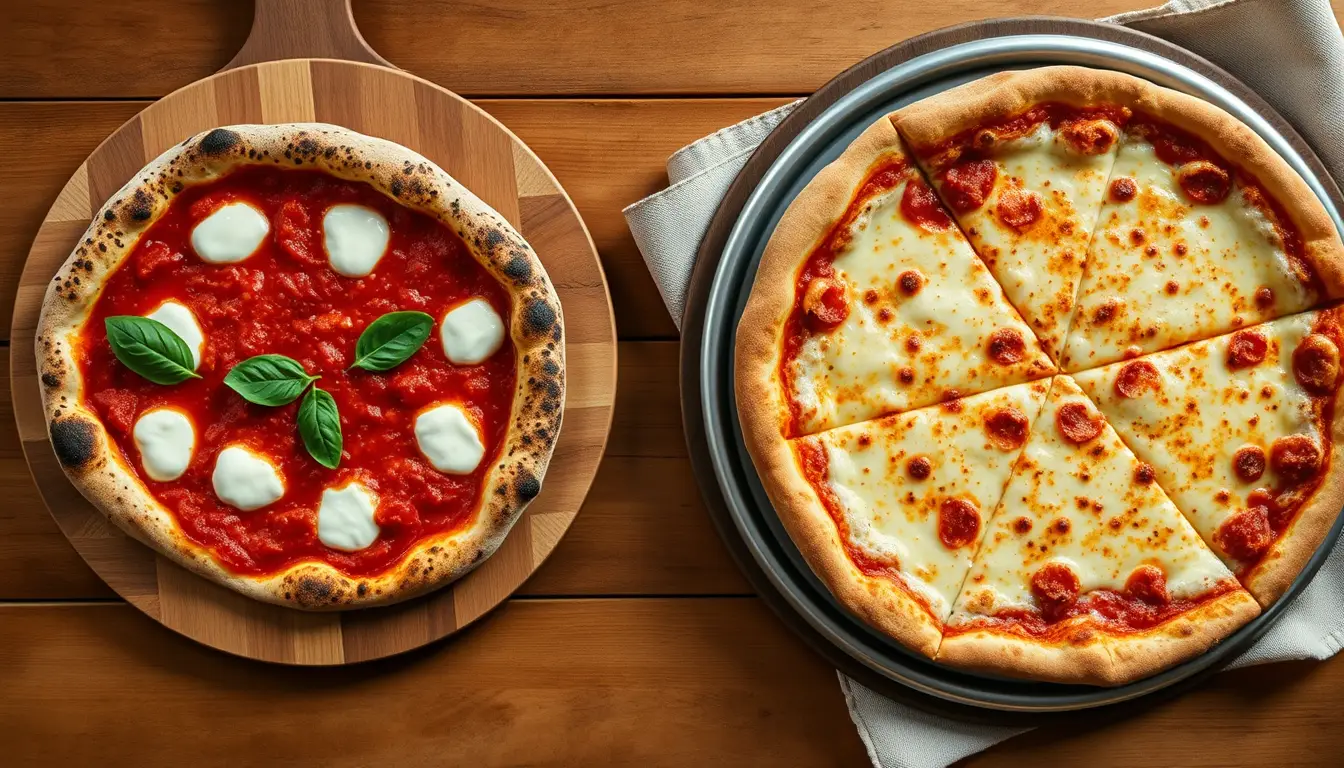
Neapolitan dough is only flour, water, salt and yeast, usually around 60 to 65% hydration, divided into balls of about 250 g and baked for 60 to 90 seconds in an oven running at roughly 430 to 480 °C (800 to 900 °F). The result is soft and foldable, with a puffy, blistered rim. New York dough is made with stronger flour and usually a little oil and sugar, divided into heavier balls of about 300 g or more, stretched thinner and wider, and baked for several minutes at 260 to 315 °C (500 to 600 °F). That gives a crisp-bottomed, chewy slice that holds its shape when you fold it. If you bake in an ordinary home oven, New York dough is the easier of the two to get right.
Almost every difference between them traces back to one thing: the heat of the oven each style was built for.
The two styles side by side
| Neapolitan | New York | |
|---|---|---|
| Flour | Finely milled 00, moderate protein | Bread or high-gluten flour |
| Hydration | About 60 to 65% | About 60 to 65% |
| Salt | About 2.5 to 3% | About 2% |
| Oil and sugar | None | Often about 2% oil and 1% sugar |
| Dough ball | About 250 g | About 300 g or more |
| Oven | Wood-fired or gas pizza oven, 430 to 480 °C | Deck oven or home oven, 260 to 315 °C |
| Bake time | 60 to 90 seconds | Several minutes |
| Result | Tender, soft centre and a puffy, charred rim | Thin, crisp-chewy, foldable slices |
These are typical ranges rather than rules. Pizzerias on both sides of the Atlantic tweak every line, and plenty of excellent pizza sits somewhere between the two columns.
Four pizzas, two formulas
The pizza dough calculator has a preset for each style. Here is what each gives for four balls with instant yeast at 0.3% and the default 2% extra for dough that sticks to the bowl:
| Ingredient | Neapolitan preset | New York preset |
|---|---|---|
| Flour | 618 g | 727 g |
| Water | 383 g | 458 g |
| Salt | 17 g | 15 g |
| Instant yeast | 1.85 g | 2.18 g |
| Oil | none | 15 g |
| Sugar | none | 7.3 g |
| Total dough | 1,020 g | 1,224 g |
| Per ball, including extra | 255 g | 306 g |
The New York batch needs about 18% more flour, simply because each ball is heavier. The formulas themselves look close on paper. Enter both sets of weights into the baker’s percentage calculator and the percentages add up to 165% for the Neapolitan dough and 168.4% for the New York one. Those extra few points of oil and sugar are small by weight but make a big difference in the oven, and baker’s percentages explained simply shows how to read a formula this way.
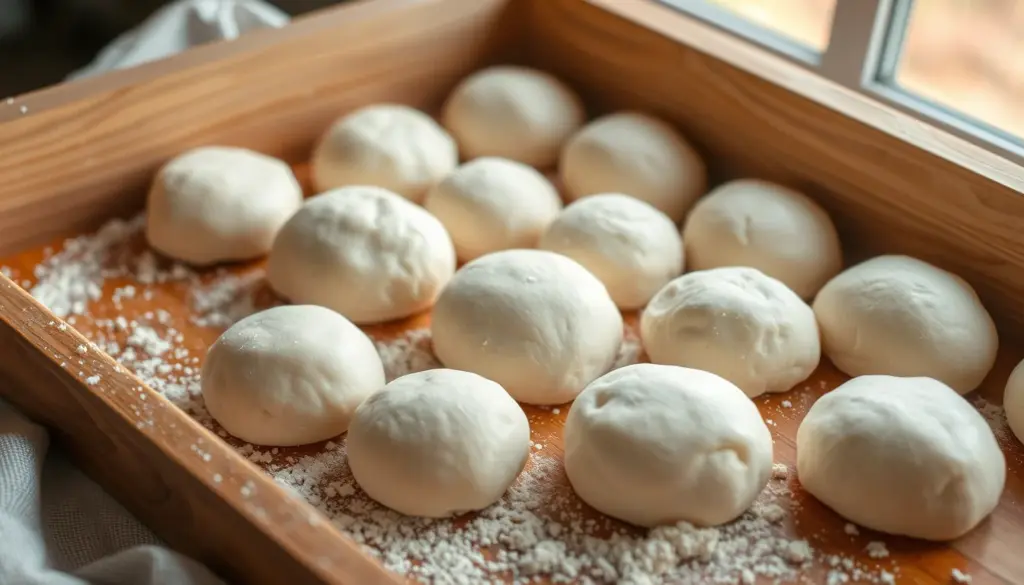
Set the style, number of balls and ball weight to build either dough:
Why the formulas differ
Oven heat
A Neapolitan pizza spends barely a minute in the oven. At that heat the crust puffs and chars before it has time to dry out, so the centre stays soft and moist. Sugar would burn long before the pizza was done, and oil isn’t needed for colour, so the dough stays lean.
A New York pizza bakes at roughly half that temperature for many times as long. A lean dough would stay pale and dry out into a cracker in that time. A little sugar feeds browning at the lower heat, and a little oil keeps the crumb tender and helps the bottom crisp.
Flour
Neapolitan dough traditionally uses 00 flour, milled very fine and with moderate protein, which gives a soft, extensible dough that stretches easily by hand. New York dough uses bread or high-gluten flour. The extra protein gives the chewy bite and lets the dough stretch thin across a wider pie without tearing, then hold up under its toppings as a folded slice. Bread flour vs all-purpose flour explains what that protein does.
Ball size and stretching
A 250 g Neapolitan ball becomes a pizza of about 30 cm (12 in), with a thin centre and a thick, airy rim. New York pies are wider, and the dough is stretched more evenly to the edge, so each ball needs to be heavier even though the finished crust is thin.
Fermentation
Both styles benefit from long, slow fermentation with very little yeast. Neapolitan dough is often fermented at room temperature for 8 to 24 hours. New York dough is commonly cold fermented in the fridge for one to three days, which builds flavour and makes the dough easier to stretch thin.
Toppings follow the oven too
The same logic shapes what goes on top. A Neapolitan pizza is dressed lightly: uncooked crushed tomatoes, a few pieces of fresh mozzarella, basil and olive oil. In a minute-long bake, wet cheese and raw tomato have no time to release much water, so the centre stays soft rather than soggy.
A New York pie spends several minutes in the oven, long enough for fresh mozzarella to flood the crust. That is why it traditionally uses grated low-moisture mozzarella, which melts and browns without pooling, over a seasoned sauce and often more of it. Put a New York-style pile of toppings on a thin Neapolitan base in a home oven and the middle usually turns wet before the rim has browned.
Making each style at home
New York in a home oven. Preheat a baking steel or stone on an upper-middle rack at your oven’s highest setting for 45 minutes to an hour, then bake for roughly 6 to 10 minutes, until the bottom is spotted brown and the cheese is bubbling. This is the style home ovens are best suited to.
Neapolitan in a home oven. Expect a compromise. At 250 to 290 °C, a lean dough bakes slowly enough to dry out, so the crust turns out pale and crackery rather than soft and puffy. Adding 1 to 2% oil and a pinch of sugar helps it colour, which in practice nudges it toward New York style. A portable pizza oven that reaches Neapolitan temperatures solves the problem properly.
Stretching each style. For Neapolitan dough, press the ball flat from the centre outward with your fingertips, leaving a band of about 2 cm untouched around the edge. That band holds the gas that becomes the puffy rim. New York dough is stretched wider and more evenly, often draped over the backs of the hands and turned so gravity does some of the work, which leaves a thinner, flatter edge.

Common mistakes
- Using New York dough in a very hot pizza oven. The sugar scorches, and the bottom blackens before the top is cooked.
- Using Neapolitan dough at home oven heat without changes. The result is often pale, dry and tough.
- Rolling with a pin. It squeezes the gas out of the rim. Stretch by hand from the centre outward instead.
- Stretching dough straight from the fridge. Cold dough fights back and shrinks. Give cold-fermented balls an hour or two at room temperature first.
- Too much flour on the peel. Excess flour burns on a hot stone and tastes bitter. Use a light dusting of semolina or flour and shake off the rest.
Pizza style questions
Can one dough work for both styles?
A middle-ground formula gets close: about 63% hydration, 2.5% salt, 1% oil and a pinch of sugar, balled at around 270 g. It won’t be perfect in either oven, but it bakes well at home and tolerates a hotter pizza oven if you watch it closely.
Does New York dough have to be cold fermented?
No, but it helps. A same-day dough with more yeast works, yet one to three days in the fridge gives better flavour, better browning and a dough that stretches thinner without tearing.
Can I make either style with sourdough?
Yes. Choose sourdough starter as the leavening in the calculator, and it subtracts the starter’s flour and water so the hydration stays true to the formula. Expect a longer rise than with yeast.
What does “Neapolitan-style” mean on a menu?
Usually a pizza in the spirit of Naples, lean dough, a soft centre and a puffy rim, without following every rule of the traditional method. Certified Neapolitan pizza follows a strict set of rules on ingredients, stretching and baking.