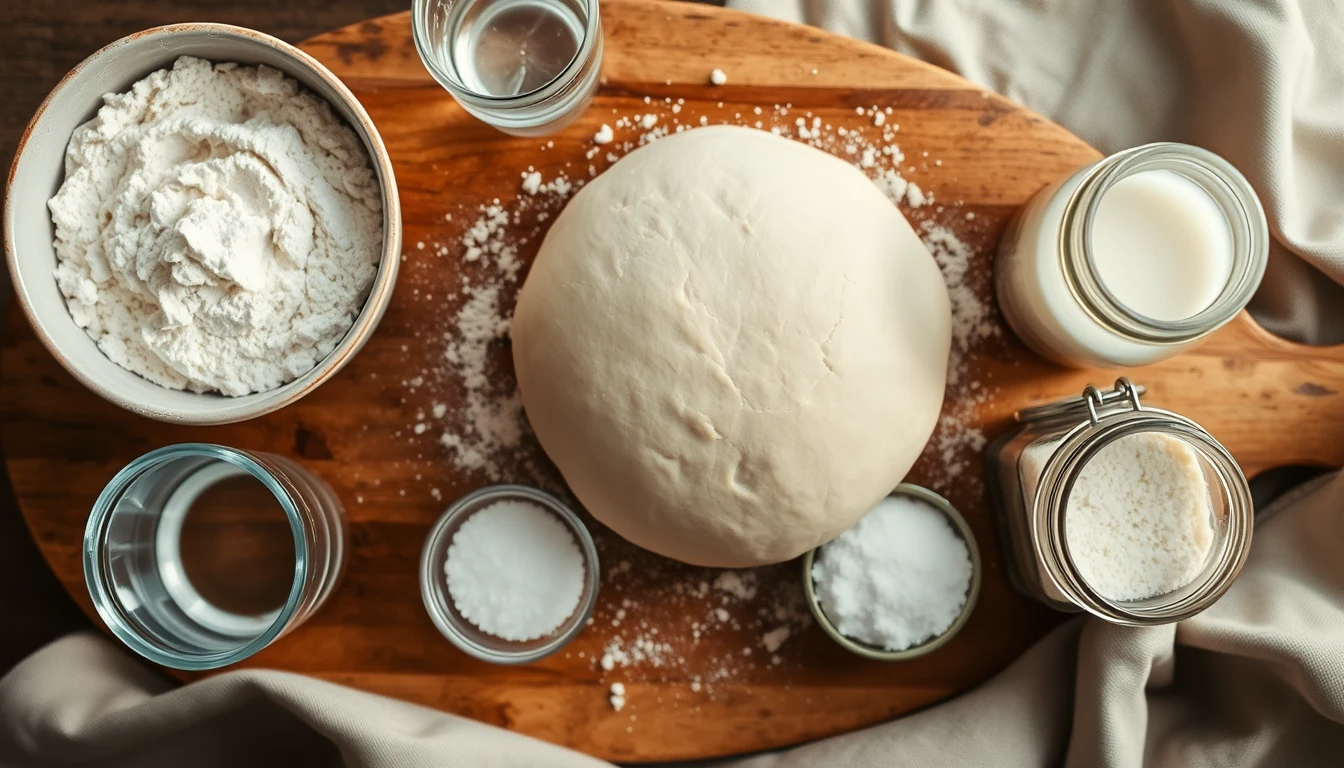
Baker’s percentages describe each ingredient as a share of the flour. The flour is always 100%, and everything else is measured against it: 70% water means 70 g of water for every 100 g of flour, and 2% salt means 2 g for every 100 g. That one rule lets you scale a recipe to any size, compare two recipes side by side, and spot a typo before it ruins a batch.
It sounds like maths homework, but in practice it is a shortcut. After a few recipes you will glance at a formula and know whether the dough will be stiff or slack, lean or rich, fast or slow.
The one rule: flour is 100%
Divide each ingredient’s weight by the total flour weight and multiply by 100. If a recipe uses more than one flour, add them together first; the flours share the 100% between them.
Flour gets to be the reference because every other ingredient exists in relation to it. Water hydrates it, salt seasons and tightens it, and yeast or starter ferments it. Expressing them all against the flour keeps the relationships steady however big or small the batch.
Because only the flour counts as 100%, the percentages add up to well over 100. That is expected, and the total turns out to be useful when scaling.
Turning a recipe into percentages
Take a simple sourdough: 450 g bread flour, 50 g whole wheat flour, 350 g water, 100 g starter and 10 g salt. The total flour is 450 + 50 = 500 g, so:
- Bread flour: 450 ÷ 500 = 90%
- Whole wheat flour: 50 ÷ 500 = 10%
- Water: 350 ÷ 500 = 70%
- Starter: 100 ÷ 500 = 20%
- Salt: 10 ÷ 500 = 2%
The dough weighs 960 g and the percentages add up to 192%. Entered into the baker’s percentage calculator, the same recipe shows a hydration of 70%, plus a second figure of 72.7% for hydration including the starter. That second number counts the 50 g of flour and 50 g of water hidden inside a 100% hydration starter: 350 + 50 = 400 g of water over 450 + 50 + 50 = 550 g of flour.
Scaling without guesswork
Once a recipe is in percentages, you can rebuild it at any size in two ways.
Scale by flour weight
Choose the flour weight you want and multiply each percentage by it. For 750 g of flour, the recipe above becomes 675 g bread flour, 75 g whole wheat, 525 g water, 150 g starter and 15 g salt, for 1,440 g of dough. This is handy when you want to use up a bag of flour or match a mixer’s capacity.
Scale by dough weight
Often you know how much dough you need rather than how much flour: one 1,000 g loaf for a particular banneton, or a set number of pizza balls. Divide the dough weight by the sum of the percentages, written as a decimal. Here that is 1,000 ÷ 1.92 = 521 g of flour. The calculator then fills in 469 g bread flour, 52 g whole wheat, 365 g water, 104 g starter and 10 g salt, which adds back up to exactly 1,000 g.
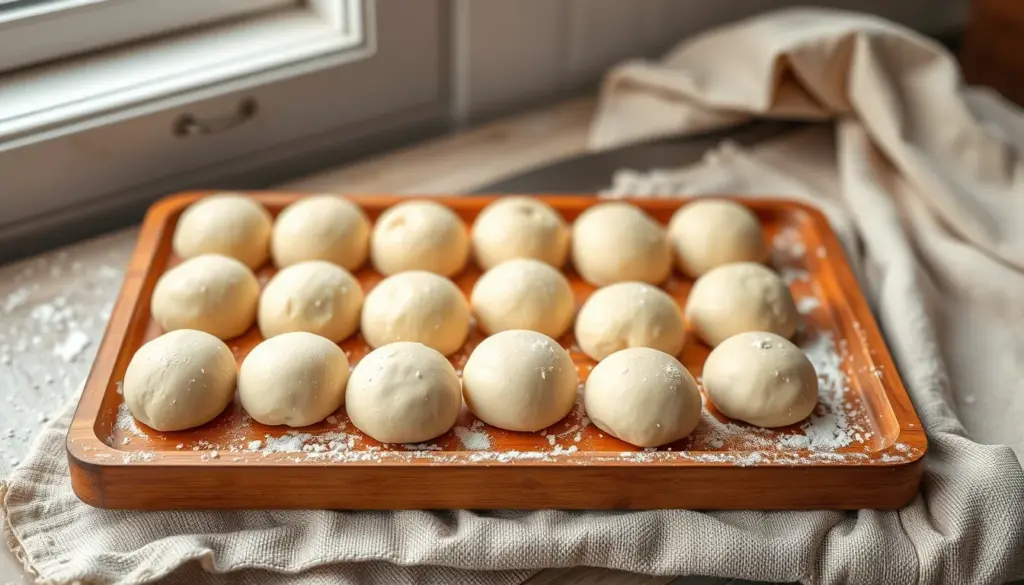
The dough will behave the same at either size because none of the relationships changed. Try it with one of your own recipes:
Reading a formula at a glance
With some practice, a formula tells you what kind of bread to expect before you mix it. These are rough ranges, not rules:
- Water: around 60 to 65% for firm sandwich loaves and many pizza doughs, 68 to 75% for most rustic loaves, and 75 to 85% for ciabatta-style breads. Dough hydration: what 65% vs 80% really means covers how those feel in your hands.
- Salt: usually 1.8 to 2.2% for bread, often a little higher for pizza.
- Instant yeast: anywhere from 0.1% for a long cold rise to 1% or more for a same-day loaf.
- Starter: commonly 10 to 25% in home recipes.
- Sugar and fat: zero in a lean loaf, a few percent in a soft sandwich bread, and 50% or more of butter in brioche.
A pizza dough made with 600 g of 00 flour, 390 g water, 17 g salt and 1.2 g instant yeast reads as 65% water, 2.8% salt and 0.2% yeast, a total of 168%. The low yeast figure tells you straight away that it is meant for a slow rise, probably in the fridge. If a salt line ever reads 20% instead of 2%, you know you have found a typo.
Where the starter fits: two conventions
This is where most confusion comes from. There are two common ways to write a sourdough formula.
In the first, the starter is treated like any other ingredient, as in the example above: 20% starter on top of 500 g of flour. The flour and water inside the starter are ignored in the headline figures.
In the second, the flour and water inside the starter are added into the totals, and the starter percentage is taken from that larger flour figure. The sourdough recipe builder works this way. Ask it for one 1,000 g loaf at 70% hydration, 2% salt, 20% starter and 10% whole grain, and it lists 471 g bread flour, 52 g whole grain flour, 349 g water, 116 g starter and 12 g salt. Its 20% is measured against 581 g of total flour, starter flour included.
Both are correct. They simply use different bases, so two recipes that each say “20% starter” and “70% hydration” can produce noticeably different doughs. When you compare recipes, check which convention each one uses before comparing the numbers.
Common mistakes
- Dividing by the total dough weight. Percentages of the whole dough are a different measurement, and they make every ingredient look smaller than it is.
- Rounding the small ingredients. At 0.2% yeast on 500 g of flour, the yeast is 1 g. Rounding that to 2 g doubles it. A pocket scale with 0.1 g resolution earns its place for yeast and salt.
- Mixing conventions. Switching halfway between counting and ignoring the starter’s flour throws off both hydration and salt.
- Forgetting to convert from cups first. Percentages only work with weights. The cups to grams converter handles the conversion, and why bakers weigh ingredients explains why it matters.
Questions about baker’s percentages
Do I need to understand baker’s percentages to bake good bread?
No. Plenty of good loaves come from recipes written in plain grams. The percentages become useful when something goes wrong and you want to see what is different, or when you want to change a recipe with some confidence.
Why do some formulas show a “total formula” and a “final dough” separately?
Professional formulas often split the recipe in two. The total formula lists every ingredient as if it all went in at once, including the flour and water in the starter or preferment. The final dough lists only what you add on mixing day, with the preferment as one line. They describe the same bread from two angles.
Can I use baker’s percentages for cakes and cookies?
Yes, and some pastry formulas are written that way. The numbers just look unusual: sugar in many cakes is 100% of the flour or more, and butter in shortbread can be well over half.
What precision should I aim for?
For flour and water, the nearest gram is plenty. For salt and yeast, a tenth of a gram helps, because a small absolute error is a large percentage error on such a small quantity.