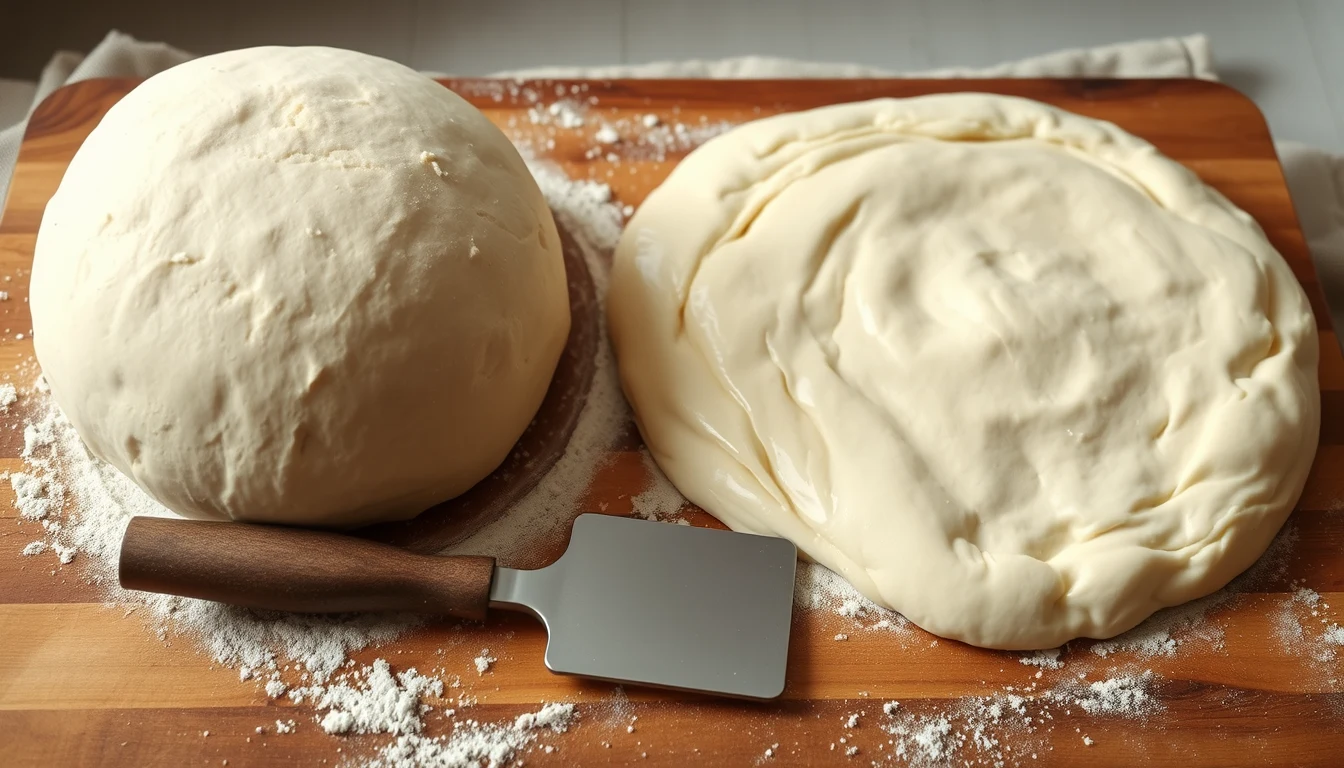
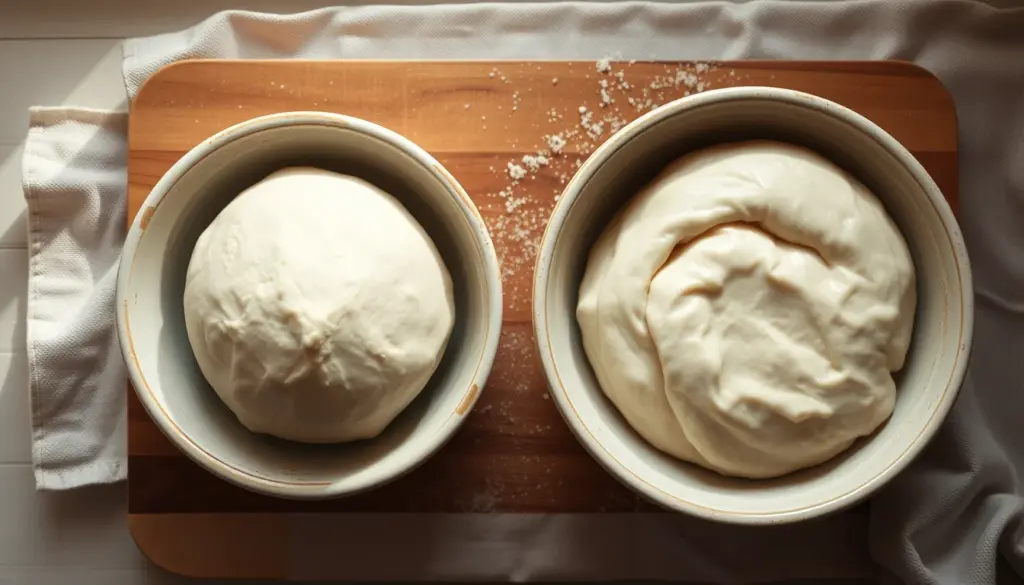
Hydration is the weight of the water divided by the weight of the flour. A 65% dough carries 65 g of water per 100 g of flour. It feels soft but holds its shape, and you can knead and shape it without much fuss. At 80%, that becomes 80 g of water per 100 g of flour. Straight after mixing it behaves more like a thick batter: sticky, slack and inclined to spread, yet capable of baking into a glossy, very open crumb once it has enough strength.
On paper the two numbers look close. In a loaf with 500 g of flour, the difference is 75 g of water, about five tablespoons, and it changes how you mix, fold, shape and bake.
What the percentage is measuring
Hydration is a baker’s percentage, so the flour is always the 100% and the water is measured against it. If that idea is new, baker’s percentages explained simply walks through it, and the baker’s percentage calculator does the arithmetic for a whole recipe.
One reason 65% and 80% sound more similar than they feel: they describe water compared with flour, not water as a share of the dough. Measured against the whole dough, water rises from about 39% to about 44%. That modest-looking step is enough to change the dough from something that sits up on the counter to something that flows.
Same loaf size, two hydrations
It also changes how much flour ends up in a loaf of a given size. Ask the sourdough recipe builder for one 900 g dough with 20% starter and 2% salt. At 65% it lists 485 g flour, 296 g water, 108 g starter and 11 g salt. At 80% it lists 445 g flour, 346 g water, 99 g starter and 9.9 g salt. Counting the flour inside the starter, the wetter dough holds 495 g of flour instead of 539 g, and more of its weight will leave as steam in the oven. If you move a favourite loaf to a higher hydration and want the baked loaf to stay the same size, scale the dough up a little.
How each level behaves
Around 65%
The dough comes together into a smooth ball and stays that way. You can knead it on a bare counter, and it keeps a tight shape in a basket or a tin. Crumb is even with smaller holes, which suits sandwich loaves, rolls and a lot of everyday bread. With less free water, the gluten network is firmer and less stretchy, so the dough resists being pulled but rarely tears or sticks.
Around 70 to 75%
This is where most country loaves live. The dough is sticky at first but firms up with a few sets of folds. It shapes with some practice and bakes into a moderately open crumb.
Around 80%
The dough spreads when you tip it out, clings to dry hands and needs more rounds of folds to gain strength. When handled well, the extra water gives a more extensible gluten network and more steam in the oven, which is where large, shiny holes come from. Ciabatta, focaccia and many open-crumb country loaves sit here or higher.
Your starter adds water you may not be counting
Many recipes work out hydration from the bowl alone: added water over added flour. The starter, though, is half water at 100% hydration, and that water ends up in the dough too.
Take a recipe with 450 g flour, 275 g water, 100 g of 100% hydration starter and 10 g salt. The bowl alone gives 275 ÷ 450 = 61.1%. Add the starter’s 50 g of flour and 50 g of water and the real figure is 325 ÷ 500 = 65%. The sourdough hydration calculator shows exactly that: a true hydration of 65%, a hydration ignoring the starter of 61.1%, and a dough weight of 835 g.
Now say you want the same loaf at 80%. Enter 80 as the target and the calculator gives the water for 80% hydration as 350 g, a change of +75 g from the recipe. Everything else stays the same.
Why the same percentage can feel different
Two 75% doughs can feel nothing alike. A few reasons:
- The flour. Strong bread flour with more protein can hold more water and still feel manageable. Softer all-purpose flour reaches its limit sooner. A dough with a third whole wheat can take several more points of water and still feel firmer than a white one.
- How far fermentation has gone. As a dough ferments, acid and enzymes gradually loosen the gluten. An 80% dough late in bulk feels noticeably wetter than it did an hour after mixing, even though no water was added.
- Temperature. Warm dough tends to feel slacker and stickier, while a dough straight from the fridge feels firm and easy to handle. Keeping the dough temperature steady, as covered in why dough temperature matters more than time, keeps its feel more predictable too.
- How much strength you have built. Well-developed gluten holds on to water. The same dough that tears after mixing can feel smooth and bouncy after four sets of folds.
Moving from 65% toward 80%
If you want a more open crumb, work up gradually rather than jumping straight to the highest number you have seen online.
- Raise hydration two or three points per bake, so you can tell what each step changes.
- Hold back about a tenth of the water at mixing. Gluten forms more easily in a slightly stiffer dough, and you can work the rest in once it has come together.
- Use a strong bread flour for high-hydration loaves.
- Handle the dough with wet hands and a bench scraper instead of adding flour to stop it sticking.
- Add a set or two of folds, spaced about 30 minutes apart, for each step you climb.
- Bake a wetter loaf a few minutes longer with the lid off, so the crumb sets fully and doesn’t turn gummy.
Common hydration mistakes
- Using high hydration to fix a tight crumb. Crumb depends at least as much on fermentation and shaping. An underfermented 80% dough gives a gummy loaf with a few big tunnels, not an airy one. Our guide on telling when bulk fermentation is done helps there.
- Flouring the bench heavily. Each handful of flour worked in lowers the real hydration and can leave raw streaks in the crumb.
- Comparing numbers without checking the starter. One recipe’s 75% might count the starter’s water while another’s does not.
- Measuring flour by volume. Cups can swing the flour weight enough to move hydration by ten points, a gap explained in why bakers weigh ingredients.
Hydration questions
Is higher hydration always better for sourdough?
No. It depends on the bread you want. A sandwich loaf at 80% would be hard to shape and might not hold a neat slice, while a ciabatta at 65% would lose its character. Choose the hydration that suits the style and your comfort handling the dough.
Does hydration change how long bulk fermentation takes?
A little. Wetter doughs often ferment slightly faster because the yeast and enzymes move more freely, but temperature and the amount of starter matter far more. Watch the dough rather than adjusting times for hydration alone.
Can I rescue a dough that turned out too wet?
Usually, yes. Give it extra sets of folds and a bit more time for the gluten to catch up, and flour only the surface when shaping. Mixing in more flour at this stage tends to leave dry lumps. Next time, hold back some water at the start.
Why does my wet dough stick to the banneton?
A wetter dough has more surface moisture. Dust the basket generously with rice flour, which absorbs less water than wheat flour, and a cold proof in the fridge firms the surface so it releases more cleanly.