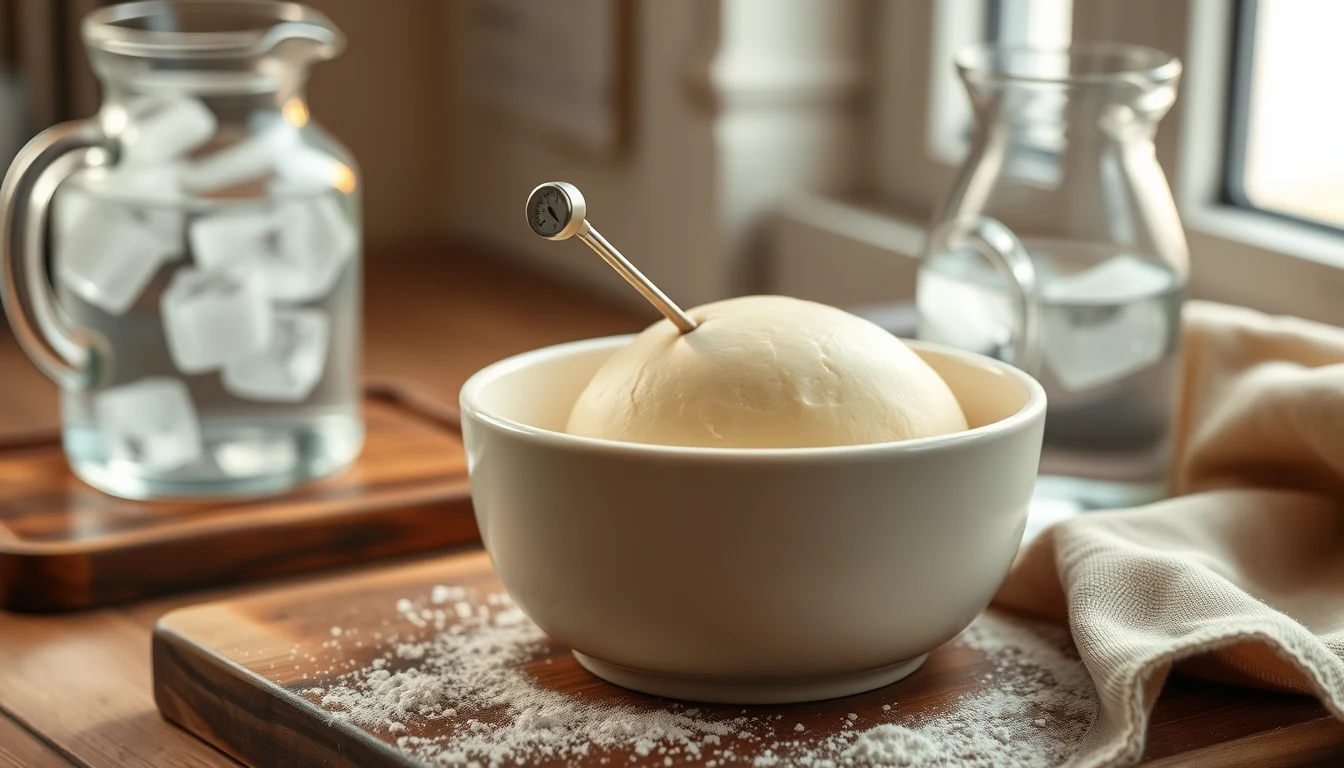
Recipe times only hold at the dough temperature the writer happened to have. Fermentation runs faster in a warm dough and slower in a cool one, so the same sourdough can need over eight hours on a cool day and four and a half on a warm one. Aim for a dough temperature instead, usually 24 to 26 °C (75 to 79 °F) for sourdough, and let the time be whatever that temperature produces. The simplest way to hit your target is to warm or chill the mixing water.
Once you think in temperatures, a lot of confusing bakes suddenly make sense: the loaf that overproofed in July, the dough that never seemed to move in January, the pizza dough that was perfect one weekend and bubbly and slack the next.
Temperature against time, in numbers
The bulk fermentation estimator shows how strongly temperature drives timing. With 20% starter and mostly white flour:
| Dough temperature | Bulk time (guide) | Middle of the range |
|---|---|---|
| 20 °C (68 °F) | about 7 h to 9 h 30 min | 8 h 15 min |
| 22 °C (72 °F) | about 5 h 45 min to 7 h 45 min | 6 h 45 min |
| 24 °C (75 °F) | about 4 h 45 min to 6 h 15 min | 5 h 30 min |
| 26 °C (79 °F) | about 3 h 45 min to 5 h 15 min | 4 h 30 min |
Six degrees nearly halves the time. A recipe that says “bulk for five hours” is really saying “bulk for five hours at a dough temperature of roughly 24 to 25 °C”, whether or not it mentions it.
Temperature beats the other levers
Adding starter speeds dough up too, just far less. At 24 °C, going from 10% to 20% starter moves the middle of the estimate from 7 h to 5 h 30 min, a saving of an hour and a half for twice the starter. Warming the same dough from 20 °C to 26 °C saves 3 h 45 min without changing the recipe at all.
There is a second advantage. Changing the starter amount changes the recipe: acidity, flavour and how the dough handles all shift. Changing the temperature keeps the recipe intact and simply lets it run at the speed it was designed for.
The same logic applies to yeasted bread and pizza dough. Commercial yeast responds to warmth in the same way, which is why a pizza dough balled at 18 °C and one balled at 26 °C can look like two different recipes a few hours later.
Flavour and texture follow temperature too
Speed isn’t the only thing temperature controls. Cooler, slower fermentation tends to build a more complex, tangier flavour, while a warm, fast one often tastes milder. Very warm dough, above about 28 °C, can move from underdone to slack and sticky within an hour, which leaves little room for error. Cold dough that is ended by the clock is usually underfermented, dense and pale.
How to hit a target dough temperature
Bakeries use a simple sum called the desired dough temperature method. The temperature of the dough after mixing is roughly the average of everything that went into it, plus a little heat from mixing. Multiply your target by the number of things you are counting (flour, room, water, and starter if you use one) and subtract the ones you already know. What is left is the water temperature. Water is the ingredient you adjust because it is the only one you can easily warm or chill on the spot.
A cold winter kitchen
The target is 25 °C. The kitchen reads 19 °C, the flour 18 °C and the levain 23 °C, with the dough mixed by hand. The dough water temperature calculator asks for water at 38 °C (100 °F): 25 × 4 = 100, minus 19 + 18 + 23 + 2 for hand mixing = 62, leaves 38. That is warm to the touch but still well below the point where it would stress the culture.
A hot summer kitchen
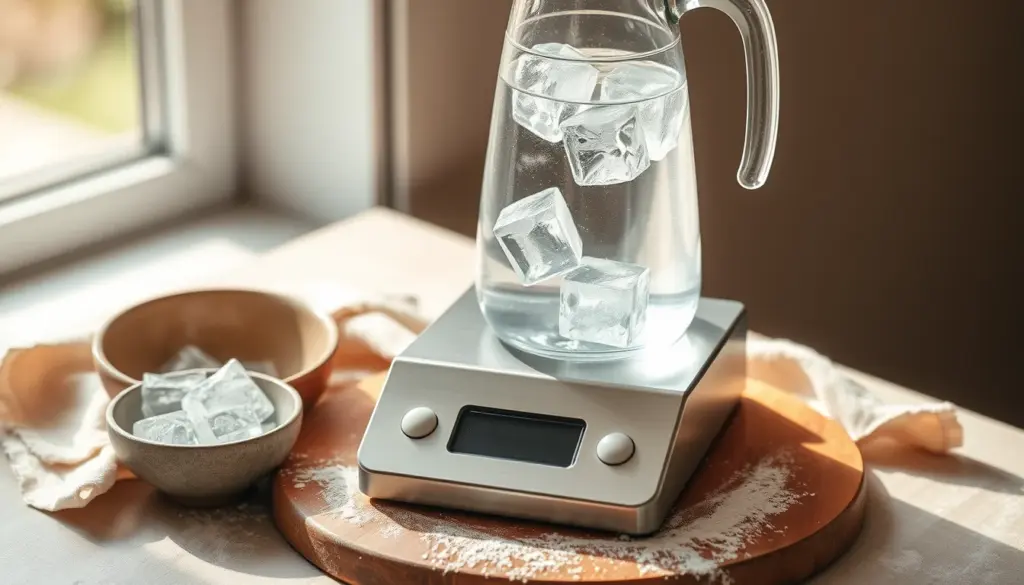
This time the target is 24 °C, but the room, flour and levain all sit at 27 °C. The calculator asks for water at 13 °C (55 °F). Add a tap temperature of 21 °C and 350 g of total water, and it splits that into 28 g of ice and 322 g of tap water. Melting ice soaks up a lot of heat, so a small handful makes a real difference.
A pizza dough in a stand mixer
For a yeasted dough there is no starter, so only three temperatures are counted. With the room and flour at 22 °C, a target of 24 °C and a stand mixer, the answer is 18 °C water. The mixer adds around 10 °C of friction heat, so water that feels cool is the right choice here.
Keeping the dough there
Hitting the temperature at mixing is most of the battle, but the dough still drifts toward its surroundings over several hours.
- In a cold house, an oven with only the light on, a microwave with a mug of just-boiled water replaced every hour or so, or a cool box with a jar of warm water all make gentle proofing spaces. Check them with a thermometer first; an oven light alone can overshoot.
- In a hot house, choose the coolest room, keep the container out of direct sun, and mix with colder water rather than relying on the fridge halfway through.
- Everywhere, check the dough itself with a probe thermometer once or twice during bulk. Knowing it has dropped two degrees tells you to expect the later end of the estimate.
Common temperature mistakes
- Using the room reading as the dough reading. A dough mixed with warm water can sit several degrees above the air around it for hours.
- Assuming the flour is at room temperature. A bag kept in a garage or an unheated pantry in winter can easily be 10 degrees colder than the kitchen.
- Rescuing a cold kitchen with very hot water. Above about 40 °C the water itself can harm yeast and starter. Bring the flour or the proofing spot up to temperature, or settle for a cooler dough that simply takes longer.
- Forgetting the mixer. Ten minutes in a stand mixer adds far more heat than hand mixing, and the water needs to account for it.
- Setting the container on a cold stone counter or a sunny windowsill. Both change the dough’s temperature from one side, which throws off the estimate.
For more on reading the dough rather than the clock, see bulk fermentation: how to tell when it’s done.
Dough temperature questions
Can I make up for a cold dough by adding more starter or yeast?
Partly, but it is a weak lever and it changes the bread. As the numbers above show, doubling the starter saves less time than a few degrees of warmth, and the extra starter makes the dough more acidic. Warmer water is the better fix.
Does proofing in the fridge count as temperature control?
Yes, and it is the most deliberate kind. At fridge temperature fermentation slows to a crawl, which lets you hold a shaped loaf for many hours. It is also why a cold proof fits so well into a sourdough schedule for people who work 9 to 5.
What kind of thermometer should I use?
An instant-read probe thermometer is ideal. To check it, stand the probe in a glass packed with ice and a little water; it should read close to 0 °C.
Does temperature matter as much for yeasted bread?
Yes. Yeasted doughs respond in the same way, and many yeasted recipes assume a dough of roughly 24 to 26 °C. If you are switching between yeast types as well, instant vs active dry vs fresh yeast covers the amounts.