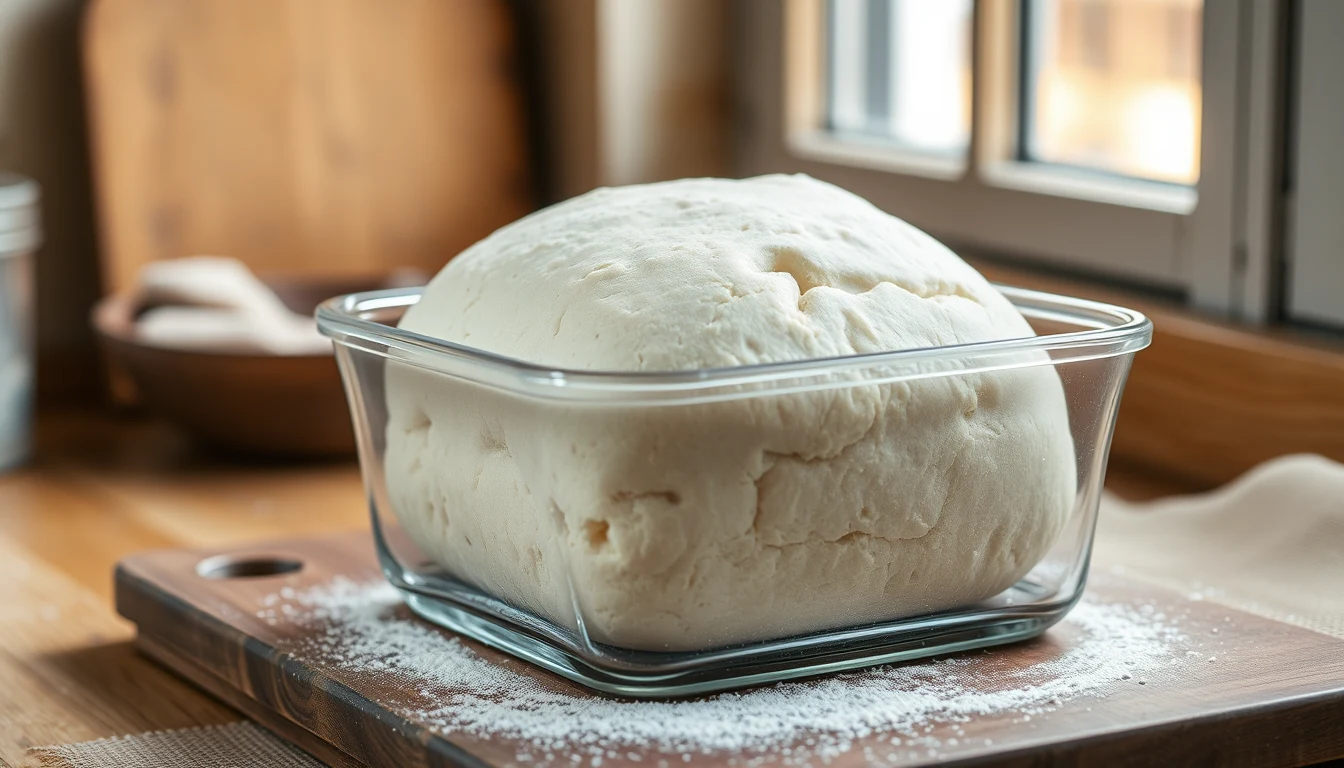
Bulk fermentation is done when the dough has grown by the right amount for its temperature and looks and feels full of gas. For a dough kept at 22 to 26 °C (72 to 79 °F), that usually means a rise of about 50 to 75%, a gently rounded top, gas bubbles showing at the edges and across the bottom, and a loose jiggle when you nudge the container. The recipe time only tells you when to start looking. The dough decides when to stop.
Ending bulk at the right point matters more than almost any other step in sourdough, and it is the one that recipes can describe least precisely. Here is how to read the signs, how to estimate when they will show up, and what to do if you miss the moment.
What is happening during bulk
Once the starter is mixed in, yeast begins producing carbon dioxide and a little alcohol, while bacteria produce acids. The gas inflates the gluten network, while the acids and time make that network both stronger and more stretchy. By the end of bulk you want enough gas for an open crumb and enough strength for the dough to survive shaping and a final proof. Stop too early and the loaf lacks both. Go too far and the gluten starts to break down while the yeast runs short of food.
The signs, from most to least reliable
How much it has grown
Rise is the most useful single measure, but only if you can read it accurately. Mark the starting level on a straight-sided container with tape or a marker right after mixing. In a bowl that flares outward, each centimetre near the top holds more dough than one near the bottom, so the dough looks as if it has risen less than it really has, and bakers tend to let it go too long.
A small sample jar makes this even easier. Straight after mixing, pull off a walnut-sized piece of dough, drop it into a small straight-sided glass, press it flat and mark the level. The sample ferments alongside the main batch, and a 50% rise is easy to see in a narrow glass. Treat it as a guide rather than a verdict, since a small sample can warm up or cool down faster than the full batch.

The surface and edges
Near the end of bulk the dough domes gently where it meets the container instead of lying flat or sagging at the edges. A few larger bubbles appear on top, and through clear sides you can see bubbles of different sizes running through the dough and across the bottom. The surface looks smooth and slightly glossy rather than dull and dense.
The jiggle
Give the container a short shake. Well-fermented dough wobbles as a whole, a bit like a set jelly. Underfermented dough barely moves and feels heavy in the container.
How it feels
Wet a hand and slide it along the side of the dough. It should feel light, airy and slightly springy, and release from the container cleanly. When you tip it onto the bench it should hold some shape rather than flooding outward, and you may feel bubbles pop under your fingers as you pre-shape.
Smell
A ripe dough smells pleasantly sour, sometimes with a mild alcoholic note. A sharp, boozy smell is a hint that it has gone too far.
How long it should take
Time isn’t the test, but a good estimate stops you checking too early or wandering off too late. Say your dough uses 10% starter and mostly white flour, and the probe reads 22 °C after mixing. The bulk fermentation estimator puts bulk at about 7 h 15 min to 10 h, centred on 8 h 30 min, and suggests aiming for a rise of about 50% to 75%. Its two comparison rows show how sensitive that is: the same dough two degrees warmer would need about 6 h to 8 h, and two degrees cooler about 9 h to 12 h 15 min.
Change the flour to up to 30% whole grain and the window moves forward to about 6 h 30 min to 9 h, because whole grain feeds the culture faster. For the white flour version, start checking the signs above at around seven hours and let the dough tell you where in the range it lands.
Notice that the target rise is smaller for warm dough. A warm dough keeps fermenting quickly through shaping and proofing, so it needs to leave bulk earlier. A cool dough slows down afterwards and can go further first.
Under, right on, or over
Signs it needs more time
The dough feels dense and tight, springs back quickly when pressed, and shows few bubbles at the sides. Baked too early, it gives a heavy crumb with a few large, irregular holes just under the top crust and dense areas elsewhere. That combination is easy to mistake for an open crumb in photos.
Signs it has gone too far
The dough is very slack and sticky, tears easily, and may sink when touched. Large bubbles burst on the surface and the smell turns sharp. The baked loaf spreads, rises little in the oven, has a pale crust because the yeast has used up the sugars that would brown it, and often tastes very sour.
Rescuing an overfermented dough
Handle it gently, shape it loosely and bake it sooner than planned, skipping or shortening the final proof. A loaf tin gives it the support it can no longer provide itself. Very far-gone dough makes a good focaccia: stretch it into an oiled pan, dimple it and bake.
Common mistakes
- Reading the room instead of the dough. The dough can sit several degrees above or below the air around it, especially just after mixing. A probe thermometer in the dough is what the estimate needs; why dough temperature matters more than time goes into this.
- Waiting for the dough to double. Many older recipes were written for cooler kitchens or yeasted doughs. At 24 °C, doubling in bulk usually means overfermenting by the time the loaf has been shaped and proofed.
- Stopping at the recipe’s time regardless. A recipe’s four hours might be your seven.
- Using a starter past its best. A sluggish or overripe starter slows everything that follows. If the starter itself is the problem, see sourdough starter not rising? causes and fixes.
- Planning the day around the recipe instead of the dough. The sourdough schedule planner works backward from your bake time so the end of bulk lands when you are home; a sourdough schedule for people who work 9 to 5 shows one worked plan.
Bulk fermentation questions
Can I use the poke test to judge bulk?
The poke test belongs to the final proof, when the shaped loaf has tension on its surface. During bulk the dough is too loose for a poke to tell you much, so rely on rise, bubbles and jiggle instead.
Should the dough be covered during bulk?
Yes. A lid, plate or shower cap keeps the surface from drying into a skin, which would tear during shaping and show up as dense streaks in the crumb.
Is a 12-hour bulk too long?
Not if the dough is cool or uses very little starter. The signs matter, not the hours. A dough with 5% starter at 20 °C can take that long and still be right on time.
Why did my dough rise well in bulk but bake flat?
It may have gone slightly too far, or it may not have had enough strength to hold its shape. Try ending bulk a little earlier next time, adding a set of folds, and shaping with more surface tension.