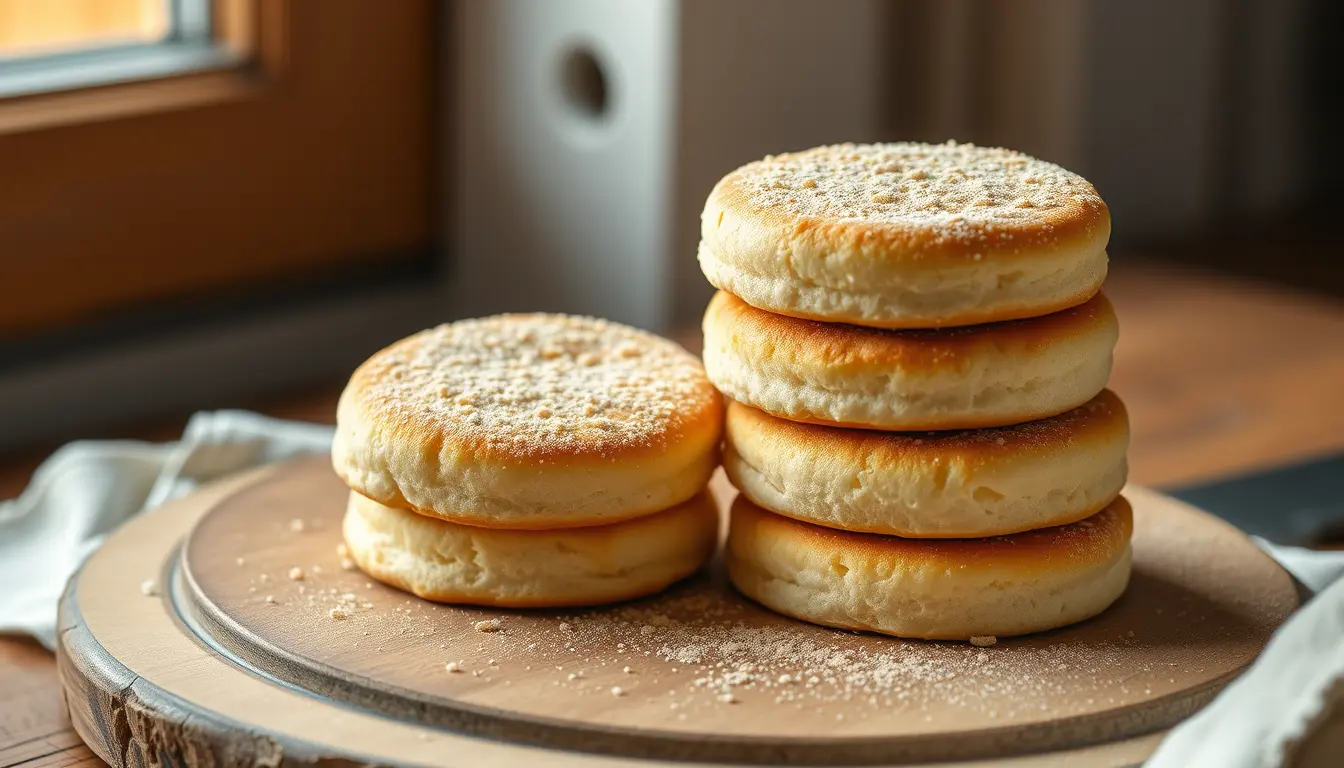
Sourdough English muffins are made from a soft, slightly enriched dough that is cut into rounds, dusted with cornmeal or semolina and cooked slowly on a dry griddle or heavy pan over low to medium-low heat, usually for 6 to 8 minutes per side. The low heat is the secret: it gives the muffins time to rise in the pan and cook through to the middle before the outside burns. Split them with a fork rather than a knife and you get the rough, craggy surface that toasts so well.
What makes an English muffin different
Unlike a bread roll, an English muffin never goes in the oven. All the heat comes from the bottom, first on one side and then the other. That means the dough has to be soft enough to puff up in the pan, but firm enough to hold a flat round shape. It also means the inside sets by steam and slow conduction, which creates the open, chewy, honeycomb texture inside.
Milk, a little butter and a small amount of sugar keep the crumb tender and help the crust colour evenly at a low temperature. Sourdough adds a gentle tang and keeps them fresh for longer than a yeasted version.
A formula to start with
Here is a batch that makes eight muffins of about 100 g each:
- 400 g all-purpose flour
- 240 g milk
- 120 g active sourdough starter (100% hydration)
- 15 g sugar
- 25 g melted butter
- 7 g salt
Type those rows into the baker’s percentage calculator, marking the milk as a liquid, the starter as starter, and the sugar, butter and salt as “other”, and you get:
| Ingredient | Weight | Baker’s % |
|---|---|---|
| All-purpose flour | 400 g | 100% |
| Milk | 240 g | 60% |
| Active starter | 120 g | 30% |
| Sugar | 15 g | 3.8% |
| Melted butter | 25 g | 6.3% |
| Salt | 7 g | 1.8% |
| Total | 807 g | 201.8% |
The calculator reports 60% hydration from the milk alone and 65.2% once the starter’s water and flour are included. That is a soft dough, but not a sticky one, and it handles well when cutting rounds. Milk is not pure water, so the dough feels a touch firmer than a water dough at the same figure.
If you’d rather design from a target, the sourdough recipe builder can do it. Eight pieces of 80 g at 65% hydration, 2% salt and 25% starter come to 335 g flour, 201 g water, 96 g starter and 7.7 g salt, for 640 g of dough. Swap the water for milk and add sugar and butter by eye if you like smaller muffins.
The timeline
English muffins fit neatly around a normal day, especially if you let the fridge do part of the work.
- Evening: mix all the ingredients into a shaggy dough, rest 30 minutes, then knead briefly until smooth.
- Overnight: cover and let the dough ferment at cool room temperature, or in the fridge after an hour or two on the counter.
- Morning: roll the dough to about 2 cm (¾ in) thick and cut rounds, or divide by weight and flatten each piece.
- About an hour later: once the rounds look puffy, cook them on the griddle.
A warm kitchen speeds everything up. At around 24 °C (75 °F) a dough with 30% starter can be ready to shape in 5 or 6 hours, so check it rather than trusting the clock. How much starter should you use explains how the starter amount shifts the timing.
Cutting and proofing
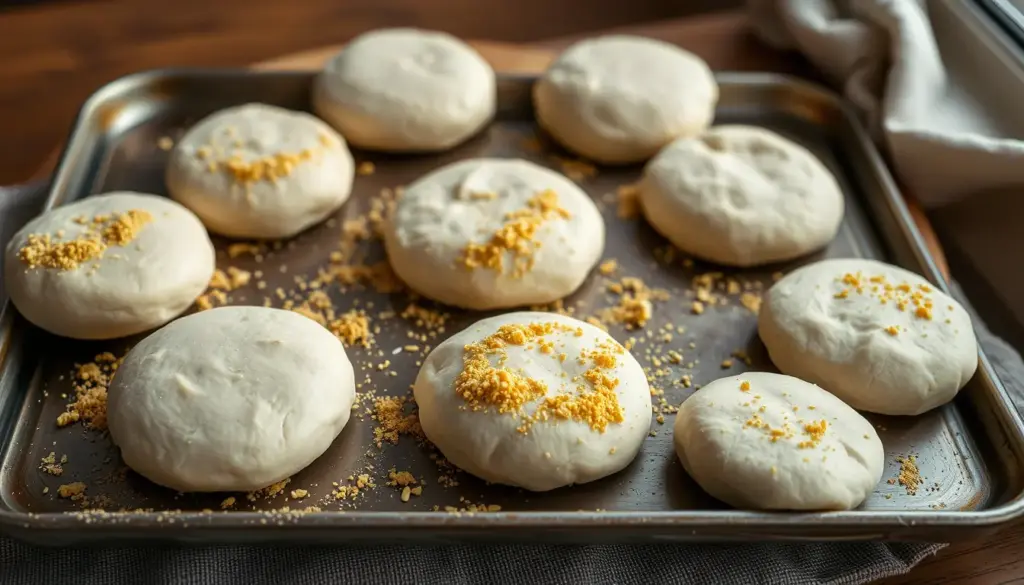
Dust the counter with semolina or fine cornmeal, not flour. It keeps the dough from sticking, gives the outside its familiar gritty finish and stops the muffins welding to the griddle. Roll the dough to an even 2 cm and cut rounds with an 8 to 9 cm (3 to 3½ in) cutter. Press straight down without twisting so the edges can rise freely. Gather the scraps, rest them for 10 minutes and roll again.
Place the rounds on a semolina-dusted tray with space between them, cover loosely and leave them to proof until they look slightly puffy and spring back slowly when pressed.
Cooking on the griddle
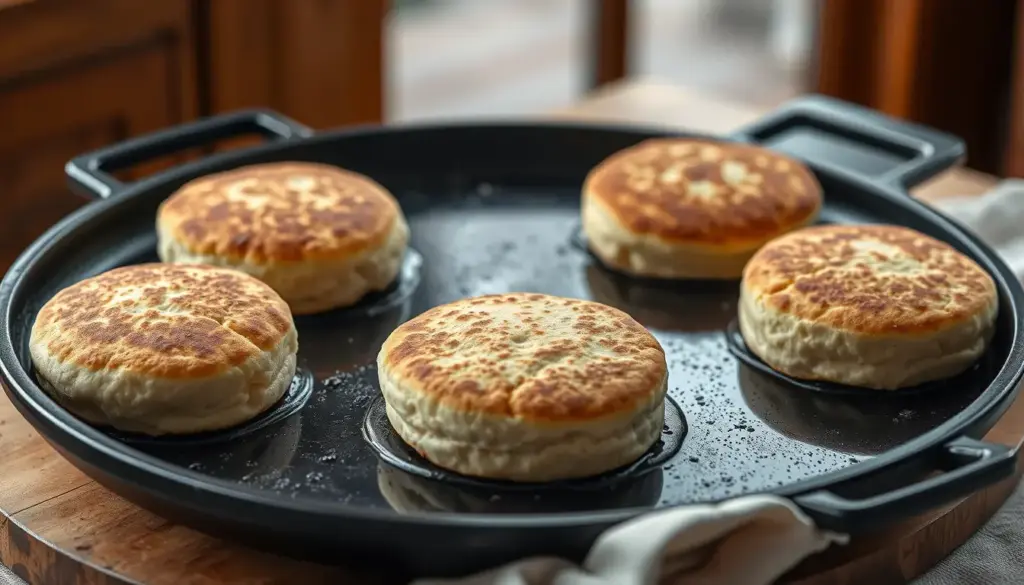
Heat a griddle, cast iron pan or heavy frying pan over low to medium-low heat for several minutes. The surface should feel warm but not fierce; around 150 to 165 °C (300 to 325 °F) on a surface thermometer is a good guide, if you have one. Don’t add oil.
Place the muffins in the pan with room to spread. Cook for 6 to 8 minutes, until the bottom is golden brown, then turn and cook the second side for another 6 to 8 minutes. The sides will still look pale, which is normal. They should feel light, sound hollow when tapped and read about 93 °C (200 °F) in the middle if you check them with a thermometer.
If the outside browns long before the middle is done, lower the heat. If the middle is still doughy, finish the muffins for 5 minutes in a 180 °C (350 °F) oven. Many bakeries do the same.
Cooking a full batch
Most pans hold three or four muffins at a time, so plan on two or three rounds. Keep the waiting rounds covered so their tops don’t dry out, and cook the most risen ones first. Between batches, wipe out any loose semolina, which otherwise scorches and leaves bitter specks on the next round. Finished muffins can rest on a rack under a clean towel; they stay soft while the rest cook.
If your pan has hot spots, you’ll see it quickly: one muffin browns twice as fast as its neighbour. Rotate them a quarter turn halfway through each side, or use a larger, heavier pan that spreads the heat more evenly.
Getting the tang you want
Tang comes mainly from fermentation time and temperature. A same-day dough fermented at a warm room temperature gives mild, milky muffins. An overnight rest in the fridge brings a clearer sour note, and a longer cold rest, up to about 24 hours, makes it stronger again. Whole wheat flour also pushes the flavour toward sour. If your family prefers them sweet and gentle, keep the timeline short and add an extra spoonful of sugar.
Splitting and storing
Let the muffins cool for at least 20 minutes before splitting. Push a fork in around the middle, all the way round, and pull the halves apart. A knife flattens the crumb and gives a smooth surface that never toasts as crisply.
They keep in a bag for about three days and freeze very well. Split them before freezing so you can toast them straight from frozen.
English muffin mistakes
- Too much heat. The crust burns before the inside sets, leaving a gummy middle.
- Too stiff a dough. The muffins rise very little in the pan and turn out dense.
- Twisting the cutter. The sealed edges stop the rounds rising evenly.
- Rushing the proof. Underproofed rounds bulge in the middle and stay tight inside.
- Cutting with a knife. You lose the open, crunchy nooks that make a toasted muffin worth eating.
For other ways to use starter in a pan, what to do with sourdough discard has ideas that need no long rise at all.
English muffin questions
Can I use discard instead of active starter?
Unfed discard can work if you add a little instant yeast, about 1 to 2 g for this batch, because discard on its own often lacks the strength to raise the dough. With ripe, active starter, no yeast is needed.
Do I need muffin rings?
No. Rings help only with very soft doughs that would otherwise spread. This dough holds its shape on its own.
Why are my muffins flat?
The dough was usually underproofed or rolled too thin. Aim for 2 cm thick rounds and let them become visibly puffy before they go in the pan.
Can I make them with whole wheat flour?
Yes. Replace up to about a third of the flour with whole wheat and add a spoonful or two of extra milk, since whole grain absorbs more liquid.