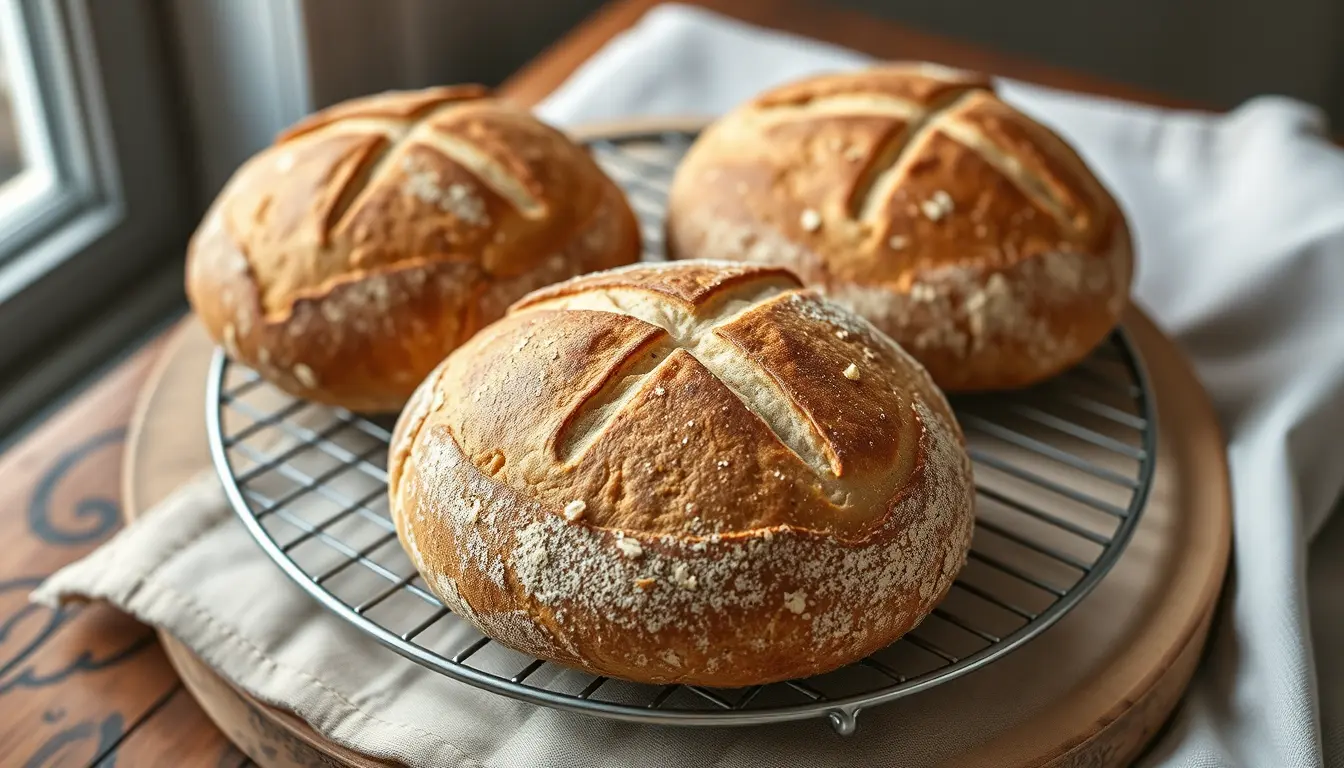
To make a sourdough bread bowl that holds soup, bake small boules of about 225 g from a slightly firmer dough, around 68% hydration, and give them a long, dark bake so the crust is thick and sturdy. Let them cool completely, cut off a lid, scoop out the crumb to leave walls of about 1.5 to 2 cm, and toast the hollow shell for a few minutes before filling it. Thick soups and stews stay put for a whole meal; thin broths soak through no matter what you do.
What a bread bowl has to do
An ordinary loaf only has to taste good. A bread bowl also has to work as a container. That changes the priorities:
- A strong crust that won’t go soggy within ten minutes of meeting hot soup.
- A closer crumb that soaks up liquid slowly instead of letting it run straight through big holes.
- A stable shape with a flat base, so the bowl doesn’t tip over on the plate.
A very open, high-hydration crumb is beautiful in a sandwich loaf, but in a bread bowl those large holes become leaks. A slightly drier dough with a tight shape gives you thicker walls and a crumb that holds.
Choosing the size
For a main-course bowl, about 225 to 250 g of dough per piece bakes into a boule roughly 12 to 13 cm (5 in) across, which holds a generous ladle or two of soup. Smaller pieces of 150 to 180 g make starter-sized bowls. These are approximate; how wide a boule spreads depends on the dough’s strength and hydration.
To plan a batch of four, enter 4 loaves at 225 g into the sourdough recipe builder with 68% hydration, 2% salt, 20% starter at 100% hydration and no whole wheat. It gives:
| Ingredient | Amount |
|---|---|
| Flour | 476 g |
| Water | 307 g |
| Ripe starter | 106 g |
| Salt | 11 g |
| Total dough | 900 g |
If you already have a favourite loaf recipe, you can scale it instead. Say it uses 500 g bread flour, 350 g water, 100 g active starter and 10 g salt, which is 960 g of dough. For six bowls of about 240 g you need 1,440 g, so scale by 1.5. The recipe scaler returns 750 g flour, 525 g water, 150 g starter and 15 g salt. Bear in mind that this recipe sits at a higher hydration than 68%, so expect slightly more spread.
Mixing and bulk fermentation
Mix, rest and fold as you would for any sourdough loaf. Three or four sets of folds in the first couple of hours build the strength the small boules need to stand tall. Bulk ends when the dough is roughly half as big again, with bubbles visible along the sides of the container and on top. How much starter should you use covers how the starter amount changes the timing if you need the bowls ready by a certain time.
Shaping small boules
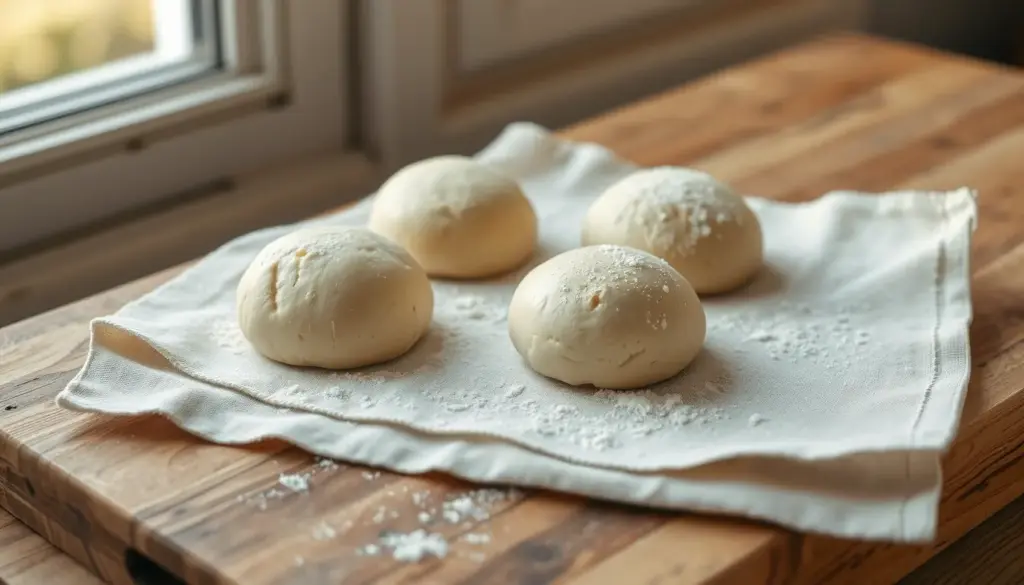
Divide the dough by weight so every bowl bakes evenly. Small pieces need firm shaping: round each one into a ball, rest them for 20 minutes, then shape again, dragging each piece toward you on an unfloured patch of counter to tighten the skin. The movements are the same as for a full-size loaf, shown step by step in how to shape a sourdough boule. A tight skin is what makes the bowl round and tall instead of flat and wide.
Proof the boules seam side up in small floured bowls lined with tea towels, or seam side down on a floured tray if they hold their shape well. An overnight proof in the fridge works well and makes the cold boules easier to score.
Baking for a sturdy crust
Bread bowls need a longer, darker bake than a sandwich loaf of the same size. Heat the oven to 240 °C (465 °F) with a stone, steel or heavy tray inside. Score each boule with a single shallow cross or one curved cut. Bake with steam for the first 12 minutes, then vent the oven and bake for another 15 to 20 minutes, until the crust is deep brown and the loaves sound hollow underneath. These timings are approximate; check the colour rather than the clock.
A pale crust is the most common reason bread bowls fail. It may look fine on the board, but it softens quickly once hot soup is inside. If the tops brown before the sides, lower the temperature by 10 to 15 °C for the last part of the bake.
Cooling, hollowing and toasting
Let the boules cool completely, at least an hour. Warm crumb is gummy and tears when you hollow it.
- Cut a lid off the top with a serrated knife, angling the blade slightly inward so the lid sits back on neatly.
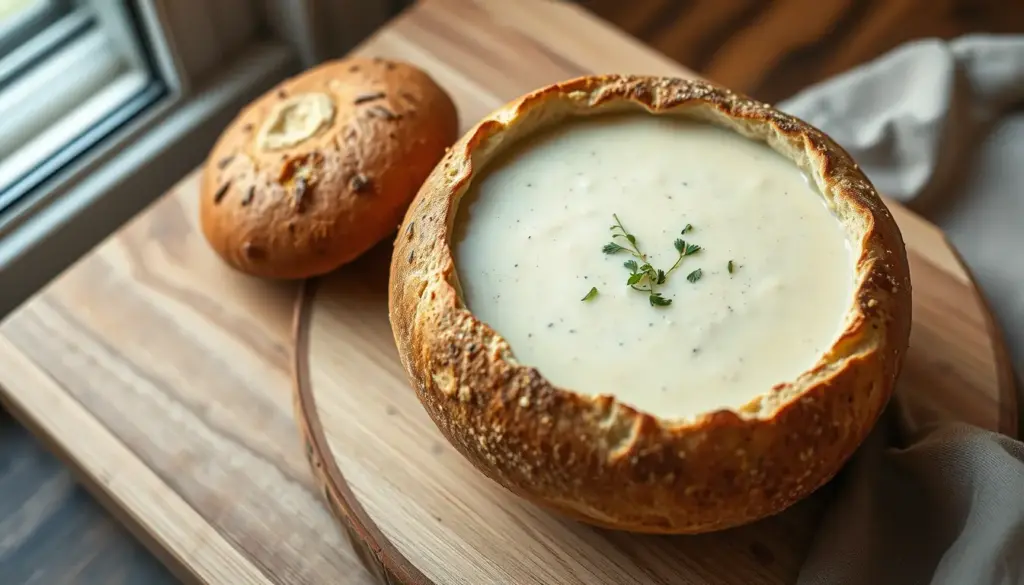
- Pull out the crumb, leaving walls and a base of about 1.5 to 2 cm (¾ in). Don’t scrape too close to the crust, especially at the bottom.
- Brush the inside lightly with olive oil or melted butter if you like, then toast the shells and lids on a tray at about 180 °C (350 °F) for 5 to 10 minutes, until the inside feels dry and slightly crisp.
Toasting seals the cut surface and slows how quickly the soup soaks in. Save the scooped-out crumb for croutons or breadcrumbs.
Planning a soup night
Bread bowls are easiest when the baking happens the day before. A two-day plan might look like this:
- Day 1, morning: feed the starter so it’s ripe by early afternoon.
- Day 1, afternoon: mix the dough and run bulk fermentation, about 4 to 6 hours at a warm room temperature.
- Day 1, evening: divide, shape and refrigerate the boules overnight.
- Day 2, morning: bake straight from the fridge and let the bowls cool through the day.
- Day 2, half an hour before dinner: cut, hollow and toast the bowls while the soup heats.
This keeps the oven work in the morning and leaves only the quick hollowing and toasting for the evening. A sourdough schedule for people who work 9 to 5 has more ideas for fitting the long steps around a working day.
Which soups work best
Choose thick soups and stews: chowder, chili, a puréed vegetable soup, a creamy mushroom soup or a hearty bean stew. Fill the bowls just before serving and set each one on a plate. Thin, brothy soups soak through the base within minutes, even with a well-toasted shell.
Bread bowl mistakes
- Using a very wet dough. The boules spread flat and the large holes in the crumb let soup run through.
- Underbaking. A golden crust that looks done goes soft almost immediately under hot liquid.
- Hollowing while warm. The crumb tears and the walls end up uneven, with thin spots that leak.
- Scraping the base too thin. The bottom is where most leaks start, so leave it the thickest.
- Filling too early. Even a good bowl starts to soften after 15 to 20 minutes.
If you have leftover bowls, how to keep sourdough bread fresh explains the best way to store or freeze them before hollowing.
Bread bowl questions
Can I make bread bowls a day ahead?
Yes. Bake them a day early, keep them whole in a paper bag, and hollow and toast them shortly before serving. The toasting refreshes the crust.
Should I add whole wheat or rye?
A little, up to about 20%, adds flavour and works fine. More than that makes the crumb softer and the walls weaker.
Can I freeze baked bread bowls?
Yes, whole and unhollowed. Thaw them at room temperature, refresh them in a hot oven for 5 minutes, then hollow and toast as usual.
Why did my bowl leak at the bottom?
The base was scraped too thin, or the bowl was underbaked. Leave at least 2 cm at the bottom and bake until the underside is well browned.