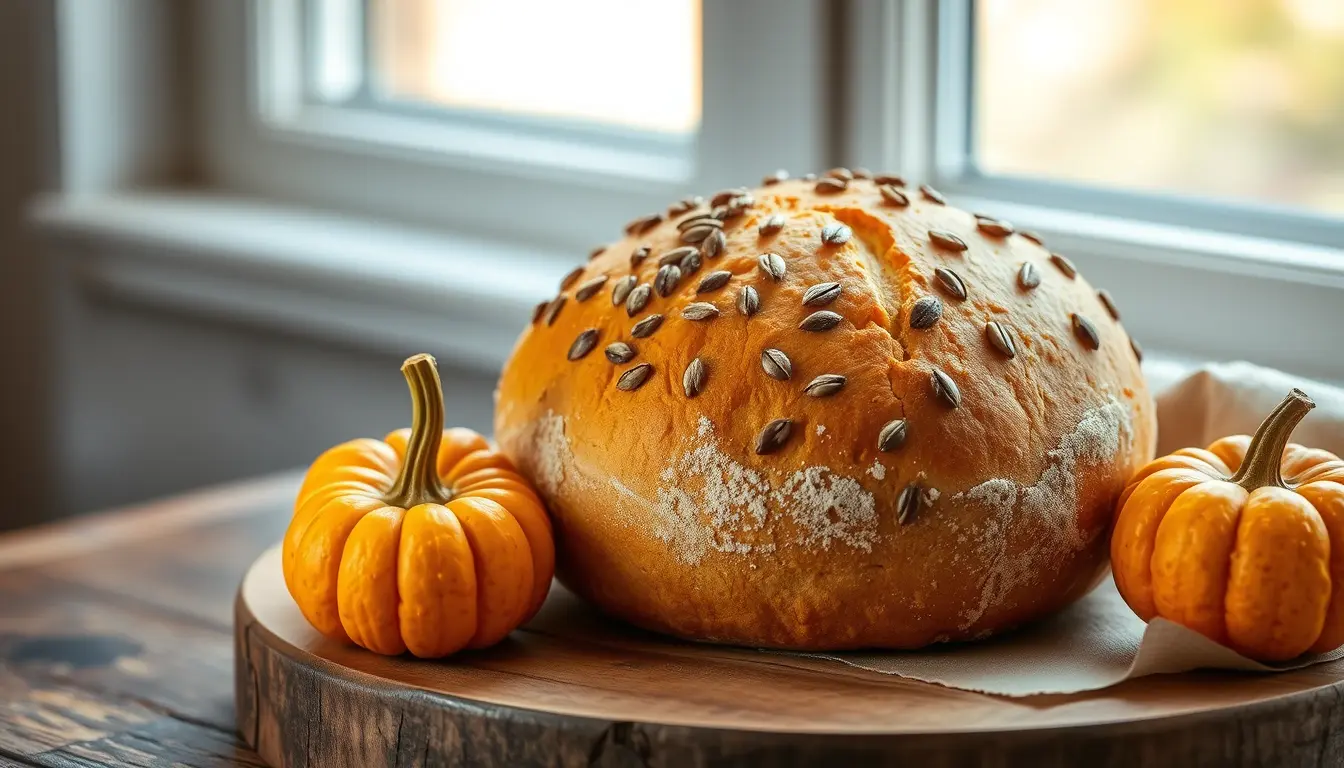
To add pumpkin purée to a sourdough loaf without a gummy crumb, treat the purée as part of the water. Canned pumpkin purée is roughly 90% water, so 200 g of it brings about 180 g of water into the dough. Take most of that out of the recipe’s water, bake the loaf a little longer than usual, and let it cool completely before slicing. Get those three things right and you’ll have a golden, soft, slightly sweet loaf with a crust that still crackles.
This page is about a crusty sourdough loaf with pumpkin in the dough, not the cake-like quick bread that shares the name. If that’s what you’re after, what to do with sourdough discard has quick bread ideas that suit a pumpkin twist.
Why pumpkin makes bread gummy
Gumminess almost always comes from too much water left in the crumb. Pumpkin causes it in three ways:
- Hidden water. Purée looks thick, but most of its weight is water. Add it on top of a full recipe and the real hydration shoots up.
- Fibre and sugar. Pumpkin’s fibre holds water tightly, and its natural sugars slow how quickly the crumb dries in the oven.
- Colour. The orange crumb and the extra sugar make the crust brown faster, so the loaf looks done before the middle is.
A loaf that’s too wet and slightly underbaked is the classic result: dense near the base, damp in the middle and sticky on the knife.
Counting the water in the purée
Canned pumpkin varies by brand, and homemade purée is often wetter still, but 90% water is a sound working figure. It is an approximation, so be ready to adjust by feel.
Start with a plain sourdough formula you trust. Here’s one at 72% overall hydration: 450 g bread flour, 310 g water, 100 g ripe starter at 100% hydration and 9 g salt. The sourdough hydration calculator confirms 72%, with 500 g total flour and 360 g total water.
Now add 200 g of purée. If you enter the recipe’s water plus the purée’s water, 310 + 180 = 490 g, the calculator jumps to 108% hydration, a soup rather than a dough. Set the target to 72% and it shows that the water should total 310 g, which is 180 g less. Since the purée now supplies 180 g of that, you add only 130 g of water from the tap.
| Version | Water from tap | Water from purée | Overall hydration |
|---|---|---|---|
| Plain loaf | 310 g | 0 g | 72% |
| Purée added, water unchanged | 310 g | 180 g | 108% |
| Purée added, water reduced | 130 g | 180 g | 72% |
Because the pumpkin’s fibre holds on to some water, the dough may feel a little stiffer than the number suggests. Mix with the reduced water first, then add up to 20 or 30 g more if the dough feels tight. It’s much easier to add water than to take it out.
The full formula
- 450 g bread flour
- 130 g water, plus a little more if needed
- 200 g pumpkin purée
- 100 g ripe starter (100% hydration)
- 9 g salt
- Optional: 1 tsp ground cinnamon and ½ tsp ground ginger or nutmeg
The baker’s percentage calculator shows why purée is awkward to classify. Typed as an “other” ingredient, this mix reads just 36% overall hydration, because only the tap water and the starter count. Typed as a liquid, it reads 76%, because the whole 200 g counts as water, fibre and all. The real figure, about 72%, sits between the two and much closer to the second. Either way, the total dough comes to 889 g, enough for one generous loaf.
Homemade purée
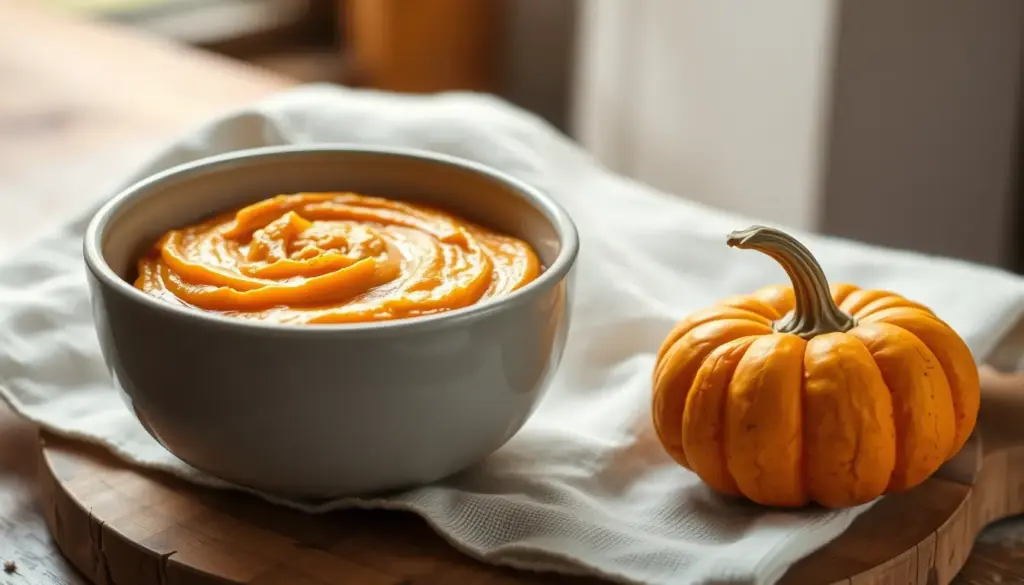
Roasted pumpkin or squash makes a deeper-flavoured loaf, but it’s usually wetter than canned. Purée it smoothly, then let it drain in a sieve lined with a coffee filter or cloth for an hour or two. Weigh it after draining, not before. Butternut squash and sugar pumpkins both work well; large carving pumpkins tend to be watery and bland.
Mixing and fermentation
Mix the purée into the water first, then add the starter, then the flour. Pumpkin dough is stickier than a plain dough at the same hydration, so lean on stretch and folds rather than kneading. Three or four sets in the first two hours build enough strength.
Expect fermentation to run a little faster than usual. The purée adds sugars that the starter feeds on, and the dough is often slightly warmer after mixing. Watch for a rise of about half and a domed, bubbly surface rather than following a fixed time. Spices, especially cinnamon in large amounts, can slow yeast down, so keep them to a teaspoon or two.
Shaping and baking
Shape as you would a normal boule or batard and proof in a floured basket. Rice flour helps if the dough is sticky. Bake in a preheated Dutch oven at 240 °C (465 °F) for 20 minutes with the lid on, then uncover, lower to 220 °C (430 °F) and bake for another 25 to 30 minutes. That’s a little longer than a plain loaf of the same size.
Because the crust colours faster, judge doneness by temperature and weight rather than colour. The middle should read at least 96 °C (205 °F) on a probe thermometer, and the loaf should feel light for its size. If the crust is getting dark too early, lay a sheet of foil loosely over the top for the last 10 minutes. How to tell when sourdough is fully baked explains the checks in detail.
Cool it completely
This step matters more than usual. A pumpkin loaf keeps cooking from the inside as it cools, and steam escapes through the crust. Cut it while warm and the crumb looks wet and gummy, even when it’s fully baked. Give it at least two hours on a rack before slicing.
A sample schedule
Pumpkin dough works well with an overnight proof, which also gives the spices time to mellow. Feed your starter in the morning and mix the dough in the early afternoon once it’s ripe. Run bulk fermentation through the afternoon, shape in the evening, and refrigerate the loaf overnight in its basket. Bake straight from the fridge the next morning, and the loaf will be cool enough to slice by lunchtime. A cold dough is also firmer and easier to score, which helps with a sticky, purée-rich loaf.
Pumpkin loaf mistakes
- Ignoring the purée’s water. The single biggest cause of a gummy loaf.
- Too much purée. Up to about 40 to 45% of the flour weight works well; beyond that the crumb gets heavy.
- Pulling it out on colour alone. The crust darkens early, so check the internal temperature.
- Heavy spicing. Large amounts of cinnamon slow fermentation and can overpower the pumpkin.
- Slicing too soon. Warm crumb always looks underbaked.
Add-ins that work
Toasted pumpkin seeds, dried cranberries and chopped pecans all suit this loaf. Fold them in during the last set of folds, at around 10 to 15% of the flour weight. Seeds, cheese and olives in bread explains why toasting seeds first and adding them late both help.
Pumpkin bread questions
Can I use butternut squash instead of pumpkin?
Yes, and many bakers prefer it for its sweeter flavour. Treat it exactly like pumpkin: purée, drain and count about 90% of its weight as water.
Can I use pumpkin pie filling?
No. Pie filling contains sugar and spices, often in large amounts. Use plain purée, which should list only pumpkin on the label.
Why is the crumb fine and close instead of open?
The fibre in pumpkin naturally gives a softer, tighter crumb, much like a sandwich loaf. A slightly higher hydration helps a little, but don’t expect large, irregular holes.
Does the purée make the bread sweeter?
A little. Pumpkin is only mildly sweet, so the loaf tastes gently earthy rather than sugary. A spoonful of honey or maple syrup in the dough rounds out the flavour if you’d like it sweeter.