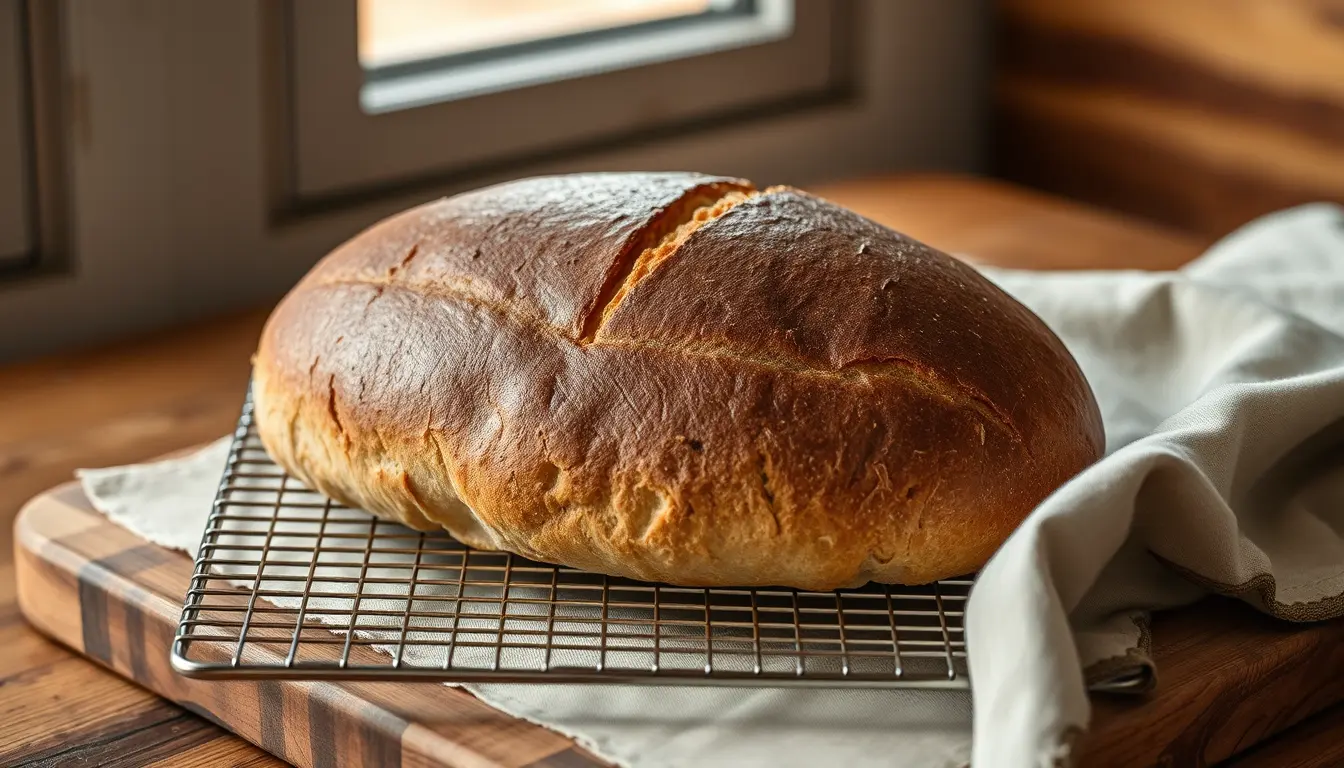
A sourdough loaf is fully baked when three things line up: the crust is a deep, even brown on the sides as well as the top, the middle of the loaf has reached roughly 96 to 98 °C (205 to 208 °F), and the base gives a hollow knock when you tap it. Any one of those signs can mislead you on its own. Together, they are very reliable.
The rest of this guide explains what each check really tells you, how to take a temperature reading that means something, and what to do when a loaf comes out a little short.
Why “done” is more than a brown crust
Inside the oven, two jobs happen at different speeds. The crust browns from the outside in, driven by dry heat on the surface. The crumb sets from the inside out, as starch swells with water, gelatinises and firms up, and as steam slowly works its way out of the loaf.
A hot oven can finish the first job well before the second. That is how you end up with a handsome loaf that is tacky and heavy in the middle. A cool oven does the reverse: the inside is cooked through long before the crust has any colour or crunch. Good timing means both finish together, and the three checks below cover both sides of that.
Check 1: colour all the way round
Look at the sides and the base, not just the top. The top crust is closest to the heat and browns first, so it flatters the loaf. The sides, especially in a pot, lag behind.
- The top: a deep chestnut brown, with darker edges on any ears or score lines.
- The sides: golden brown at the very least. Pale, soft sides are the most common sign of a loaf that came out early.
- The base: evenly browned and firm. Lift the loaf with a cloth and look underneath.
Colour depends on more than time. A loaf that fermented a long way, or one made with very plain white flour, can stay paler even when it is fully cooked. Our guide to pale, thick and hard crusts goes through those causes.
Check 2: the internal temperature
A probe thermometer takes the guesswork out of the inside. For a lean sourdough, aim for 96 to 98 °C (205 to 208 °F) in the centre of the crumb. Wetter doughs, above about 75% hydration, benefit from the upper end, because they hold more water that needs to leave before the crumb sets.
| Bread | Typical centre temperature | Notes |
|---|---|---|
| Lean sourdough, white or light whole grain | 96 to 98 °C (205 to 208 °F) | Aim higher for very wet doughs |
| Mostly rye | 98 °C (208 °F) or a little more | Needs a long rest before slicing |
| Enriched loaves with butter, milk or eggs | 88 to 91 °C (190 to 195 °F) | Sugar browns them early, so they finish cooler |
| Sandwich loaf in a tin | 95 to 97 °C (203 to 207 °F) | The tin shields the sides, so check the base too |
Different bakers and books give slightly different targets, usually within a couple of degrees of these. Treat the number as a floor rather than a finish line: a loaf at 93 °C is almost certainly underbaked, while one at 97 °C can still benefit from a few more minutes for crust.
How to take a useful reading
- Lift the loaf out with oven gloves and turn it upside down on a heatproof surface.
- Push the probe in through the base, angled towards the centre of the loaf, not just under the crust.
- Wait until the number stops climbing, usually a few seconds with a digital probe.
- For a long batard, check near the middle, which is the last part to cook.
Pushing in from the base keeps the top crust and score intact. The small hole closes up as the loaf cools.
At altitude, the numbers drop
Water boils at a lower temperature the higher you live, and a loaf full of moisture can’t get much hotter than that. At around 1,500 m (5,000 ft) water boils at about 95 °C (203 °F), so a loaf there may never reach 96 °C. Aim for a few degrees below your local boiling point and rely more on colour and the tap test.
Check 3: the tap, and the weight
Turn the loaf over and knock firmly on the base with a knuckle. A baked loaf sounds hollow and slightly drum-like. A damp one gives a duller thud. It is a rough test that takes practice to read, so use it to back up the other two checks rather than replace them.
Weight is a quieter clue. A loaf loses water as it bakes, and most lean loaves come out roughly 10 to 15% lighter than the dough that went in. Small loaves and long, dark bakes lose more. If you weigh the shaped dough and the cooled loaf for a few bakes, you will learn your own figure, and a loaf that has lost much less than usual is a warning sign.
Matching the oven to the loaf
Most of the “is it done?” trouble starts with an oven that runs cooler or hotter than the recipe expects. A common pattern is to start a lean loaf at 250 °C (482 °F) and finish at 230 °C (446 °F), but recipes are written for conventional heat, and a fan oven bakes faster at the same number. The oven temperature converter handles the translation. A recipe that says 250 °C conventional becomes 230 °C on a fan setting, and 230 °C becomes 210 °C fan. On a gas cooker, the same two steps are mark 9 and mark 8.
Convert your own recipe’s settings here:
An oven thermometer on the middle shelf is worth having, because many home ovens drift 10 °C or more from the dial. Fan vs conventional oven temperatures covers how to test yours.
Loaf size changes the timing too. If you scale a recipe with the sourdough recipe builder, expect a 700 g loaf to finish a few minutes before a 1 kg one, and a 1.2 kg loaf to need longer uncovered. The checks above matter more than the clock when the size changes.
When the loaf comes out short
If the crust looks right but the centre reads low, put the loaf straight back in. Set it directly on the oven rack, without the pot or tray, at around 200 to 220 °C (390 to 430 °F) for another 5 to 10 minutes, then check again. If the top is already dark, rest a sheet of foil loosely over it.
Once a loaf has cooled completely, a second bake helps the crust but rarely rescues a gummy middle. Slices toast well, though, and a gummy loaf still makes good croutons or breadcrumbs.
An underbaked centre is mostly a texture problem. Genuinely raw, doughy patches are a different matter: raw flour is not a ready-to-eat ingredient, so those shouldn’t be eaten as they are.
Cooling finishes the bake
The loaf keeps cooking for a while after it leaves the oven. Steam carries on escaping, and the crumb firms as the starch cools. Cutting into a loaf hot from the oven releases that steam all at once and leaves the crumb sticky, which can look exactly like underbaking. Give a standard loaf at least an hour on a rack, and a mostly rye loaf much longer.
If your loaves keep coming out heavy even when the temperature is right, the cause is more likely fermentation than baking. Why is my sourdough dense? walks through the usual suspects. For the full pot method, timings included, see baking sourdough in a Dutch oven.
Mistakes that lead to underbaked loaves
- Judging by the top crust alone. The top always looks more finished than the sides and base.
- Taking a reading just under the crust. The outer centimetre is much hotter than the middle.
- Pulling the loaf at the first sign of colour. A pale gold loaf usually needs another 5 to 10 minutes.
- Trusting the oven dial. An oven running 15 °C cool can add a lot of time to a bake.
- Slicing too soon. A sticky crumb in a warm loaf is often just a loaf that hasn’t finished setting.
Baked-through questions
Can a loaf reach the right temperature and still be gummy?
Yes, occasionally. A very wet dough can hit 96 °C in the centre while still holding a lot of moisture, and slicing it early makes things worse. Bake it a few minutes past the target, let it cool fully, and if it happens often, try lowering the hydration a little.
Is it worth leaving the loaf in the switched-off oven?
It can help a crust that softens as it cools. Turn the oven off, prop the door open a few centimetres and leave the loaf inside for 10 to 15 minutes. The gentle dry heat drives off a little more moisture without darkening the crust further.
How long should a rye loaf rest before cutting?
Much longer than a wheat loaf. A loaf with a high share of rye is usually best left for 12 to 24 hours, wrapped in a cloth, before slicing. Rye crumb stays sticky while warm and sets slowly as it cools.