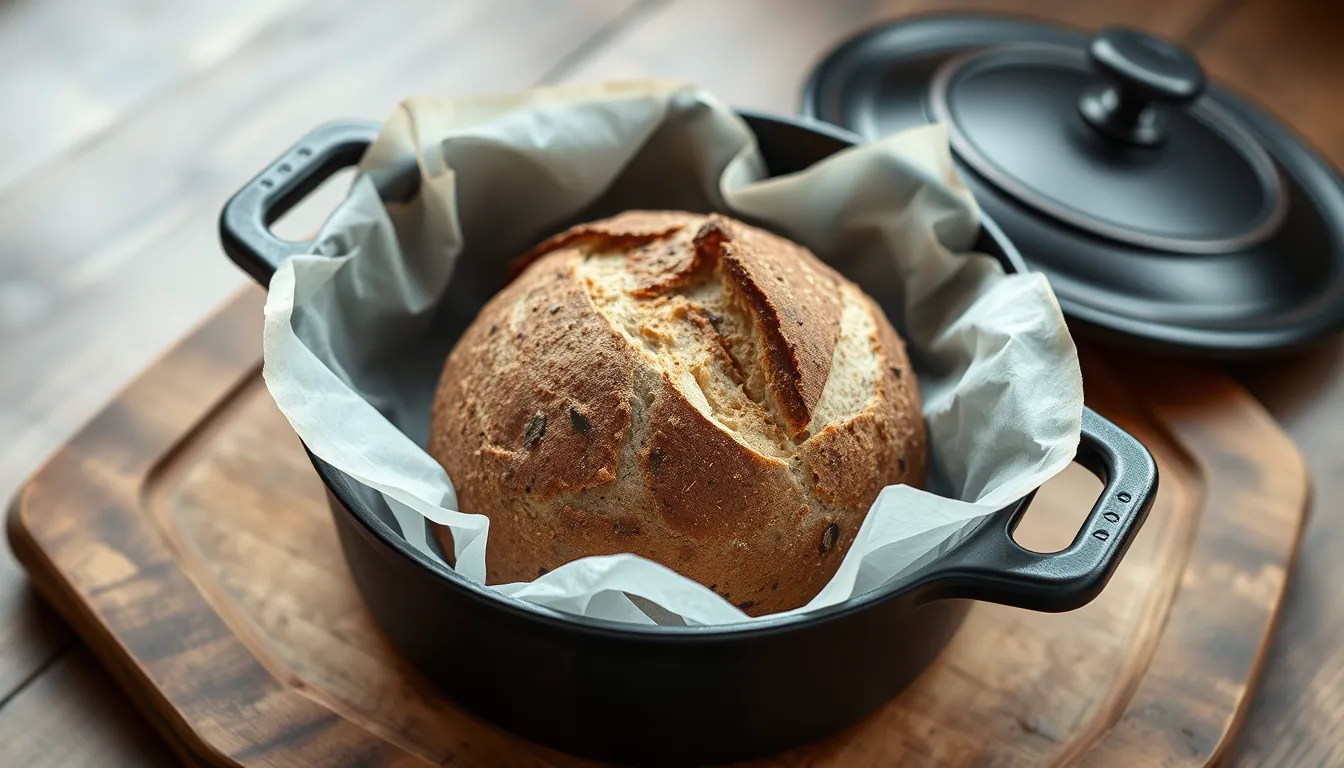
A Dutch oven gives a home oven what bread needs most in the first part of the bake: trapped steam and strong, even heat. The standard method is to preheat the pot in the oven at about 250 °C (480 °F) for 45 to 60 minutes, lower the loaf in on a sheet of parchment, bake it covered for 20 minutes, then take the lid off, turn the oven down to about 230 °C (445 °F) and bake for another 20 to 25 minutes, until the crust is a deep brown.
That is the whole method. The rest of this guide covers why it works, how to pick and size the pot, and how to avoid the two classic problems: a burnt base and a loaf that spreads.
Why a pot works so well
Professional bread ovens inject steam at the start of the bake. The steam condenses on the cool surface of the dough, keeping it soft and stretchy while the loaf expands, and it gives the finished crust its shine. Home ovens vent most of their moisture, so a loaf baked on an open tray loses that help.
A covered pot solves this neatly. As the loaf heats, water evaporates from the dough and stays trapped under the lid. The loaf bakes in its own steam, no extra water needed. At the same time, the thick, preheated walls radiate heat evenly from every side and push the loaf upward. And the walls give a softer dough some support, so it has less room to spread.
Once the lid comes off, the dry heat takes over and browns the crust.
Choosing a pot
Material
Cast iron is the classic choice, either bare or enamelled. It holds a lot of heat, which is exactly what you want. A combo cooker, a cast-iron pan with a deep pot that doubles as the lid, is especially handy: you place the loaf on the shallow part and cover it with the deep part, so there are no high sides to reach over.
Check the knob on the lid. Some enamelled pots come with plastic knobs that are only rated to around 200 °C (390 °F). Replace them with a metal knob, or remove the knob and plug the hole with foil for bread.
Size and shape
A round pot about 24 to 26 cm (9½ to 10 in) across suits a loaf of around 900 g to 1 kg. A smaller pot of about 20 to 22 cm (8 to 8½ in) suits 700 to 800 g. Oval pots are made for oval loaves. The dough should have a couple of centimetres of space on each side, but not much more. In a very wide pot the loaf spreads before it sets, a problem covered in flat sourdough loaf: common causes and fixes.
Sizing the dough to your pot
If your recipe makes more dough than your pot can handle, adjust the recipe rather than squeezing it in. The sourdough recipe builder starts from the loaf weight you want.
For a 1,000 g loaf in a 26 cm pot, at 75% hydration with 2% salt, 20% starter and 15% whole grain, the builder gives 432 g of bread flour, 76 g of whole grain flour, 367 g of water, 113 g of starter and 11 g of salt. For a smaller 20 cm pot, change the weight to 700 g and it becomes 303 g of bread flour, 53 g of whole grain, 257 g of water, 79 g of starter and 7.9 g of salt.
Set your own loaf weight and hydration here:
Baking step by step
- Put the pot and its lid in the oven and preheat to 250 °C (480 °F) for 45 to 60 minutes. A heavy pot needs the full time.
- Cut a sheet of parchment a little larger than the loaf, with two long ends to use as handles.
- Turn the proofed loaf out onto the parchment, dust off excess flour and score it; the scoring guide covers angle and depth.
- Take the pot out, remove the lid and lower the loaf in by the parchment handles. Put the lid back on straight away.
- Bake covered for 20 minutes.
- Remove the lid, reduce the heat to 230 °C (445 °F) and bake for another 20 to 25 minutes, until the crust is deep brown.
- Check the loaf. The centre should reach about 96 to 98 °C (205 to 208 °F), and the base should sound hollow when tapped.
- Lift it out onto a rack and let it cool for at least an hour before slicing.
These timings suit a loaf of about 800 g to 1 kg. A 700 g loaf may be done 5 minutes sooner; a 1.2 kg loaf may need 5 to 10 minutes more uncovered. If you have a fan oven, lower the temperatures to match; fan vs conventional oven temperatures explains how.
Stopping the base from burning
Cast iron delivers a lot of heat to the base of the loaf, and a dark, bitter bottom crust is the most common complaint. Several small changes help:
- Put a baking tray on the rack directly below the pot to shield it from the bottom element.
- Move the pot one shelf higher.
- Scatter a little semolina or coarse cornmeal on the parchment under the loaf.
- For the last 10 minutes, lift the loaf out of the pot and finish it directly on the oven rack.
Try one change at a time, since each one also slows browning a little.
Getting the loaf in safely
The pot is heavy and extremely hot, and the risky moment is lowering the loaf in. Use long oven gloves that cover your wrists, set the pot on the hob or a heatproof board rather than holding it, and keep the lid on a trivet upside down so the hot handle is easy to grab again. The parchment sling means your hands never go near the walls.
A shaped loaf proofed in the fridge is firm and easy to move. How to shape a sourdough boule covers building a skin that holds together during this step.
No Dutch oven?
A heavy casserole with a tight lid does the same job. Failing that, bake on a preheated stone or steel and cover the loaf with a large upturned metal bowl for the first 20 minutes. Or bake the dough in a loaf tin, which supports the sides the way a pot does; how much dough for a 9×5 loaf pan helps you size it.
Dutch oven mistakes
- A short preheat. The oven may beep at temperature within 15 minutes, but a thick pot takes much longer to heat through.
- Taking the lid off too early. Before about 20 minutes the loaf is still expanding and needs the steam.
- Leaving the lid on too long. The crust stays pale and soft. Brown colour only develops once the steam is gone.
- Putting a wet dough in a very wide pot. It spreads before it sets. Choose a snug pot, or bake a firmer dough.
- Skipping the cooling time. The inside is still setting for an hour after baking. Cutting early leaves it damp.
Dutch oven questions
Can I use a stainless steel stockpot?
It will work if it is oven safe and has a metal lid, but thin steel holds much less heat than cast iron, so the base can scorch while the top browns slowly. A heavy, thick-walled pot gives far more even results.
Is it safe to preheat an enamelled pot empty?
Many manufacturers say yes for bread, but some warn against it. Check the instructions for your pot. If the enamel is chipped or crazed inside, bake on parchment and consider a bare cast-iron pot for bread instead.
Do I need to grease the pot?
No. Parchment is simpler and more reliable than oil or flour, and it makes lifting the loaf out easier. A well-seasoned bare cast-iron pot will usually release a floured loaf without it, but parchment removes the risk.