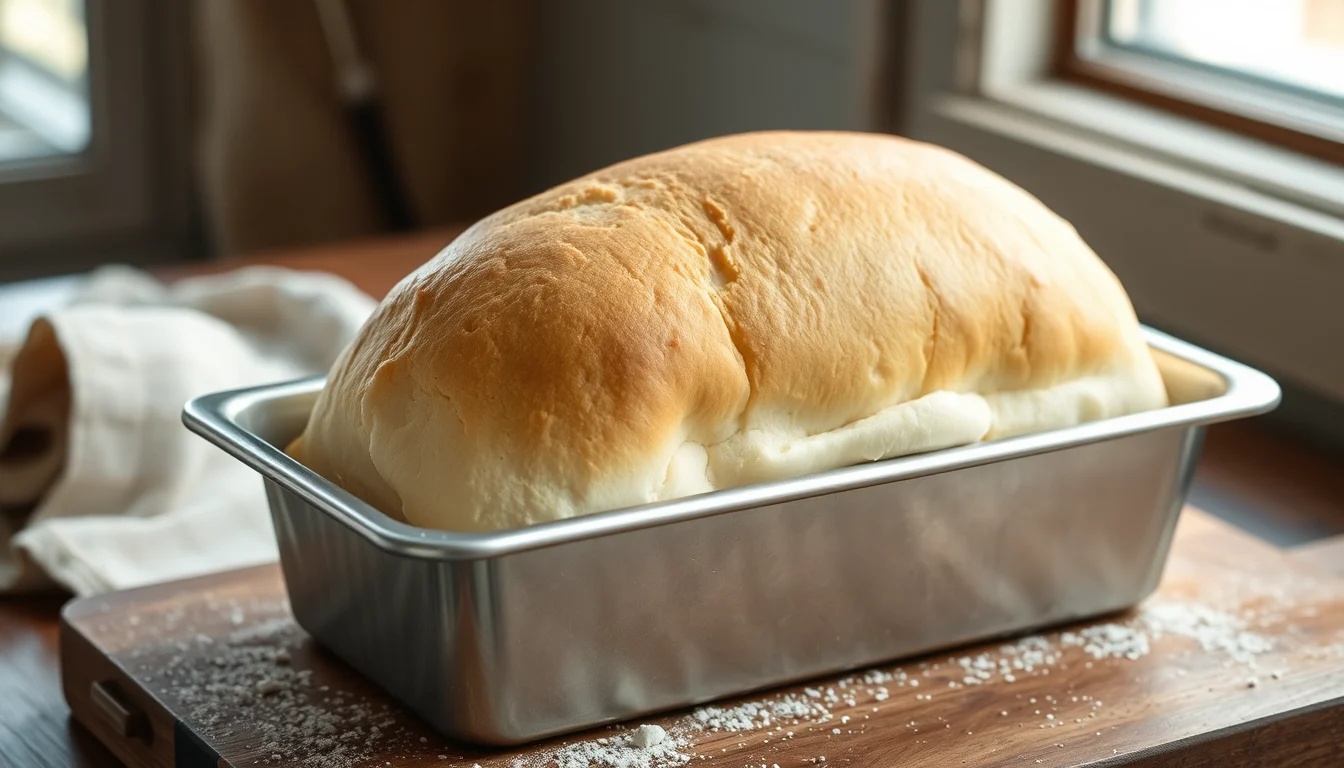
About 885 g of dough, just under 2 lb or 31 oz, for a standard 9 × 5 × 3 in loaf pan baked with an open top and a domed crown. That is the figure the loaf pan dough weight calculator gives for the pan’s full inside volume of 2.21 litres. For a square-sided loaf baked under a lid in the same pan, use less, about 619 g. And before trusting any number, measure your own pan across the inside of the rim, because pans sold as 9 × 5 are not all the same size.
A loaf pan is a mould, so the right amount of dough is mostly a question of volume. Underfill it and the loaf barely clears the rim, with a close, heavy crumb. Overfill it and the dough spills over the edges, tears along the rim or stays raw in the middle.
Where 885 g comes from
The calculator multiplies the pan’s volume by a dough density, the weight of dough per litre of pan. A 9 × 5 × 3 in pan measures about 22.9 × 12.7 × 7.6 cm inside, which is 2.21 litres. For an open-top loaf the density is 400 g per litre, so 2.21 × 400 = 885 g.
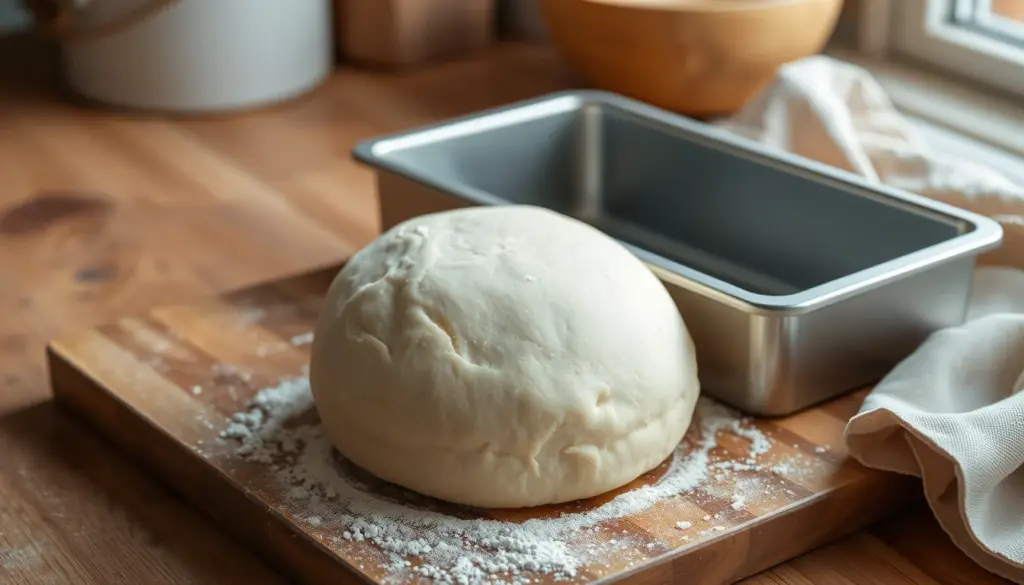
That density leaves room for the dough to rise just above the rim and dome in the oven. Shaped into a log and set in the pan, 885 g of dough comes roughly a third to halfway up the sides, which suits a lean or lightly enriched sandwich dough.
The slightly smaller 8½ × 4½ × 2¾ in pan, the other common American size, takes 689 g. The two look almost identical on a shelf, yet the 9 × 5 holds about 28% more, which is why a recipe written for one pan often looks wrong in the other.
Measure your own pan
Labels often give rounded or outside measurements rather than the space the dough actually fills. Measure inside the pan, at the rim, from one wall to the other, and measure the depth from the base to the rim.
Say your pan is sold as 9 × 5 but measures 23 × 13 × 7 cm inside. Enter those under a custom size and the calculator gives a volume of 2.09 litres and 837 g of dough, nearly 50 g less than the standard figure. Pans with steeply sloped sides, including many glass and ceramic ones, hold a little less than their rim size suggests, so start near the lower end for those too.
Choose your pan, or enter its measurements, to get your own figure:
Turning 885 g into a recipe
Knowing the dough weight is only half the job. To build a recipe around it, work in baker’s percentages and divide the dough weight by their total.
For a soft white sandwich loaf, a simple formula is bread flour 100%, water 64%, sugar 6%, butter 6%, salt 2% and instant yeast 1%, which adds up to 179%. In the baker’s percentage calculator, switch to percentages, scale by total dough and enter 885 g. It returns:
- Bread flour: 494 g
- Water: 316 g
- Sugar: 30 g
- Butter: 30 g
- Salt: 9.9 g
- Instant yeast: 4.9 g
That totals exactly 885 g. If you would rather bake sourdough in the tin, the sourdough recipe builder starts from a dough weight in the same way.
The same arithmetic explains a common mismatch. Many American sandwich bread recipes start from about 3 cups of flour, roughly 360 g when spooned and levelled. With a formula like the one above, that makes about 360 × 1.79 = 644 g of dough, much closer to the 8½ × 4½ in pan’s 689 g than to the 9 × 5’s 885 g. Baked in the larger pan, it gives a short loaf. Scale it up by about 1.37 times, or bake it in the smaller pan.
Adjusting for the type of dough
The 400 g per litre figure suits most everyday sandwich breads. Some doughs call for a nudge either way.
- Rich, soft doughs such as milk bread and brioche rise higher and lighter. Try about 10% less; at 360 g per litre, the 9 × 5 pan takes 796 g.
- Whole wheat, rye and seeded doughs rise less and bake denser. Try about 10% more; at 440 g per litre, the pan takes 973 g.
- Lidded, square loaves need much less, because the lid stops the rise and the dough can only fill out toward the corners. At 280 g per litre the pan takes 619 g.
- Two pans at once simply double the figure: 1,770 g for two open 9 × 5 loaves.
Tins labelled by weight
Outside North America, loaf tins are often sold by the size of loaf they make, such as a 1 lb or 2 lb tin, or by capacity. Those labels describe the finished bread only loosely, and two tins with the same label can differ noticeably. Measure the inside at the rim, choose a custom size in the calculator, and let the volume decide the dough weight rather than the name on the packaging.
How to tell you got it right
- Too little dough: the loaf barely clears the rim, has a flat or sunken top and a closer, heavier crumb.
- Too much dough: it rises well over the rim before it is fully proofed, spreads into a mushroom shape and may tear at the sides or stay damp in the centre.
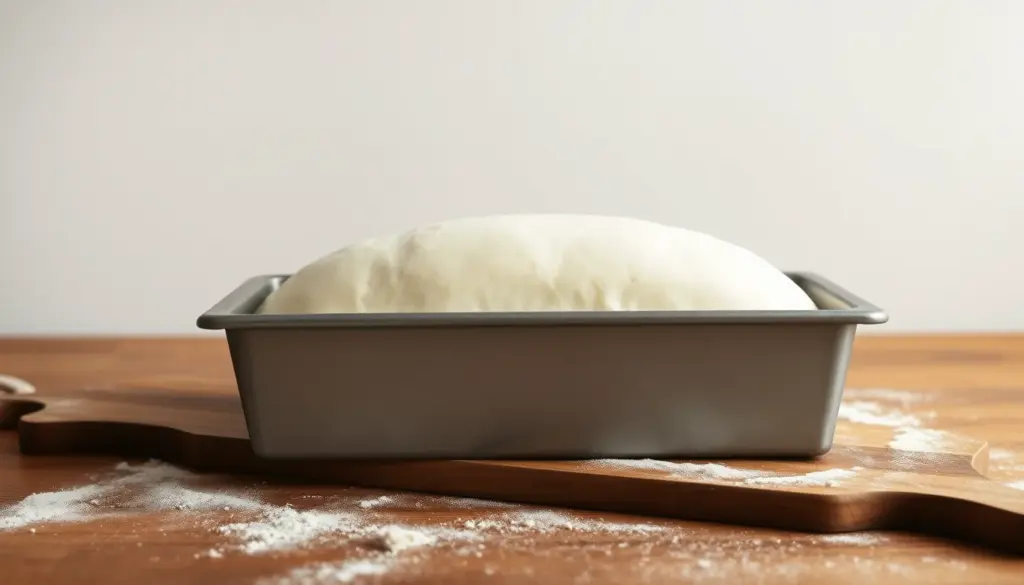
- About right: at the end of proofing the centre has risen just above the rim, and the loaf domes nicely in the oven with straight, even sides.
Proof by the height of the dough rather than the clock. A warm or cool kitchen shifts proofing times by an hour or more (the dough temperature guide has the numbers), but a loaf that has risen to the right height is ready whatever the clock says.
Baking the loaf
Most sandwich loaves of this size bake in about 30 to 40 minutes at 180 to 200 °C (350 to 400 °F). The loaf is done when the top is deep golden, the sides are coloured when you ease it out of the pan, and the centre reads around 88 to 93 °C (190 to 200 °F) for a soft enriched dough, a little higher for a lean one. Turn it out onto a rack within a few minutes, because steam trapped in the pan softens the crust and can leave the base damp.
Common loaf pan mistakes
- Measuring the outside. The walls and a rolled rim can add a centimetre or so each way.
- Using an 8½ × 4½ recipe in a 9 × 5 pan. It looks fine in the bowl and short out of the oven.
- Forgetting the pan will be lidded. A Pullman-style loaf with open-pan dough forces the lid up or compresses the crumb.
- Guessing the dough weight after mixing. Weigh the whole batch before dividing, especially when splitting dough between pans.
- Changing pans without changing time. A larger loaf needs a few more minutes in the oven, and a smaller one fewer.
Loaf pan questions
Can I bake a sourdough boule recipe in a 9 × 5 pan?
Usually, yes. Many home sourdough recipes make 850 to 950 g of dough, which suits a 9 × 5 pan well. Shape it into a log, proof it in the greased pan and bake it without a lid, a little cooler than you would in a Dutch oven.
Does quick bread batter follow the same weights?
No. Batters for banana bread or pound cake don’t rise the way yeast dough does, and they are poured rather than shaped. Fill the pan about two-thirds full, or compare pan sizes by area as described in how to convert a cake recipe to a different pan size.
Why did my tin loaf sink in the middle?
Usually it overproofed, rising so high before baking that the gluten could not support the dome, or it came out of the oven before the centre was fully set. Bake until the base sounds hollow and the sides are firm and golden.
My recipe makes 1 kg of dough. What should I do with the extra?
Bake 885 g in the pan and shape the rest into two or three rolls, or scale the whole recipe down by about 0.89 so every ingredient shrinks together.