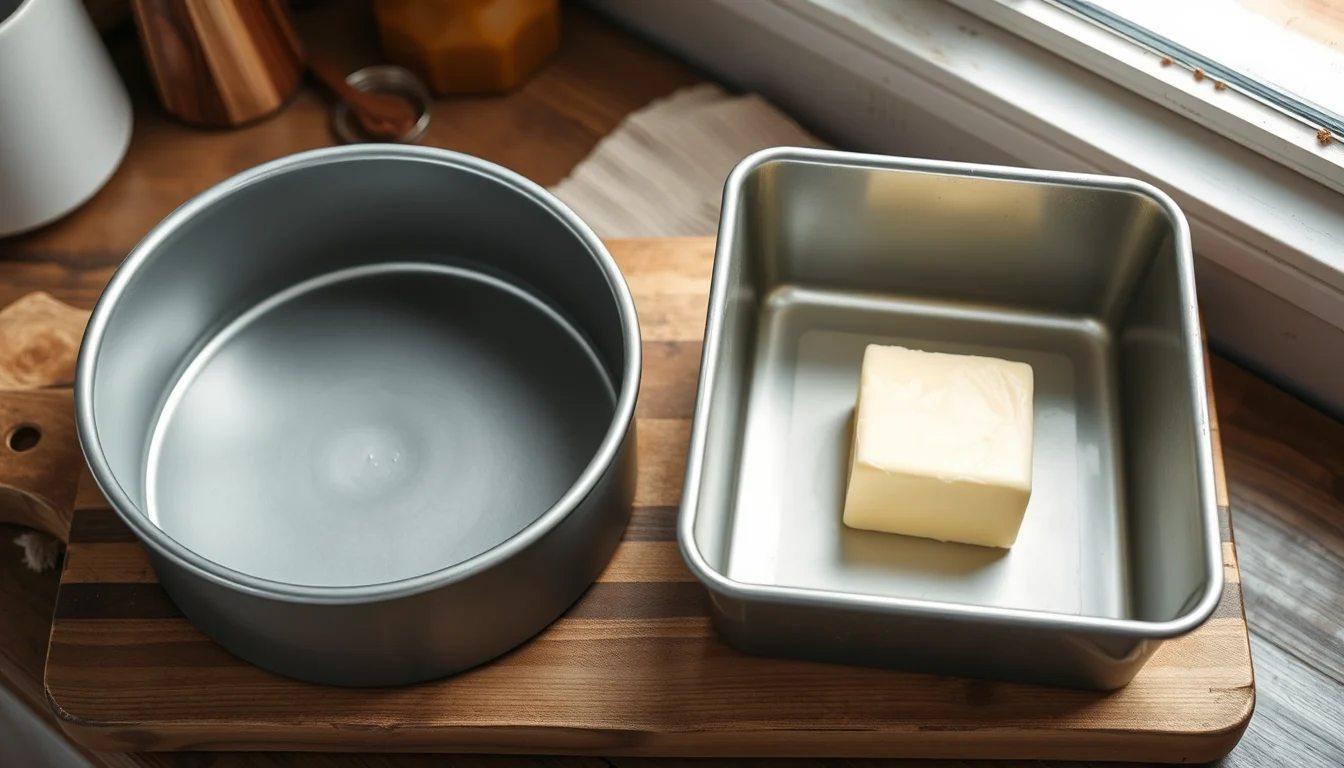
Work out the area of both pans, divide the new area by the original one, and multiply every ingredient by the result. A brownie recipe for a 9 in square pan, moved to an 8 in square, needs 0.79 times each ingredient. Scaling this way keeps the batter at the same depth, so you can leave the oven temperature alone and expect a similar baking time, checking a few minutes early or late depending on the size of the new pan.
The step people skip is the arithmetic of area. Pans that sound close in size can hold very different amounts of batter, and a cake baked at the wrong depth is where most pan-swap disasters come from: thin, dry layers on one side, and sunken, gooey middles or overflowing tins on the other.
Why area, not diameter
Batter spreads across the floor of the pan, so what matters is how much floor there is. For a round pan that is π × radius², for a square it is the side squared, and for a rectangle it is length × width.
Because area grows with the square of the size, small changes in measurement add up quickly. A 6 in round cake might sound like three quarters of an 8 in one, but its area is 28.3 in² against 50.3 in², so going from 6 in to 8 in means multiplying the recipe by 1.78, not 1.33. Get that wrong and the larger cake comes out only a little over half as deep as it should be.
Four common pan swaps
A 9 in square brownie recipe in an 8 in square pan
The cake pan size converter compares 81 in² with 64 in² and gives a factor of × 0.79. Bake the full recipe in the smaller pan instead and the batter sits × 1.27 as deep, which means a longer bake, an underdone centre and possibly an overflow. In metric kitchens the usual equivalent, a 23 cm square to a 20 cm square, comes out at × 0.76, because those two sizes are not quite the same ratio as 9 and 8 in.
A two-layer 8 in round cake baked as one 9 × 13 in sheet
The converter compares one pan with one pan. An 8 in round to a 9 × 13 in rectangle gives × 2.33, but a two-layer recipe already fills two 8 in pans, so divide by two: the whole recipe needs about × 1.16. Many bakers would pour the unscaled batter into the sheet pan and get a slightly thin cake that dries at the edges. The small increase keeps it at the same depth as the original layers.
An 8 in round sponge made as a 6 in cake
Going down from 8 in to 6 in gives × 0.56, a little over half the recipe. Halving it is close enough for most cakes, but the extra 6% matters in a tall, delicate sponge, and the recipe scaler handles the awkward amounts.
A 9 in round recipe in a 10 in round pan
A one-inch step up gives × 1.23. Baked unscaled, the cake would be about × 0.81 as deep, noticeably thinner and done sooner.
Try your own pans here. Leave the batter weight empty unless you know it:
Making the scaled amounts usable
Multiplying by 0.56 or 1.16 is easy for grams and awkward for everything else. Paste the ingredient list into the recipe scaler, set the factor, and it rounds each line to an amount you can actually measure.
Here is a classic 4-egg sponge scaled by × 0.56 for the 6 in version:
| Original | Scaled × 0.56 |
|---|---|
| 225 g butter, softened | 126 g |
| 225 g caster sugar | 126 g |
| 4 large eggs | 2¼ large eggs: beat 3 and use 112 g |
| 225 g self-raising flour | 126 g |
| 2 tbsp milk | 1 tbsp + ⅜ tsp |
The eggs are the only fiddly part. Beat three eggs together, weigh out 112 g, and keep the rest for scrambled eggs.
Cup recipes are harder. Scaling an American two-layer cake by × 1.16 turns 2 cups of flour into 2⅓ cups and ¾ cup of milk into ¾ cup + 1 tbsp + 2¾ tsp, and 2 eggs become 2⅓ eggs, measured by beating 3 and using 116 g. It works, but converting to grams once, using the cups to grams converter, makes every future scaling cleaner, a point why bakers weigh ingredients instead of using cups makes in more detail.
Time, temperature and pan type
- Keep the oven temperature the same. The depth is unchanged, so the heat needs the same time to reach the centre. Changing the temperature to compensate usually causes more problems than it solves.
- Adjust the timing a little. A much larger pan often needs a few extra minutes because the centre is farther from the edges; a much smaller one may be done a few minutes early. Start checking about ten minutes before the original time.
- Check depth as well as area. A 9 × 13 in pan is often about 2 in deep, while some round cake tins are only 1½ in. Scaling by area only works if the new pan has room for the batter at its original depth.
- Watch pan material. Glass and dark metal pans absorb and hold more heat than light aluminium, so edges brown faster.
- Know your oven. If the recipe gives a conventional temperature and you use a fan oven, see fan vs conventional oven temperatures before you preheat.
Test for doneness the usual way: a skewer in the centre comes out clean or with a few moist crumbs, and the top springs back when pressed lightly.
If you can’t scale the recipe
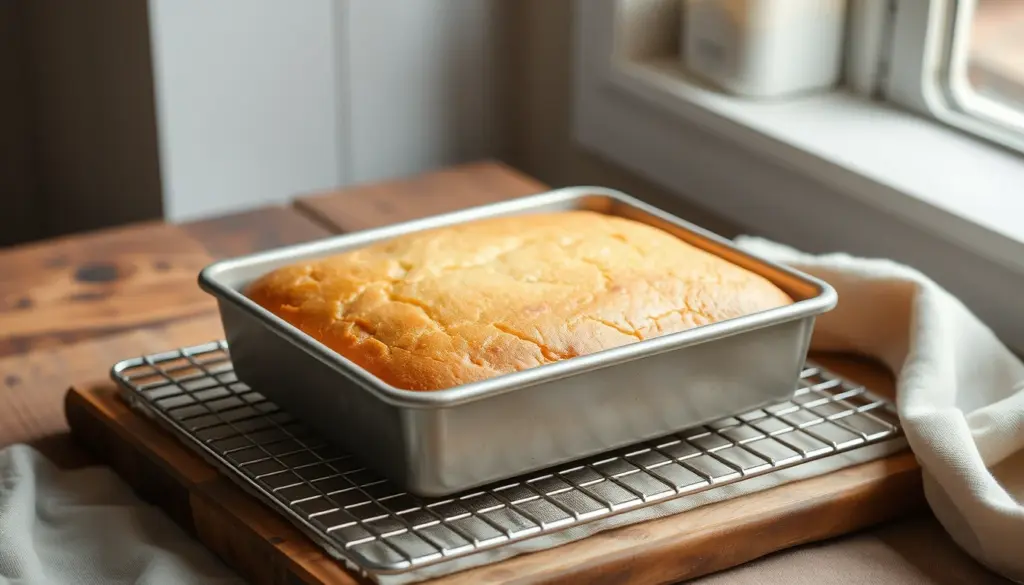
Sometimes scaling isn’t practical, perhaps because the recipe uses a whole can or packet of something. You can still bake the batter unscaled, as long as you adjust for the new depth.
- Shallower batter bakes faster. Keep the temperature and start checking well before the recipe’s time, perhaps two-thirds of the way through.
- Deeper batter needs longer, and the outside can overbake before the centre sets. Lower the oven by about 10 to 15 °C (25 °F), bake longer and check the middle with a skewer. Don’t fill any pan more than about two-thirds full.
The converter’s last line, which shows how much deeper or shallower the unscaled batter would sit, tells you which of these applies.
Mistakes that ruin a pan swap
- Scaling by diameter or side length. A 10 in pan is not 25% bigger than an 8 in one; it holds more than 50% more batter.
- Forgetting that a layer cake has two pans. Compare one pan with one pan, then account for how many the recipe fills.
- Overfilling. If the scaled batter comes more than about two-thirds of the way up the pan, it may overflow. Use a deeper pan or bake the extra as cupcakes.
- Rounding eggs carelessly in small cakes. In a 6 in sponge, an extra half egg changes the texture. Weigh the beaten egg.
- Using the same bake time without checking. Even with the depth right, a different pan and oven can shift the time.
Pan size questions
Can I turn a layer cake recipe into cupcakes?
Yes. Fill each liner about two-thirds full and bake at the same temperature for much less time, often somewhere around 18 to 22 minutes for standard cupcakes. A recipe for two 8 or 9 in layers usually makes roughly two dozen, but count as you fill rather than relying on a formula.
Does baking powder scale like everything else?
Within roughly half to double the original, yes. Multiply it by the same factor as the other ingredients. For very large increases, some bakers trim the leavening slightly, but that is rarely needed at home.
What if my pan is deeper than the original?
That is fine. The converter keeps the batter at the original depth, and taller sides simply leave more headroom. The cake may brown a little less at the edges because the walls shade it.