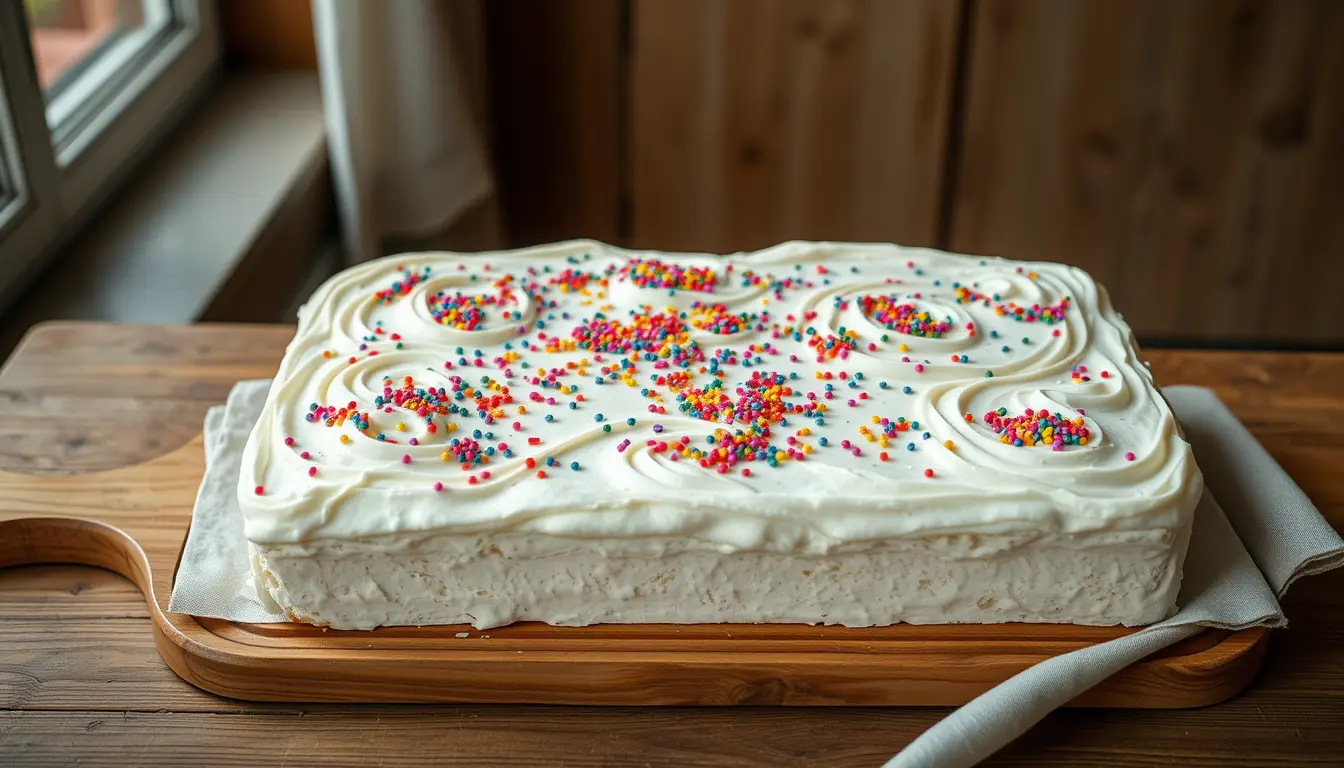
Whether you can double a 9×13 recipe for a half sheet cake depends on the pan. A deep 12 × 18 inch sheet cake pan, about 5 cm (2 in) tall, holds roughly twice the batter of a 9 × 13: the area ratio is about 1.85, so doubling the recipe works with a little room to spare. A standard rimmed half sheet tray, about 2.5 cm (1 in) deep, is a different story. A doubled recipe would overflow it, so it’s better suited to about 1 to 1¼ times a 9×13 recipe, which bakes into a thinner sheet cake. Either way, bake at a moderate temperature, rotate the pan halfway, and check the middle before the edges dry out.
In short:
- Doubling a 9×13 recipe: only in a deep 12 × 18 inch pan with sides of about 2 in (5 cm).
- A rimmed half sheet tray with a 1 in rim: use about 1 to 1¼ times a 9×13 recipe. A doubled recipe would overflow it.
Two pans called “half sheet”
The name causes most of the confusion. In bakeries, a half sheet cake is often baked in a deep, straight-sided pan of about 12 × 18 inches and 2 inches deep. In home kitchens, “half sheet” usually means the rimmed baking tray sold for roasting and cookies, about 13 × 18 inches on the outside with a 1 inch rim.
Measure your pan before you start. The inside size at the top of the rim is what counts, and on rimmed trays it’s often a little smaller than the size on the label because of the rolled edges.
Scaling by area
The cake pan size converter compares the pans by area:
| From | To | Area | Scale by | Unscaled batter would be |
|---|---|---|---|---|
| 9 × 13 in | 13 × 18 in (label size) | 117 → 234 in² | × 2 | × 0.5 as deep |
| 9 × 13 in | 12 × 18 in | 117 → 216 in² | × 1.85 | × 0.54 as deep |
| 9 × 13 in | 12 × 17 in (inside of a rimmed tray) | 117 → 204 in² | × 1.74 | × 0.57 as deep |
In metric, a 23 × 33 cm pan to a 30 × 43 cm tray gives × 1.7. If you weigh your batter, the converter does the rest: 1,300 g of batter for the 23 × 33 cm pan becomes 2,209 g for the larger tray.
These factors keep the batter at the same depth as in the 9 × 13. That’s exactly what you want in a deep 12 × 18 pan. In a 1 inch rimmed tray, though, the same depth is too much, as the next section shows.
How deep can the batter go?
A typical 9 × 13 cake recipe fills the pan to roughly 2 cm (¾ in) before baking and rises to around twice that. These are approximate figures that vary by recipe. A 2 inch deep pan has room for that rise. A 1 inch rim doesn’t.
As a rule of thumb, fill any cake pan no more than about half to two-thirds full. For a 1 inch rimmed tray, that means about 1.3 to 1.7 cm (½ to ⅔ in) of batter. Scaling a 9 × 13 recipe by about 1 to 1¼ gets you there, giving a thinner, quicker-baking cake that suits frosting in a single layer. Doubling the recipe for a rimmed tray risks batter spilling into the oven.
Doubling for a deep 12 × 18 pan
For the deep pan, the area says × 1.85. Rounding up to × 2 makes the arithmetic simple and leaves the batter only about 8% deeper than in the 9 × 13, well within a 2 inch pan. Here’s a basic vanilla sheet cake doubled with the recipe scaler:
| Ingredient | 9 × 13 | Doubled |
|---|---|---|
| All-purpose flour | 2¼ cups | 4½ cups |
| Sugar | 1½ cups | 3 cups |
| Baking powder | 1 tbsp | 2 tbsp |
| Salt | ½ tsp | 1 tsp |
| Butter, softened | ½ cup | 1 cup |
| Vegetable oil | ½ cup | 1 cup |
| Large eggs | 3 | 6 |
| Milk | 1¼ cups | 2½ cups |
| Vanilla extract | 2 tsp | 1 tbsp + 1 tsp |
For a rimmed tray, scale the same recipe by 1.25 instead and check the depth before baking.
Doubled batters can be too much for a stand mixer bowl. If yours is 4.5 to 5 quarts, it’s often easier to mix two single batches one after the other and combine them in the pan. How to halve or double a baking recipe covers when that’s worth doing.
Baking it evenly
A large, flat cake heats unevenly: the edges and corners cook faster than the middle. A few habits help.
- Use a moderate oven. Around 165 to 175 °C (325 to 350 °F) gives the middle time to catch up. These are approximate.
- Bake in the centre of the oven. Make sure there’s space around the pan for air to move.
- Rotate halfway. Most ovens have a hot side. Turn the pan 180° once the cake has set.
- Try cake strips. Damp fabric strips wrapped around the outside of a deep pan slow down the edges so the cake rises more evenly.
- Use a heating core in deep pans. A metal heating core, or an upturned, greased flower nail, set in the middle of a 2 inch pan conducts heat into the centre.
Bake time depends on depth more than area. A thin rimmed-tray cake may be done in about 20 to 25 minutes; a doubled cake in a deep pan often needs 35 to 50. Start checking early and test in the centre with a skewer, which should come out with a few moist crumbs.
Frosting a larger cake
A half sheet’s top is about twice the size of a 9 × 13, so plan on roughly double the frosting for the deep pan and about one and a half to double for a rimmed tray, depending on how thickly you spread it. For a buttercream recipe written in cups, the recipe scaler handles that doubling just as it does for the cake. Make the frosting while the cake cools and keep it covered so it doesn’t crust over before you use it.
Lining and turning out
Grease the pan and line the base with baking paper, leaving an overhang on the long sides. Large cakes are fragile, and the overhang lets you lift them out once cool. Many sheet cakes are simply frosted and served from the pan, which avoids the risk entirely.
Sheet cake mistakes
- Doubling for a 1 inch tray. The batter overflows or the cake domes over the rim.
- Measuring the label size, not the inside. Rolled rims make the usable area smaller.
- A hot oven. The edges dry out before the middle sets.
- Not rotating. One side browns, the other stays pale.
- Forgetting the frosting. A half sheet has about twice the top surface of a 9 × 13, so it needs about twice the frosting too.
For other shape changes, how to convert a cake recipe to a different pan size explains the area method, and turning a cake recipe into cupcakes covers individual portions.
Half sheet questions
How many servings does a half sheet cake give?
Cut into 5 cm (2 in) squares, a 12 × 18 inch cake gives about 54 pieces. Larger party slices of about 5 × 7.5 cm give around 36.
Can I double a 9×13 recipe in my rimmed half sheet tray?
No. A standard rimmed tray has a rim of only about 1 in (2.5 cm), and a doubled batter would rise over it and spill. Use about 1 to 1¼ times the 9×13 recipe in a rimmed tray, and save the doubled recipe for a deep 12 × 18 inch pan with sides of about 2 in (5 cm).
Can I bake a box mix in a half sheet pan?
Yes. Two boxes usually suit a deep 12 × 18 pan, while one to one and a half boxes suits a rimmed tray. Follow the depth rule rather than the box’s timing.
Should I bake two 9 × 13 cakes and join them instead?
That works well and avoids uneven baking. Trim the inner edges, place the cakes side by side and frost them as one.