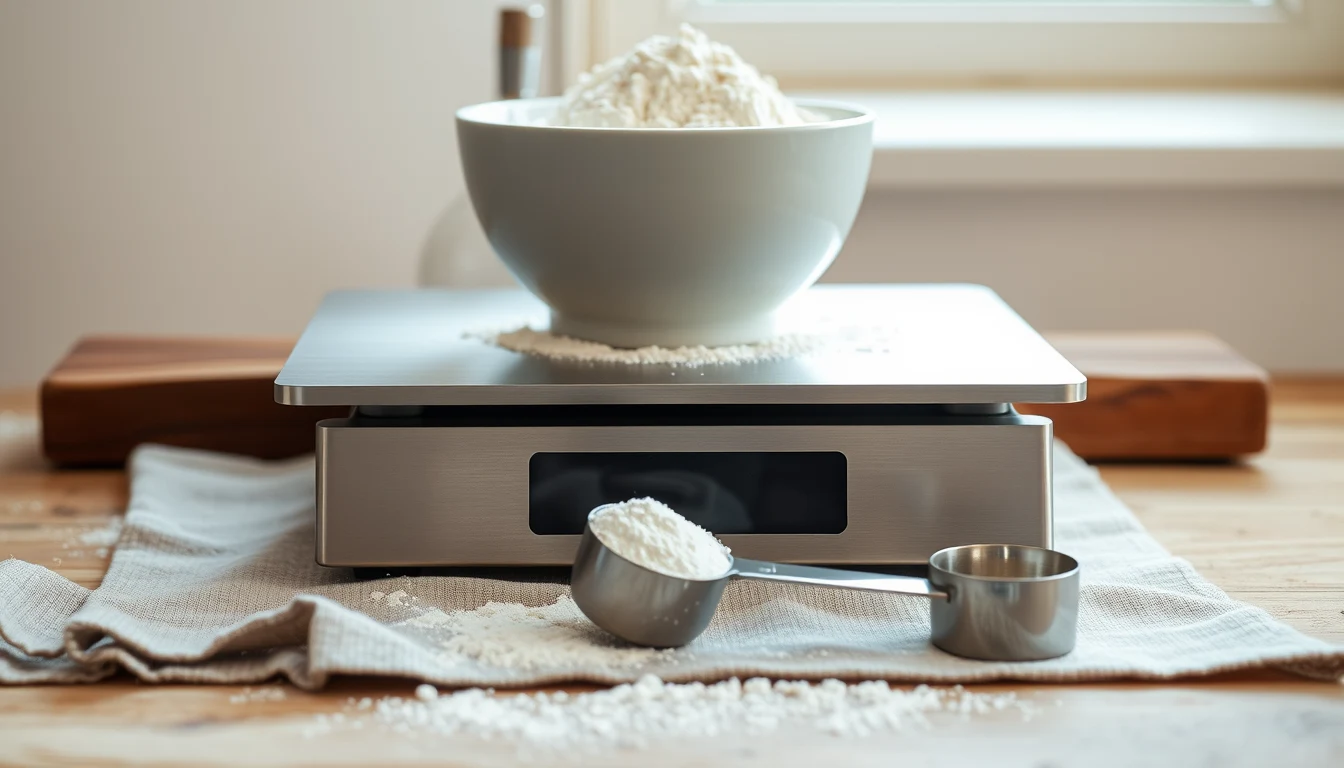
Because a cup measures space, and the amount of flour that fits in that space changes every time you fill it. A scale measures the flour itself, so 270 g is 270 g whoever is measuring and however the bag was packed. Accuracy is only part of the appeal, though. Weighing is also quicker, dirties fewer dishes and turns scaling a recipe into simple multiplication.
If you have ever made the same cookie recipe twice and got two different cookies, measuring is a likely reason. Here is what goes wrong with cups, with real numbers, and how to move to a scale without giving up the recipes you already love.
What goes wrong with a cup of flour
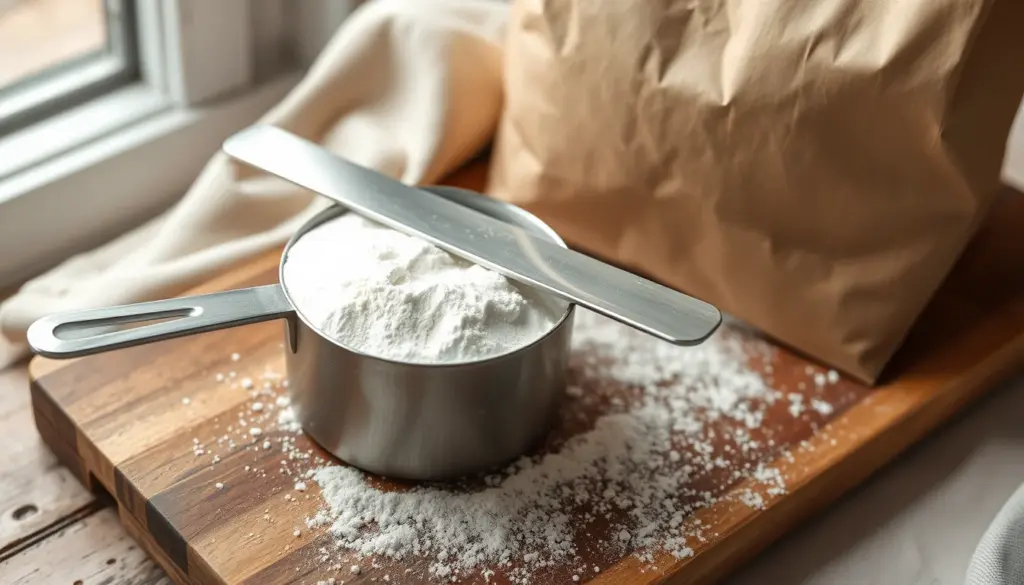
Flour is compressible. Spoon it loosely into a cup and level it off, and you get about 120 g of all-purpose flour, the figure used in the King Arthur Baking chart our converter relies on. Dip the cup into the bag and drag it up the side, and you press more flour into the same space.
Suppose your scooped cups come out at 145 g each, a realistic figure for flour packed in straight from the bag. A cookie recipe calling for 2¼ cups of flour expects 270 g. Scooped, it gets 326 g, which is 56 g too much, or nearly half a cup. The extra flour soaks up the butter and sugar, so the cookies spread less, bake up thick and cakey, and taste dry.
The problem isn’t carelessness. Two careful bakers using the same cup can differ by 20 g or more simply because one stirs the flour before measuring and the other doesn’t.
Bread takes an even bigger hit
With bread, the balance of water to flour is everything. Take a simple loaf written as 4 cups of bread flour and 1½ cups of water. Spooned and levelled, that is 480 g of flour and 355 g of water, a hydration of 74%. If the cups are scooped at 140 g each, the flour becomes 560 g and the hydration drops to 63%.
Those are two different breads. The first is a soft, open country loaf; the second is a firm sandwich dough. Dough hydration: what 65% vs 80% really means explains how much a ten-point gap changes. The water barely varies between measurements because liquids level themselves. All of the swing comes from the flour.
Small spoons, big swings
Measuring spoons have the same problem on a smaller scale, and for salt it is worse. A teaspoon of table salt weighs about 6 g, while kosher and flaky salts have much larger crystals and weigh far less per spoon, with big differences between brands. A recipe written with one salt and made with another can turn out bland or noticeably salty. By weight, 6 g of salt is 6 g of salt, whatever the crystal size.
Yeast is similar. In a slow dough that uses only a gram or two, a slightly heaped teaspoon can almost double the amount. Our guide to instant vs active dry vs fresh yeast gives the weights for common packets and spoons.
Converting a cup recipe once
You don’t need to abandon cup recipes. Convert each one once, write the grams in pencil beside the original measures, and from then on just weigh. Here is a classic chocolate chip cookie recipe converted with the cups to grams converter:
| Ingredient | US measure | Weight |
|---|---|---|
| All-purpose flour | 2¼ cups | 270 g |
| Butter | 1 cup (2 sticks) | 227 g |
| Granulated sugar | ¾ cup | 149 g |
| Brown sugar, packed | ¾ cup | 160 g |
| Baking soda | 1 tsp | 6 g |
| Table salt | 1 tsp | 6 g |
| Chocolate chips | 2 cups | 340 g |
Butter is the exception that proves the rule. US sticks are portioned by weight at the factory, so cutting along the wrapper lines is already a weight measurement: the butter converter puts 10 tablespoons at 142 g, or 1¼ sticks. Butter packed into a measuring cup is where it goes wrong, because air pockets get trapped.
More reasons bakers prefer grams
- Scaling is simple. One and a half times 270 g is 405 g. One and a half times 2¼ cups is 3⅜ cups, which nobody enjoys measuring.
- Baker’s percentages need weights. Once a recipe is in grams you can compare it with others and adjust it with confidence; see baker’s percentages explained simply.
- Fewer dishes. Set the bowl on the scale, press tare, add the flour, press tare, add the sugar. No stack of sticky measuring cups.
- Recipes travel. A metric cup is 250 ml, so a cup of bread flour in an Australian recipe is about 127 g rather than 120 g. Grams mean the same thing everywhere.
- Easier troubleshooting. When a bake goes wrong and you weighed everything, you can rule out measuring and look at time, temperature or technique instead.
Getting started with a scale
A basic digital kitchen scale is inexpensive and does everything a home baker needs. Look for:
- 1 g increments and a tare button.
- A capacity of at least 5 kg, so a heavy mixing bowl plus dough doesn’t max it out.
- A platform wide enough that the bowl doesn’t hide the display.
- Optionally, a small pocket scale reading to 0.1 g for yeast, salt and spices.
Weigh liquids too. Water is 1 g per ml, so there is no conversion to remember, and pouring straight into the bowl on the scale saves a measuring jug.
Test your own cup first
Before converting anything, it is worth seeing how you measure. Fill a cup with flour exactly the way you normally would, tip it onto the scale and note the weight. Do it three times. If your numbers land well above 120 g, or spread over 15 g or more from one try to the next, every cup recipe you have made has been carrying that variation. It is also a handy way to persuade a doubtful family member.
Common mistakes when switching
- Mixing up fluid ounces and weight ounces. A cup is 8 fluid ounces of space, but the all-purpose flour filling it weighs only about 4.2 oz. The two kinds of ounce only match for water and similar liquids.
- Forgetting to press tare. Weighing the sugar on top of the flour without resetting is the classic first-week error. Some bakers keep a running total instead; either works if you stick to one.
- Using a conversion from a different source. Charts disagree by several grams per cup of flour because they assume different filling methods. Pick one reference and stay with it.
- Converting half a recipe. Mixing grams for the flour and cups for everything else keeps half the original problem. Convert every line once.
Kitchen scale questions
How accurate does a kitchen scale need to be?
For flour, sugar, butter and liquids, 1 g resolution is plenty. For ingredients used in amounts under about 10 g, such as yeast and salt, a 0.1 g scale is worth having, because a single gram is a large share of the total.
Should I weigh eggs too?
For most recipes, the size printed on the box is close enough. A large egg is roughly 50 g without its shell. For delicate cakes, custards or when you are halving a recipe, weighing lets you use part of an egg accurately.
Do professional recipes still use cups?
Professional and bakery recipes are almost always written in grams. Many American home recipes still use cups, although more and more cookbooks and websites now list both.
Is a measuring jug good enough for water?
For most bakes, a clear jug read at eye level is fine. Weighing is still quicker, because you pour straight into the bowl and there is one less thing to wash.