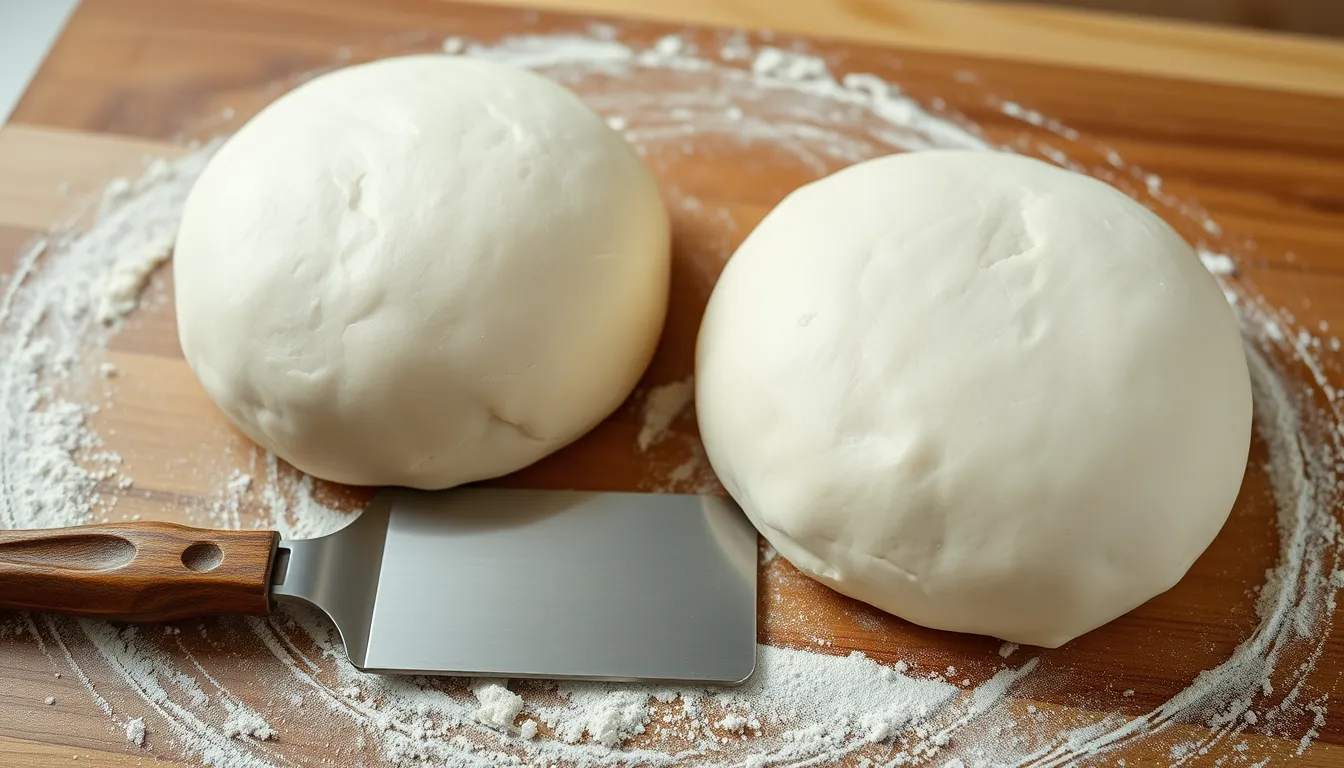
Shaping a boule takes about five minutes once you know the moves. In short:
- Tip the dough out onto a clean, very lightly floured counter at the end of bulk fermentation.
- Pre-shape it into a loose round and let it rest, uncovered, for 20 to 30 minutes.
- Flip it over, fold the edges into the centre to build a tight package, then turn it seam side down.
- Drag it toward you across the counter a few times to stretch the surface taut.
- Lift it into a floured basket, seam side up, and pinch the seam closed.
The rest of this guide explains each step, what the dough should feel like, and what to do when it doesn’t cooperate.
What shaping is for
Shaping gives the loaf its final form, but its real job is tension. By stretching the outer layer of dough tight, you create a skin that holds the gas in and pushes the loaf upward in the oven. A boule with good surface tension rises tall and opens along the score. One without it spreads, even if everything else went well. Flat sourdough loaf: common causes and fixes looks at the other reasons a loaf ends up low.
Shaping also evens out the gas. Big pockets get redistributed, so the crumb is more consistent from edge to edge.
Before you start
Check the dough is ready
Shape at the end of bulk, when the dough has risen by the amount your temperature calls for, feels airy, jiggles when you shake the container and shows bubbles at the sides. Shaping too early gives a tight, dense loaf; shaping too late gives a dough too weak to hold tension. For a closer look at each of those cues, see how to tell when bulk fermentation is done.
Get your tools together
You need a bench scraper, a proofing basket or a bowl lined with a tea towel, and some rice flour for dusting. Rice flour doesn’t absorb water the way wheat flour does, so the dough releases cleanly later.
Match the dough to the basket
A basket that is too big lets the dough spread; one that is too small forces it to spill over. As a rough guide, a round basket about 20 cm (8 in) across suits something like 700 to 850 g of dough.
The sourdough recipe builder works backwards from the weight you want. For one 800 g boule at 72% hydration, with 2% salt, 15% starter at 100% hydration and 10% whole grain, it gives 383 g of bread flour, 43 g of whole grain flour, 297 g of water, 69 g of starter and 9.2 g of salt. Change the loaf weight to fit your own basket:
Step 1: turn out and pre-shape
Tip the container upside down over the counter and let the dough fall out under its own weight. Help it along with a wet hand or the scraper if it sticks, but avoid pulling hard.
Now gather it into a rough round. The easiest way is with the bench scraper: slide it under one side of the dough and push it in a curve, rotating the dough a quarter turn as you go. The underside catches on the counter and the top tightens a little. Four or five passes is enough. You are not aiming for a perfect ball at this point, just a loose, even shape.
Step 2: the bench rest
Leave the round uncovered for 20 to 30 minutes. The gluten relaxes so that it can be stretched again without tearing, and the surface dries slightly, which makes it easier to handle.
Watch how it behaves. A dough that spreads into a flat puddle within ten minutes is either very wet or overfermented, and it needs a firmer final shape. One that barely moves is strong and can be shaped gently.
Step 3: the final shape
Lightly flour the top of the round, then flip it over with the scraper so the floured side is on the counter and the sticky side faces up.
Now fold it into a package:
- Gently stretch the bottom edge toward you and fold it up to the middle.
- Stretch the left side out and fold it over to the centre, then do the same with the right.
- Stretch the top edge away from you and fold it down over the rest.
- Roll the whole thing toward you so the folds end up underneath and the smooth side faces up.
Each fold should stretch the dough a little before it lands. That stretching is what builds tension.
Step 4: tighten the skin
With the smooth side up, cup your hands around the far side of the dough. Pull it toward you across the unfloured counter in short movements. The base grips the surface while the top stretches tight over it. Rotate a quarter turn and repeat three or four times.
Stop when the surface looks smooth and taut and the ball holds a tall, rounded shape. If the skin starts to tear, you have gone far enough.
Step 5: into the basket
Dust the basket with rice flour. Lift the dough with the scraper and one hand and lower it in upside down, so the smooth top sits on the bottom of the basket and the seam faces up.
Pinch the seam closed along its length. If it looks loose, “stitch” it: pull a little dough from each side across the middle, alternating left and right, like lacing a shoe. A sealed seam stops the loaf from bursting open along its base in the oven. The other reasons for a split are covered in why bread bursts on the side.
Cover the basket and proof at room temperature or in the fridge. When it is ready, turn it out onto parchment, score it and bake. Baking sourdough in a Dutch oven picks up from there.
When the dough won’t behave
It sticks to everything
Use wet hands or a wet scraper rather than more flour. A little flour on top of the dough before flipping it is fine, but flour on the counter under the final shape stops the base gripping and makes it impossible to build tension.
It tears as you shape it
The gluten hasn’t relaxed enough. Give the pre-shaped round another 10 minutes and try again, more gently this time.
It won’t hold any shape
The dough may be overfermented or too wet for your flour. Shape it as firmly as you can, get it into the basket quickly and plan a lower hydration or shorter bulk next time. Stretch and folds vs kneading helps if the dough lacks strength from the start.
Shaping mistakes
- Over-flouring the counter. The dough slides instead of gripping, and the skin never tightens.
- Skipping the bench rest. The gluten is still tight from pre-shaping and tears during the final shape.
- Pressing all the air out. Handle the dough firmly but gently. The goal is to organise the gas, not remove it.
- Leaving the seam open. It becomes the weak point that bursts in the oven.
- Shaping too tightly. A skin stretched until it tears loses its strength. Stop as soon as it looks smooth and taut.
Boule shaping questions
Do I have to pre-shape?
For a strong, fairly firm dough you can shape directly, but pre-shaping makes almost every dough easier to handle. It is especially helpful with wetter doughs, because the bench rest shows you how much support the final shape will need.
Rice flour or wheat flour for the basket?
Rice flour is the better choice because it doesn’t absorb water and turn gluey. A mix of half rice flour and half wheat flour also works. Plain wheat flour on its own is the most likely to stick.
Can I shape a boule without a basket?
Yes. Line a medium bowl with a clean, smooth tea towel, dust it generously with rice flour and use it exactly like a basket. Choose a bowl that the dough will fill to about two thirds.
How is shaping a batard different?
A batard is the oval version. You fold the dough into a rectangle, roll it up tightly from one short end and seal the seam, then place it in an oval basket. The idea of building surface tension is the same; only the shape of the package changes.