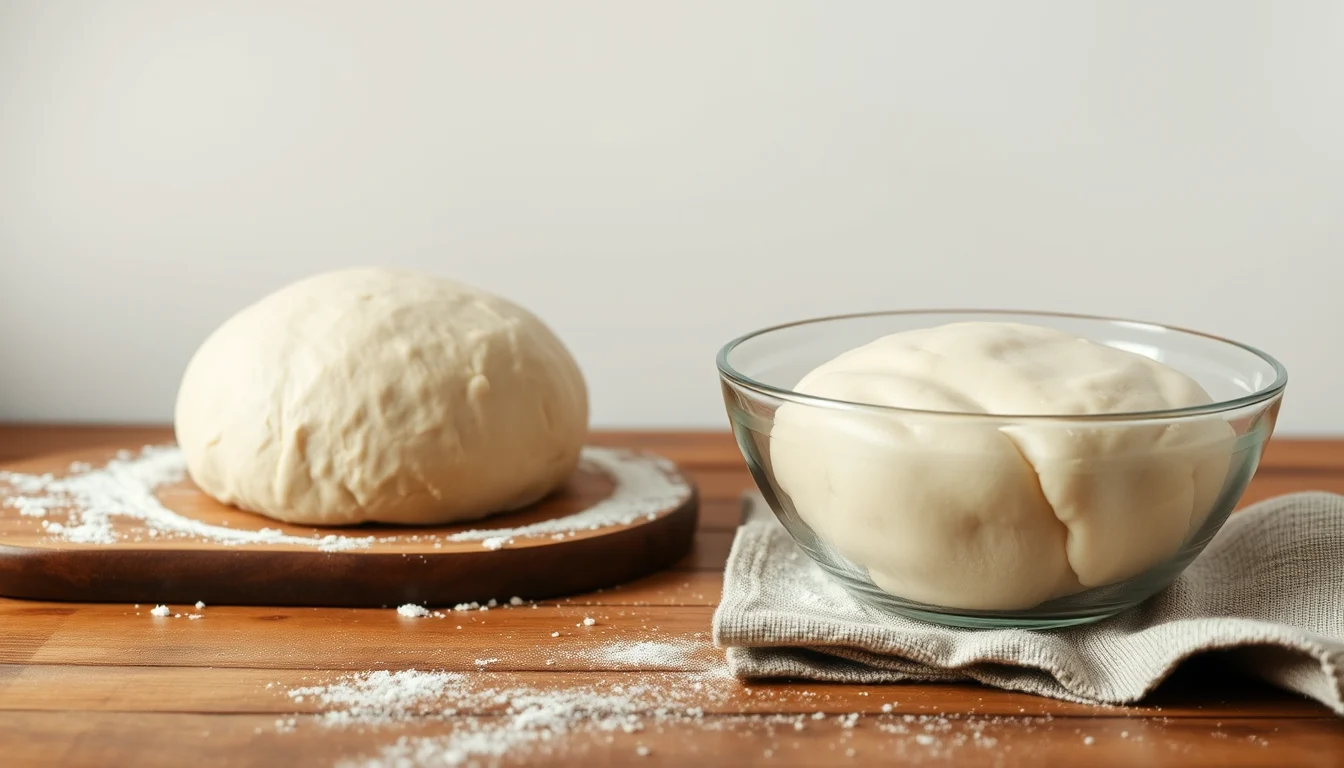
Both build the same thing: a gluten network strong enough to trap gas. Kneading does it quickly, with around ten minutes of steady work straight after mixing. Stretch and folds do it gradually, in a few short sessions spread across the first couple of hours of bulk fermentation, and let time do much of the work between them. Firmer doughs, roughly 60 to 68% hydration, knead easily and suit it well. Wetter doughs, from about 70% upward, are awkward to knead by hand and respond better to folds. Many bakers use a bit of both.
Neither method is more authentic, and the crumb you end up with depends far more on fermentation and shaping than on which one you pick. What changes is how the work feels, how long it takes and how easy the dough is to handle along the way.
What both methods are building
Wheat flour contains proteins that link up into gluten once they meet water. At first the strands are short and tangled. Working the dough stretches and aligns them into an elastic web; so does time, because as the flour absorbs water the network organises itself even when nobody touches it. That second effect is why a rest after mixing, or an autolyse, leaves a dough noticeably smoother without any extra effort.
A well-developed dough feels smooth, holds a rounded shape, springs back slowly when pressed and stretches thin before it tears. The windowpane test checks that last point: pull a small piece gently between your fingertips, and if it thins into a translucent film before it rips, the gluten is well developed. Kneading and folding are two routes to that same point.
Kneading: quick and hands-on
How to knead by hand
Press the dough away from you with the heel of your hand, fold it back over itself, give it a quarter turn and repeat. Keep a steady rhythm for 8 to 12 minutes. The dough starts rough and shaggy and gradually turns smooth and satiny. A stand mixer with a dough hook gets there in roughly 5 to 8 minutes on a low to medium speed.
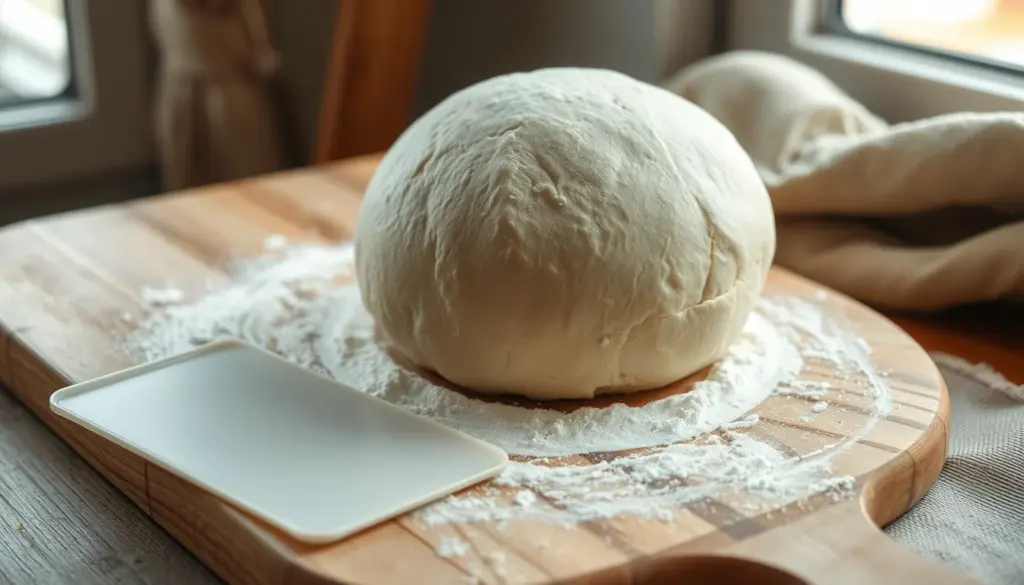
Resist dusting the counter with flour every time the dough sticks. A plastic scraper, a few pauses and a very light film of oil keep things moving without drying the dough out.
Where kneading makes sense
- Firm doughs. Bagels, pretzels, sandwich loaves and many pizza doughs sit at hydrations where kneading is comfortable.
- Enriched doughs. Brioche and milk bread need a lot of development to carry butter and sugar, and a mixer handles that best.
- Same-day yeasted bread. When bulk only lasts an hour or two, there is little time for folds to do their work.
The downsides are effort and warmth. Ten minutes of kneading warms a dough through hand heat and friction, which speeds up fermentation. That is useful in a cold kitchen and a nuisance in a hot one, where cooler mixing water offsets it, as the post on why dough temperature matters more than time shows.
Stretch and folds: slow and gentle
How to do one set
- Wet your hand so the dough doesn’t cling to it.
- Take hold of the edge furthest from you, lift it upward until you feel resistance, and lay it over the top of the dough.
- Rotate the container a quarter turn and repeat until you have folded all four sides.
- Cover the container and leave it alone for about 30 minutes before the next set.
A set takes under a minute. Most doughs need three to six sets before they hold a rounded shape, feel springy and stop spreading flat between sessions. Once they do, stop folding and let the dough rise undisturbed.
Variations worth knowing
- Coil folds. Lift the dough from the middle with both hands and let the ends tuck underneath. Gentler than a standard fold, and good for very wet dough.
- Lamination. Stretch the dough out thin across a damp counter once, early in bulk, then fold it back up. It builds a lot of strength in one go and is an easy moment to add seeds or other inclusions.
- Slap and fold. Lift the dough, slap it onto the counter and fold it over itself, repeatedly, for a few minutes. It is intensive work for wet doughs, closer to kneading than folding.
Fitting the folds into bulk
Folds belong in the first part of bulk fermentation, while the dough is still building strength. For a dough at 24 °C (75 °F) with 18% starter, the bulk fermentation estimator gives about 4 h 45 min to 6 h 30 min, and a rise target of about 50% to 75%. Four sets at 30-minute intervals finish around the two-hour mark, which leaves the second half of bulk for the dough to inflate without being pressed back down.
Letting hydration decide
The single best guide to which method will feel easier is the dough’s real hydration, counting the water inside the starter. A recipe can look moderate on paper and handle like a batter once the starter is included.
Take two sourdough recipes. The first uses 500 g of flour, 300 g of water, 100 g of starter at 100% and 10 g of salt. The sourdough hydration calculator puts it at a true hydration of 63.6%, or 60% if you ignore the starter. That dough is firm enough to knead on a bare counter without a struggle.
The second uses 450 g of flour, 340 g of water, 90 g of starter and 9 g of salt. The calculator reads 77.8%, or 75.6% ignoring the starter. Try to knead that by hand and most of it will end up on your fingers. Folds in the container, or a few minutes of slap and fold followed by folds, will get you a far better dough with less mess. Both doughs carry the same 18.2% starter, so the difference in handling comes almost entirely from the water.
Check your own recipe before you decide how to work it:
As a rough guide:
| True hydration | How the dough feels | Method that usually suits |
|---|---|---|
| 55 to 65% | Firm, smooth, barely sticky | Kneading, by hand or machine |
| 65 to 72% | Soft and tacky | Either; a short knead plus two or three sets of folds works well |
| 72 to 80% | Sticky and inclined to spread | Stretch and folds or coil folds |
| Above 80% | Close to a thick batter at first | Coil folds, with slap and fold or lamination early on |
Flour shifts these bands. Whole wheat and rye soak up more water, so a whole wheat dough at 75% can knead more easily than a white dough at 72%. Dough hydration: what 65% vs 80% really means goes into how each level behaves.
Combining the two
Many home bakers settle on a hybrid. Mix the dough by hand or in a mixer just until it comes together and starts to smooth out, a few minutes rather than ten, then give it two or three sets of folds in the first hour of bulk. You get most of the strength from the short mix and the rest from time, with less work than either method alone and a dough that is easier to read.
Common mistakes
- Flouring the counter to fight a sticky dough. Every handful lowers the hydration you planned. Use a scraper and wet or lightly oiled hands instead.
- Folding late into bulk. Folds in the last hours press out gas the dough has spent all morning building. Finish them early.
- Stretching until it tears. Stop at the first firm resistance. If the dough tears easily, it needs rest, not force.
- Giving a very wet dough too few sets. A slack dough that still spreads flat after two sets usually needs two more. Skipping them often shows up as a flat, heavy loaf; see why is my sourdough dense?.
- Judging strength right after mixing. Every dough feels weak at first. It becomes smoother over the first hour even without handling.
Folding and kneading questions
Can I skip both and still get good bread?
Yes. No-knead methods rely entirely on time: a long rest lets the gluten organise itself. The loaf is usually a little less structured and the dough slacker to shape, but it can still be very good bread.
Do my hands really need to be wet?
For sticky doughs, yes. A thin film of water stops the dough gripping your skin, so you can stretch it cleanly. Dry, floury hands pick up dough and add raw flour to the surface.
Does kneading or folding change the flavour?
Very little directly. Flavour comes mainly from fermentation time and temperature. Long, fast machine mixing can work in enough air to pale the crumb slightly, but that rarely happens in a home kitchen.
What if my dough still spreads after six sets?
Look beyond the folds. The dough may be wetter than the flour can manage, the starter may be weak, or bulk may have run too long. Lower the water a few points next time and check that the starter is peaking properly when you mix.