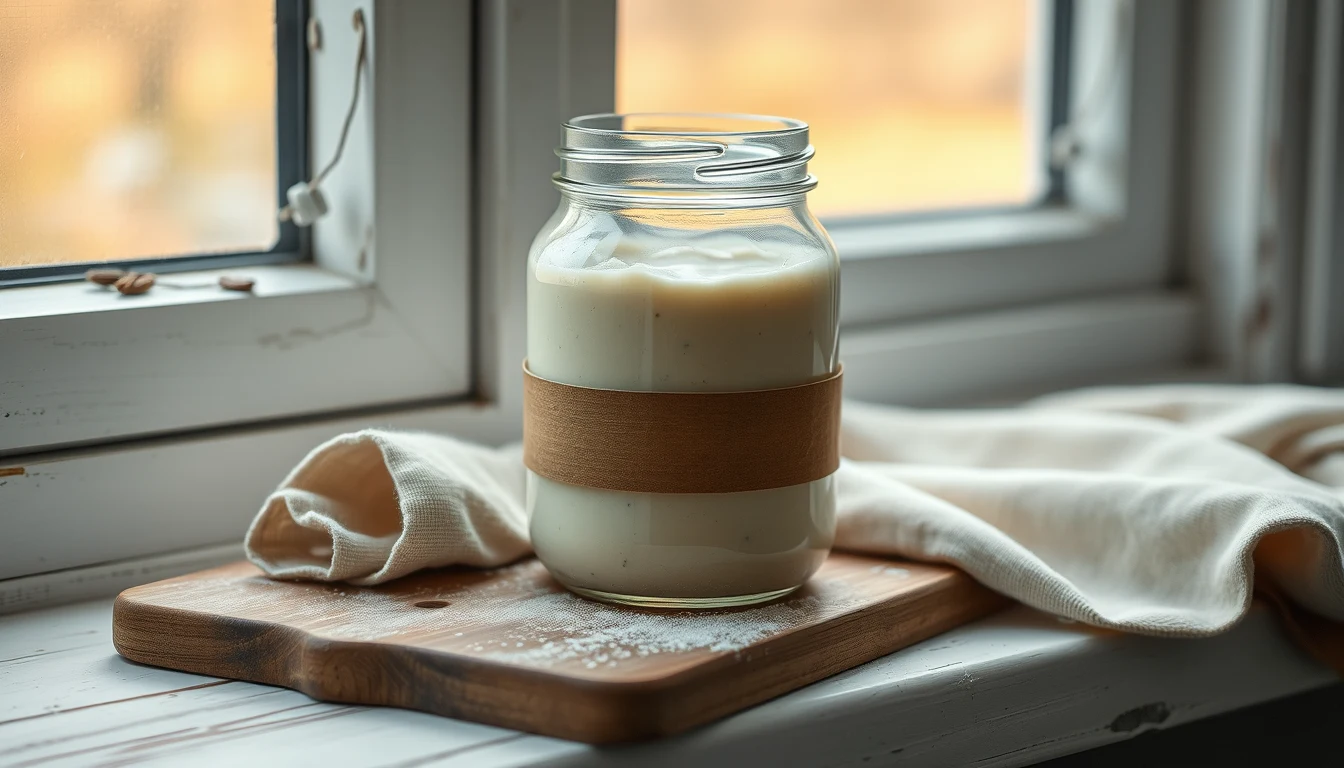
A starter that won’t rise is usually too cold, too young, or rising and falling while you aren’t looking. Check those three before anything else. Move the jar somewhere around 24 to 26 °C (75 to 79 °F), feed it at a ratio that fits the hours you actually have, and put a rubber band at the level right after feeding so you can spot a rise that has already collapsed. If the starter is less than two weeks old, patience is often the entire fix.
Genuinely dead starters are rare. Flour and water are forgiving, and almost every stalled jar comes back once the conditions are right. The sections below go through the causes in the order they tend to show up, with a fix for each.
A two-minute diagnosis
Before changing anything, answer these:
- How old is the starter? Under two weeks means it may simply still be establishing.
- How warm is the spot it lives in? Measure with a thermometer rather than guessing from the thermostat.
- What ratio was the last feed, and how many hours ago?
- Are there streaks or dried film on the glass above the current level?
- Is it thick like porridge, or pourable like pancake batter?
- Does it smell sour and yeasty, or sharp and vinegary, or of very little at all?
Keep your answers in mind as you read. Most jars match one or two of the causes below.
Cause 1: it is too cold
This is the most common reason by a wide margin. Yeast and bacteria slow down sharply as they cool, and a kitchen that feels comfortable to you can be slow going for a starter. The timing guide in the starter feeding calculator shows the scale of it. A 1:1:1 feed peaks in about 3 h 30 min to 5 h 30 min at 25 °C, but at 19 °C (66 °F) the same feed needs about 6 h 45 min to 10 h. A 1:5:5 feed at 19 °C can take about 12 h 15 min to 18 h 15 min. Check a cold jar after six hours and it will look lifeless even though it is working normally.
The fix is warmth, applied in two ways.
- Find a warmer spot. An oven with only the light switched on, the top of the fridge, a shelf near (not on) a radiator, or a small cool box with a jar of hot water beside the starter all work. Check with a thermometer first, because an oven light can push the inside well past 30 °C.
- Feed with warmer water. The desired dough temperature method, normally used for bread dough, works for a starter feed too. Count the room, the flour and the old starter as three of the four temperatures, choose the no-knead setting since stirring with a spoon adds almost no heat, and the result is the water temperature that brings the fresh mixture to your target.
Here is how that plays out in a 20 °C (68 °F) kitchen, where the flour and starter are also at 20 °C and you want the fed starter at 24 °C. The water temperature calculator asks for water at 36 °C (about 97 °F): 24 × 4 = 96, minus 20 + 20 + 20 + 0 = 60, leaves 36. If the jar comes straight from a 5 °C fridge instead, the same sum asks for 51 °C water and the calculator flags it as too hot for the culture. In that case let the jar sit out for an hour first.
Be realistic about what warm water can do. A small jar drifts back toward room temperature within an hour or two, so the water gives a head start while the warm spot does most of the work over the following hours.
Cause 2: it rose while you weren’t watching
At warm temperatures a 1:1:1 feed can peak in four hours and sink back down by the time you check it the next morning. From the outside, a starter that has risen and fallen looks the same as one that never moved. The clues are on the glass: a streaky, dried residue well above the current surface, a flat or slightly sunken top, and a sharper sour smell.
Mark the level with a rubber band every time you feed. If you keep finding streaks above the band, the starter is healthy and only the timing is off. Switch to a higher ratio so the peak lands when you are awake, as explained in what starter feeding ratios actually do.
Cause 3: it is still too young
Starters go through a noisy first week: a big bacterial burst around day 2 or 3, then several quiet days before the yeast population catches up. A jar in that quiet phase isn’t broken. It usually takes 7 to 14 days, sometimes longer in a cool kitchen, before the rise becomes dependable. Our day-by-day starter guide describes what each stage looks like.
Cause 4: it is too runny to hold gas
A very wet starter can be full of life and still barely rise, because gas bubbles break through the loose surface instead of lifting it. The telltale sign is lots of small bubbles on top, some foam, and very little change in height. Whole wheat or rye starters run thicker at the same hydration, so a white-flour starter at 100% can look surprisingly thin.
Stiffen it for a few feeds. In the starter feeding calculator, choose a custom ratio of 1 part starter, 2 parts flour and 1.5 parts water. For 100 g plus 20 g to keep, it returns 27 g of starter, 53 g of flour and 40 g of water, and shows the hydration after feeding dropping to 80%. A thicker paste traps gas, so the rise becomes visible again and easier to judge.
Cause 5: it is hungry and too acidic
A starter left unfed for several days at room temperature, or for weeks in the fridge, builds up acid and runs out of food. It often grows a layer of grey liquid, smells sharp, and turns thin because the acid and enzymes have broken down its structure. Yeast works poorly in that sour environment, so the first feed or two after a long gap may produce very little rise.
Pour off the liquid and give it a high-ratio feed, such as 1:5:5, which dilutes the acid along with the old culture. Repeat at room temperature until it peaks on schedule again, usually within two or three rounds.
Cause 6: the flour changed
Switching from whole grain to white flour all at once, moving to a bleached flour, or using a bag that has sat open for a long time can all slow a starter down. White flour isn’t a problem in itself, but the change removes a lot of the minerals and wild microbes the culture has been used to. Mix 10 to 20% whole rye or whole wheat into each feed for a few days and choose unbleached flour.
Cause 7: the jar is fooling you
In a wide jar, a doubling in volume shows up as a modest change in height. In a jar far too big for the amount inside, the rise barely registers at all. Neither means the starter is weak. A narrower, straight-sided jar filled about a third of the way makes the rise much easier to read.
When to start again
Start over only if you see fuzzy mould, or pink, orange or red streaks, which point to unwanted organisms. A sharp smell, grey liquid, a thin texture or a slow rise are all recoverable.
Starter rescue questions
Should I add sugar or honey to wake it up?
No. The culture feeds on sugars released from flour starch, so extra sugar doesn’t fix the real problem, which is almost always temperature, timing or acidity. It can also encourage a different balance of microbes than the one you want.
My starter bubbles but never doubles. Can I bake with it anyway?
If it reliably rises by half and domes at the top, you can, but give the dough more time and judge when bulk fermentation is done by the dough rather than the recipe clock. A few extra days of regular warm feeds usually produces a stronger starter and a better loaf.
Does the float test prove the starter is ready?
It can confirm that a spoonful holds a lot of gas, but a failed float doesn’t mean much. Very wet starters and whole grain starters often sink even at their peak. A predictable rise after each feed is a better test.
Can a starter die in the fridge?
Rarely. Even after a month or two of neglect, a starter usually recovers after several warm feeds. If it shows mould or coloured streaks, though, throw it out and start fresh.