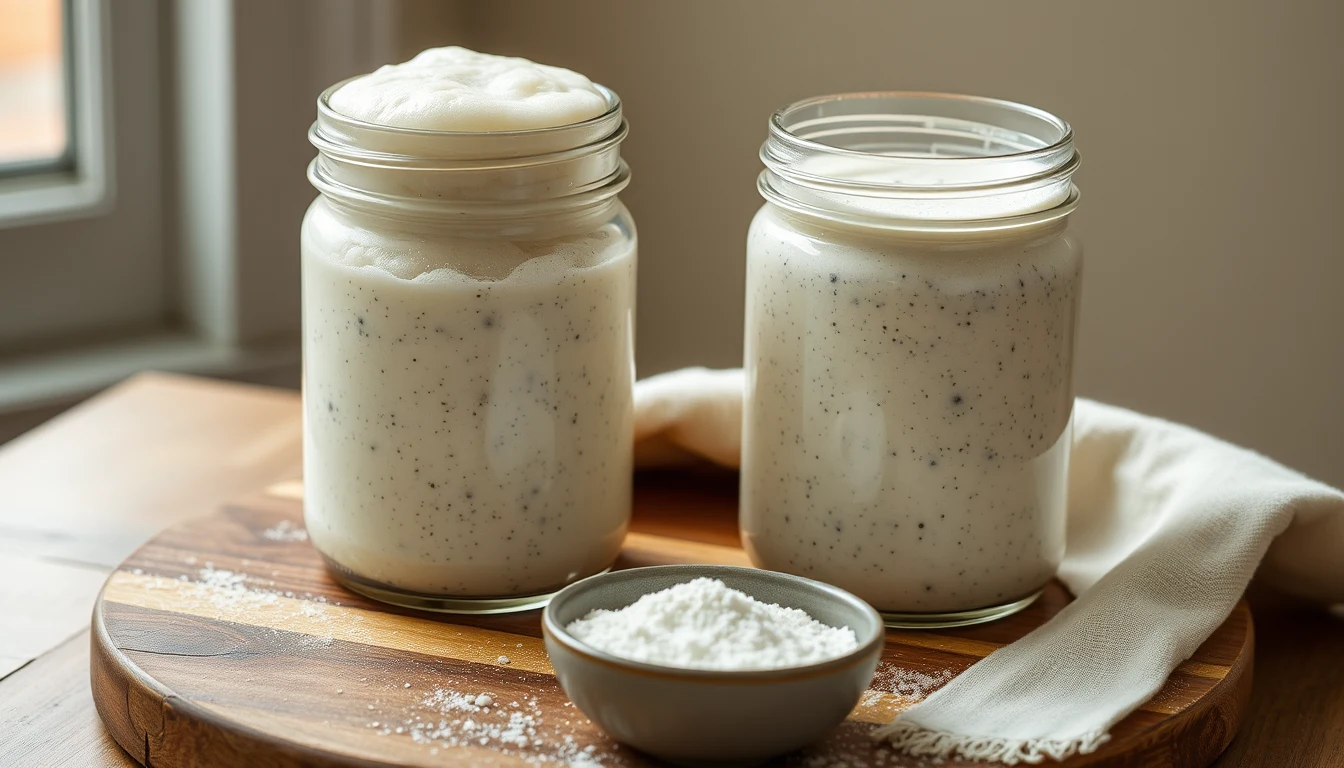
A feeding ratio is the weight of old starter compared with the fresh flour and water you mix into it. 1:1:1 means equal weights of all three. 1:5:5 means one part starter to five parts flour and five parts water. The main thing the ratio changes is time: the more you dilute the old starter, the longer the fresh mixture takes to reach its peak. A 1:1:1 feed suits a quick turnaround, while a 1:5:5 feed lets the same starter ripen across a workday or a night’s sleep.
The ratio also nudges acidity, flavour and how much discard you produce. Once you know what each number is doing, you can pick a ratio to fit your day instead of rearranging your day to fit the starter.
How to read the three numbers
The first number is ripe starter carried over from the jar. The second is fresh flour and the third is fresh water, all measured by weight. Add the three together and divide by the first, and you get the dilution: 3 for a 1:1:1 feed, 5 for 1:2:2, 11 for 1:5:5 and 21 for 1:10:10. In a 1:5:5 feed, the old starter is only one eleventh of the mixture.
That dilution drives two things at once. It sets how many yeast cells and bacteria start the job, and how much food each of them has. Fewer microbes with more food take longer to work through it.
When the second and third numbers match and your starter is kept at 100% hydration, the fed starter stays at 100%. When they differ, the hydration shifts. A 1:5:4 feed, for example, gives a stiffer starter of about 82%.
Same starter, four ratios
To see the effect clearly, keep everything else fixed. Your recipe needs 120 g of starter, you add 12 g as a buffer, and the kitchen is 23 °C (73 °F). The sourdough starter feeding calculator returns:
| Ratio | Starter | Flour | Water | Time to peak (guide) |
|---|---|---|---|---|
| 1:1:1 | 44 g | 44 g | 44 g | about 4 h 30 min to 6 h 45 min |
| 1:2:2 | 26 g | 53 g | 53 g | about 5 h 45 min to 8 h 45 min |
| 1:5:5 | 12 g | 60 g | 60 g | about 8 h to 12 h |
| 1:10:10 | 6.3 g | 63 g | 63 g | about 10 h to 14 h 45 min |
Every row ends at 132 g of fed starter, yet the timing nearly doubles from the first row to the third. Notice, too, that going from 1:5:5 to 1:10:10 adds only a couple of hours even though the dilution almost doubles again.
That pattern comes from how microbes grow. The population roughly doubles at a steady pace while food lasts, so doubling the amount of food only asks for about one more doubling of the population. Each step up in ratio adds a similar chunk of time rather than multiplying it.
What changes besides the timing
Acidity and flavour
Ripe starter is acidic. In a 1:1:1 feed, a third of the new mixture is that acidic starter, so the feed begins sour and gets sourer. At 1:5:5 the acid is spread through eleven parts, so the starter at its peak tends to smell milder and sweeter. Many bakers find that a gentler, less acidic starter gives a milder loaf and is kinder to the gluten in the dough, though bulk fermentation and cold proofing shape the final flavour more than the feed does.
How much ripe starter you need
At 1:1:1, the table above needs 44 g of ripe starter from the jar. At 1:5:5 it needs 12 g. A high ratio lets you keep a small jar and throw away much less discard, which matters if you feed every day.
Forgiveness
A slower feed changes more slowly near its peak, so an hour either way makes less difference to when you mix. A fast 1:1:1 feed on a hot day can rise, peak and begin to sink within one afternoon.
Choosing a ratio for your day
Start with when you want to use the starter, then choose the ratio that gets it there at your kitchen’s temperature. Some combinations that work, using the calculator’s guide:
- Feed at breakfast, mix by early afternoon, around 23 °C: 1:1:1 or 1:2:2.
- Feed before work, mix after dinner, around 23 °C: 1:5:5, which peaks in about 8 h to 12 h.
- Feed at bedtime, mix after breakfast, around 22 °C: 1:3:3 (about 7 h 30 min to 11 h 15 min) or 1:5:5 (about 9 h to 13 h 30 min).
- Overnight in a hot 27 °C summer kitchen: even 1:5:5 peaks in about 5 h 15 min to 8 h, so 1:10:10 at about 6 h 30 min to 9 h 45 min is the safer choice.
- A cold 19 °C winter kitchen: a plain 1:1:1 already takes about 6 h 45 min to 10 h, so there is little reason to go higher for an overnight feed.
Enter your own amounts, ratio and room temperature to see the weights and the peak window for your kitchen:
The time to peak is an estimate for an active starter. A young starter, or one that has been sitting in the fridge, usually runs slower until it has had a few regular feeds. If yours falls well behind the guide, work through sourdough starter not rising? causes and fixes.
Levain ratios work the same way
Recipes that call for a levain usually give a ratio of starter to fresh flour, such as 1:5, along with a hydration. At 100% hydration that is the same thing as a 1:5:5 feed. When the levain’s hydration differs from your starter’s, or you want a share of rye or whole wheat in it, the levain builder adjusts the fresh water so the result matches the recipe’s hydration.
Common ratio mistakes
- Reading the numbers backwards. In 1:5:5, the one is the starter. Five parts starter to one part flour would barely be a feed at all.
- Jumping to a high ratio with a weak starter. A young or sluggish culture diluted 1:10:10 may never reach a proper peak. Build strength with a few 1:1:1 or 1:2:2 feeds first.
- Measuring the small part by eye. At 1:10:10 the starter in the example is 6.3 g, and a few grams either way changes the dilution a lot. A scale solves this; see why bakers weigh ingredients instead of using cups.
- Keeping one ratio all year. The same feed can peak hours earlier in July than in January. Adjust the ratio with the seasons rather than waiting longer or setting an alarm.
Feeding ratio questions
Does a 1:5:5 feed make my bread less sour?
Usually a little milder, because the starter carries less acid into the dough. If you want a tangier loaf, a longer cold proof and a stiffer starter have a bigger effect than the feeding ratio.
Can I feed once a day at a high ratio instead of twice at 1:1:1?
Yes, and many bakers who keep their starter at room temperature do exactly that. At 22 °C a 1:10:10 feed takes about 11 h to 16 h 30 min to peak, so a single daily feed keeps the starter from sitting hungry for long.
Is a feeding ratio the same as the starter percentage in a recipe?
No, they describe different things. The ratio describes how you feed the starter; the percentage describes how much finished starter goes into the dough compared with the flour. Baker’s percentages explained simply covers how that second number works.
Is there anything wrong with always feeding 1:1:1?
Not at all, especially in a cool kitchen. It just gives you a short window in warm weather and a more acidic starter, and it uses more ripe starter for every feed.