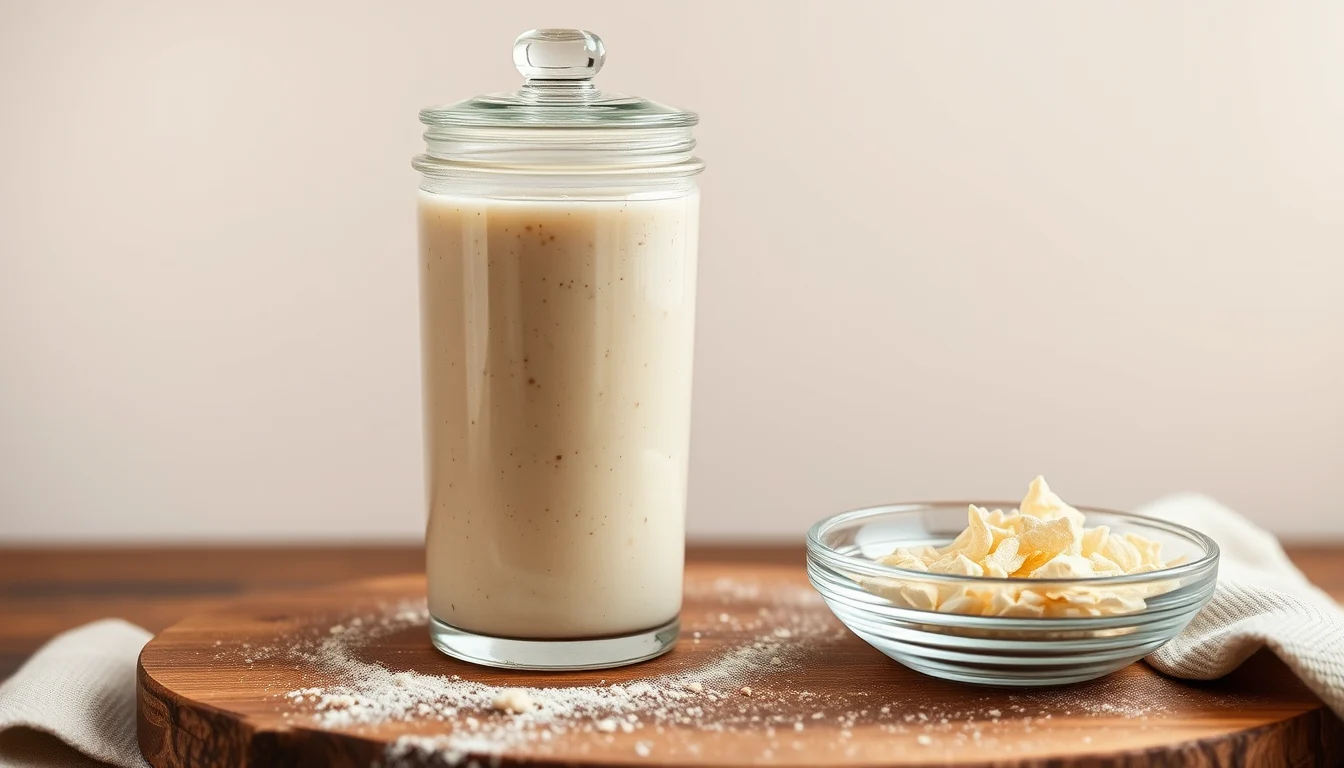
For most home bakers, the fridge is the answer. A fed starter kept cold will sit contentedly for one to two weeks between feeds, and it is ready to bake with again after a feed or two at room temperature. If you are going away for a month or more, or you simply want insurance, dry a few spoonfuls into flakes: dried starter keeps for many months in a sealed jar. Freezing works too, but revival tends to be slower and less predictable, so treat it as a fallback rather than your main plan.
All three methods do the same job in different ways. They slow the yeast and bacteria until they barely eat, and they wait for you to bring back food and warmth when you want the culture working again.
Picking the right method
| Method | Best for | How long it keeps | Back to full strength |
|---|---|---|---|
| Fridge | Baking every week or two | 1 to 2 weeks per feed, often longer | 1 to 2 feeds, about a day |
| Dried flakes | Long breaks, a spare copy, sending to a friend | Many months, sealed and cool | 3 to 7 days of feeds |
| Frozen | Long breaks when drying is not practical | Several months | Several days, sometimes longer |
These are typical figures, not promises. An established starter copes with every method far better than a young one, so give yours a few weeks of steady, predictable rises before you put it away for any length of time.
Keeping a starter in the fridge
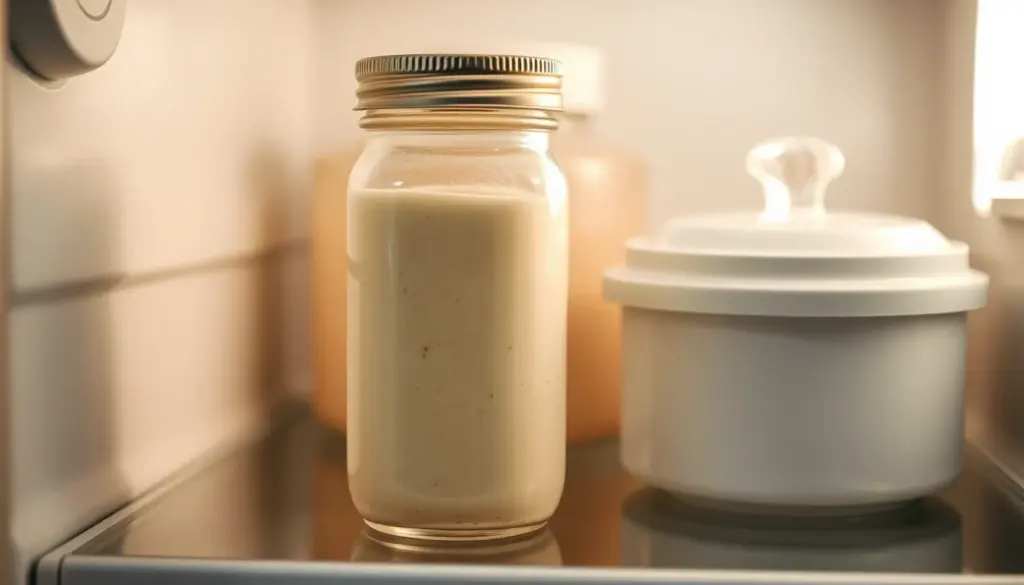
Cold does nearly all the work here. At a normal fridge temperature of about 4 °C (39 °F), fermentation slows to a crawl. The microbes keep eating, only very slowly, which is why a weekly or fortnightly feed is enough to keep them healthy.
Set the jar up for storage
A small, stiff starter keeps better in the cold than a large, runny one. A firm paste ferments more slowly than a batter-like one, so it works through its food and builds acid at a gentler pace. Keeping only a small amount also means less to throw away when you next feed it.
Say you want 60 g in the jar at about 60% hydration. In the sourdough starter feeding calculator, enter 60 g, no extra, and a custom ratio of 1 part starter, 2 parts flour and 1 part water. It returns 15 g of starter, 30 g of flour and 15 g of water, with the hydration after feeding at 60%. Work it into a firm ball in a clean jar, give it about an hour on the counter to get going, then close the lid and move it to the fridge.
How often to feed it
Once a week is a comfortable routine, and a stiff starter will usually cope with two. Beyond that, it survives but grows hungrier and more acidic, and it needs an extra feed or two before it behaves normally. To feed without baking, keep 15 g, mix a fresh batch exactly as above and use the rest as sourdough discard. There is no need to wait for it to rise before it goes back in the fridge.
Waking it up for a bake
Straight from the fridge, a starter is cold, sour and slow, so plan on two feeds before it goes into dough. The first feed wakes the culture up. The second builds exactly the amount your recipe needs, timed to peak when you want to mix.
Here is a Saturday morning bake using the stiff storage starter above, in a kitchen at about 22 °C (72 °F):
- Friday, 1 PM: the wake-up feed. Take 15 g of cold starter and add 15 g of flour and 15 g of water, a 1:1:1 feed. Set the current starter hydration to 60 and the calculator shows 85% after feeding, with a peak in about 5 h to 7 h 15 min. A starter fresh from the cold often needs the full window or a little longer.
- Friday, around 8 PM: the build feed. For a recipe that needs 150 g of starter, with 20 g more left behind in the jar, feed 1:5:5 overnight. At 21 °C the calculator gives 15 g of starter, 77 g of flour and 77 g of water, peaking in about 10 h to 15 h.
- Saturday, between about 6 AM and 11 AM: mix the dough once the starter has doubled and domed.
Why two feeds rather than one big one? A week of cold storage leaves the jar sour as well as sluggish, and each feed dilutes that acid before the starter meets your flour. If it still lags after the second feed, give it a third, and if it keeps dragging, the troubleshooting guide for a starter that won’t rise covers the other usual suspects.
Enter your own storage starter, recipe amount and kitchen temperature to plan both feeds:
Drying a starter
Drying takes away the water the microbes need to stay active, and many of them survive in a dormant state for a long time. That makes a dried starter the best long-term backup, and it is how bakers often share a culture by post.
- Start with a ripe starter. Feed it as usual and wait until it has peaked, so the jar is full of lively yeast.
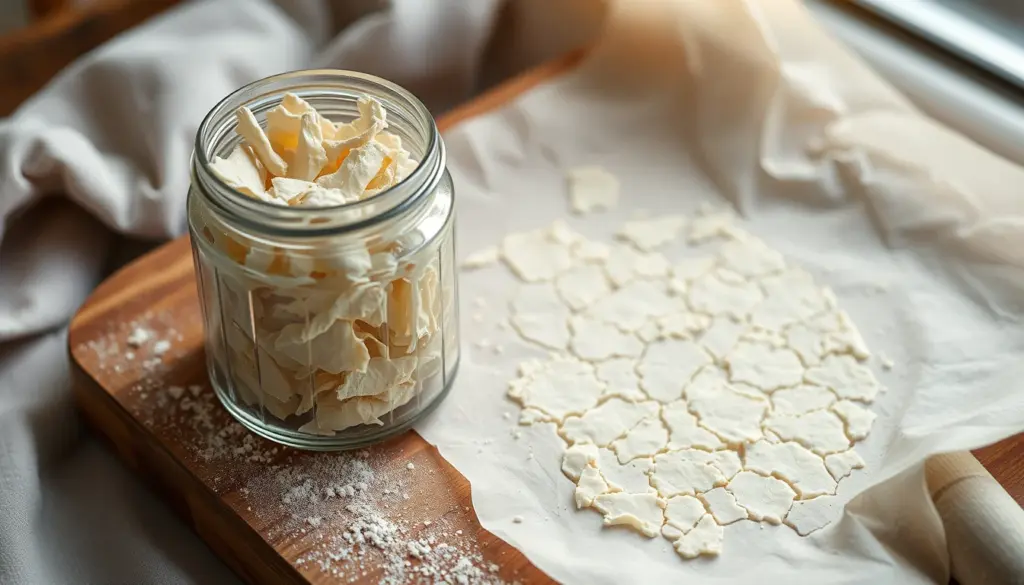
- Spread it thin. Use a spatula to smear a few spoonfuls as thinly as you can across a sheet of baking paper. A thin film dries quickly and evenly, while thick patches can stay damp in the middle and go mouldy.
- Let it dry in the air. Leave it at room temperature, out of direct sun, for one to three days until it is brittle and lifts off the paper in sheets. Skip the oven, since most cannot hold a temperature low enough to be safe for yeast.
- Break it into flakes. Crumble it by hand, or pulse it briefly in a blender for a coarse powder.
- Seal it away. A small, dry jar or zip bag in a cool, dark cupboard keeps it for many months. Write the date on it.
Bringing dried starter back
Weigh 10 g of flakes into a jar, pour over 20 g of lukewarm water and let them soften for 30 minutes to an hour, stirring now and then. Stir in 10 g of flour to make a paste, and keep the jar somewhere warm, around 25 °C (77 °F) if you can manage it. The flakes are mostly flour, so this lands close to 100% hydration. From the next day, feed it once or twice a day at 1:1:1.
Expect a few quiet days. The first sign of life is usually a scattering of bubbles after a day or two, followed by a proper rise somewhere between day three and day seven. Once it doubles on a predictable timetable, it is ready for bread.
Freezing a starter
Freezing is the least reliable of the three, because ice crystals damage some of the yeast cells as they form. Plenty of bakers still revive frozen starters without trouble, and it takes less effort to set up than drying.
- Freeze a small portion. 20 to 30 g of a healthy starter that has recently peaked is plenty.
- Make it stiff if you can. A firm starter has less free water to turn into ice.
- Pack it well. Use a small airtight tub, or press it flat in a thick freezer bag, and date it.
- Thaw it slowly. Move it to the fridge overnight, then feed it at room temperature once or twice a day until it rises on schedule again. Allow up to a week.
If you have the time, keep one dried batch and one frozen batch. Two backups stored in different ways are safer than one.
What a starter looks like after storage
- Grey or brownish liquid on top. Hungry starters push out a layer of alcohol and water, often called hooch. Pour it off for a milder jar or stir it back in for more tang, then feed.
- A sharp, solvent-like smell. Common after a long rest, and it fades within two or three feeds.
- A slack, sunken texture. Acid and enzymes have loosened the paste. Fresh flour firms it up again.
- Pink, orange or fuzzy patches. These mean spoilage. Throw the jar away and bring out your backup.
Storage mistakes to avoid
- Keeping a huge jar. A large starter needs a large feed to revive and produces a lot of discard. Around 50 to 60 g is plenty for a home kitchen.
- Sealing a just-fed jar airtight. Some gas still forms in the cold. Close the lid, but not so hard that pressure has nowhere to go.
- Mixing dough with a starter straight from the fridge. A cold, acidic starter leads to a slow, heavy dough; why is my sourdough dense? goes through the knock-on effects.
- Relying on one copy. A dropped jar or a forgotten month can end a starter. A spoonful of dried flakes costs almost nothing to keep.
- Losing track of the date. A strip of tape on the lid with the last feed day tells you how much waking up the jar will need.
Starter storage questions
Can I leave a starter on the counter while I’m away for a few days?
Only if someone can feed it. At room temperature a starter needs food roughly daily. For a long weekend away, the fridge is the safer choice, even if you skip the stiff storage feed.
Do I have to keep the fridge starter stiff?
No. A 100% starter keeps in the cold as well; it just gets hungry sooner and tends to separate. If a weekly feed suits you anyway, store it at whatever hydration your recipes expect.
Will a dried or frozen starter taste the same when it comes back?
Close to it, though not guaranteed. The balance of yeast and bacteria can shift during storage and revival, and your own flour and kitchen shape it again over the following weeks. Most bakers notice little change in the finished bread.
Can I dry discard instead of ripe starter?
You can, but starter dried at its peak carries more active yeast than discard from a hungry jar. Dried discard often revives, just more slowly, so use ripe starter when you are making a backup on purpose.