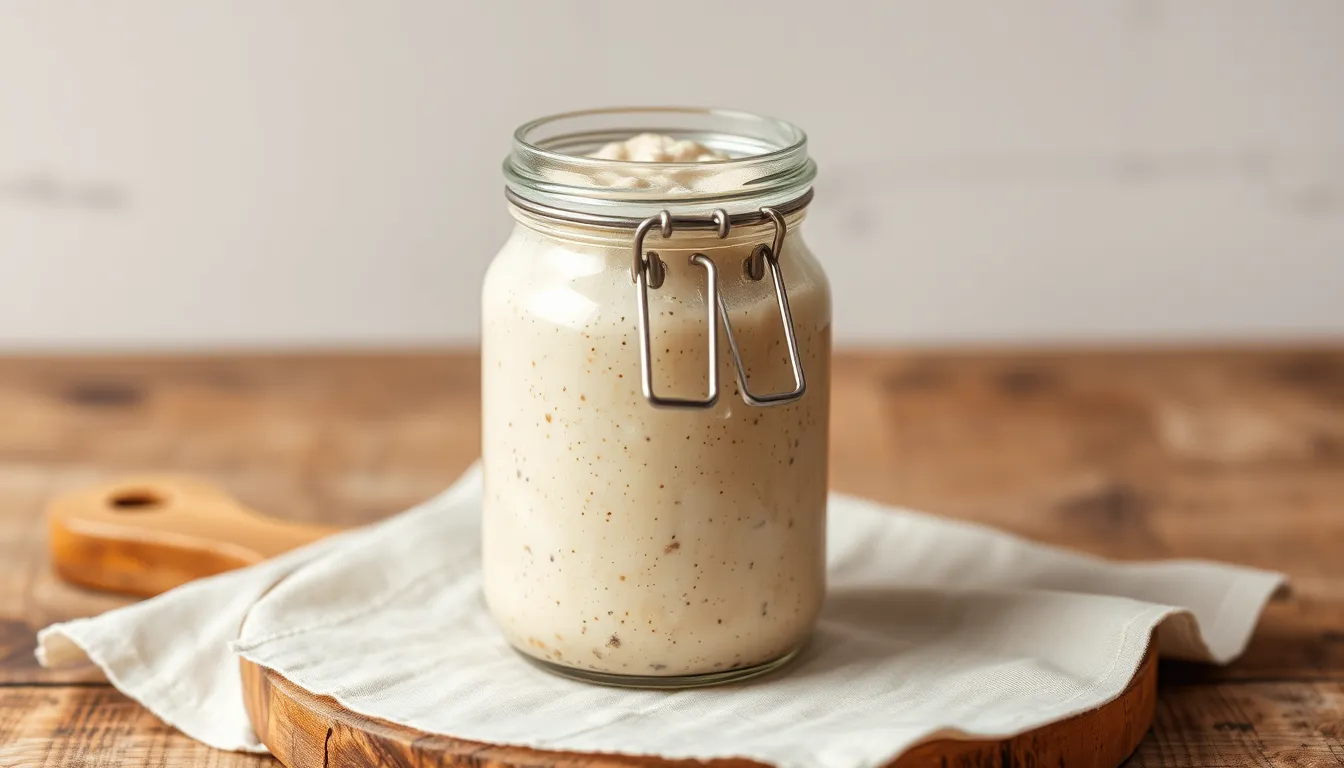
Most starter smells are normal, and they tell you where the culture is in its feeding cycle. Yogurt, sour cream or a gentle vinegar note means it is healthy. Nail polish remover or strong alcohol means it is hungry. A sharp vinegar smell means it has been too cool, too stiff or unfed for a while. Cheesy, sweaty or even sick-like smells are common in young starters and fade within a week or two.
A smell on its own almost never means you need to throw a starter away. The signs that do are things you can see: pink, orange or red streaks or patches, and fuzzy mould. More on those below.
Why a starter smells at all
A starter is a crowded little ecosystem. Wild yeast and lactic acid bacteria eat the sugars in the flour and give off gas, alcohol, acids and a whole range of aromatic compounds. The mix changes as the food runs out, as the temperature changes and as the culture matures. Your nose is picking up that shifting balance.
Because the smell changes through the day, it helps to sniff at the same point each time, such as just before a feed, so you are comparing like with like.
A quick smell guide
| What you smell | What it usually means | What to do |
|---|---|---|
| Yogurt, sour cream, buttermilk | Healthy, near its peak | Use it or feed it as normal |
| Apples, fruit, beer | Active yeast, at or just past its peak | Use it soon or feed it |
| Sharp vinegar | Cool, stiff or long since fed | Feed more often, keep it a little warmer |
| Nail polish remover | Very hungry | Feed at a higher ratio |
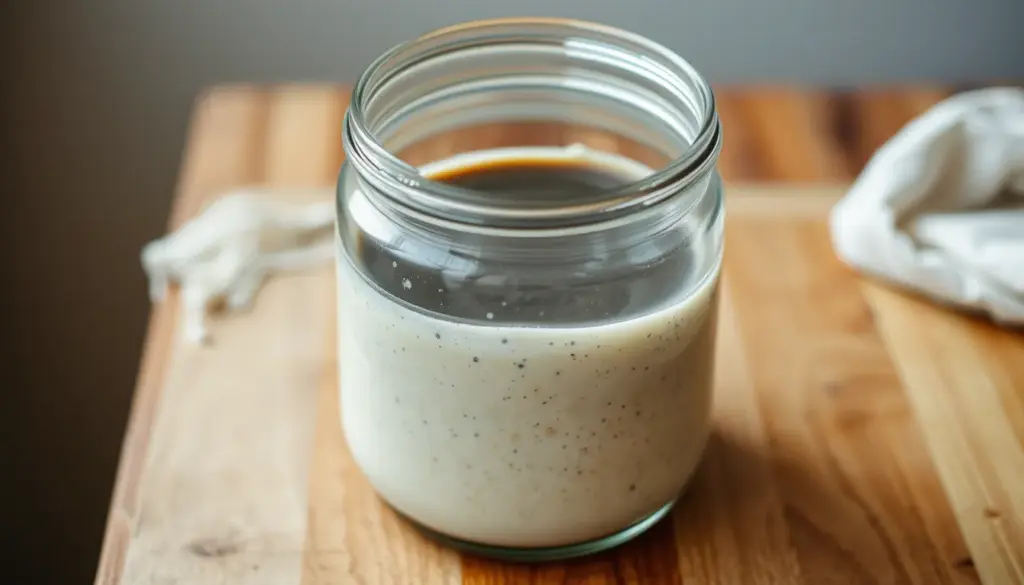
| Strong alcohol, with grey liquid on top | Hungry, food ran out | Pour off the liquid and feed |
| Cheese, sweaty socks, vomit | A young starter settling in | Keep feeding on schedule |
| Rotten eggs | Occasional in young starters | Keep feeding and watch for other signs |
| Just flour and water | Freshly fed, or too cold to get going | Give it time and warmth |
Acetone and alcohol: a hungry starter
When the yeast and bacteria run out of fresh flour, they start producing more alcohol and other by-products, and the smell turns sharp and solvent-like. It is especially common in warm kitchens, where a starter can peak and crash within a few hours of a 1:1:1 feed.
The fix is more food relative to the amount of old starter, so it lasts longer between feeds. Say you need 80 g of starter for a loaf tomorrow and want 20 g left in the jar, and your kitchen is at 23 °C (73 °F). The sourdough starter feeding calculator gives 33 g each of starter, flour and water for a 1:1:1 feed, with a peak in about 4 h 30 min to 6 h 45 min. Switch to 1:4:4 and it asks for 11 g of starter with 44 g each of flour and water, and the peak moves out to about 7 h 30 min to 11 h 15 min.
The same 100 g of fed starter now has four times as much fresh food per gram of old culture. It rises more slowly and gently, and it is far less likely to be sitting there hungry and smelling of nail polish when you come back to it. Plan a feed with your own numbers:
A higher ratio also dilutes the acids already in the jar, so after two or three feeds at 1:4:4 or 1:5:5 the smell usually turns milder and more yogurty. What starter feeding ratios actually do goes further into the trade-offs.
Vinegar: cool, stiff or neglected
A sharp, vinegary smell comes mostly from acetic acid. Cultures make more of it when they are cool, when they are kept stiff with little water, and when they sit for a long time after peaking. It isn’t a fault, and some bakers like the tang it brings to bread.
If you want to soften it, keep the starter a little warmer, around 24 to 26 °C (75 to 79 °F), feed it at 100% hydration or slightly wetter, and use it closer to its peak.
Cheesy and sweaty: a young starter
In the first week or so after you mix flour and water, all sorts of bacteria compete for space before the familiar sourdough culture takes over. Some of them produce smells that are frankly unpleasant: old cheese, sweaty socks, even vomit. This is normal. As the environment becomes more acidic, those early organisms die back and the smell settles into something sour and yeasty.
Keep feeding on a steady schedule and resist the urge to start again. How to make a sourdough starter from scratch, day by day explains what to expect in each phase.
After a spell in the fridge
A starter that has been in the fridge for a week or two often smells boozy and sharp, with a layer of liquid on top. It is simply hungry and cold. Pour off the liquid, feed it and let it come back to room temperature. It should smell like itself again within a feed or two.
When something is actually wrong
Smells can be dramatic, but they are rarely the problem. These are the signs that the culture has been taken over by something you don’t want:
- Pink, orange or red streaks or patches. A pink or orange tinge anywhere in the starter, on the surface or through the paste, points to bacteria that shouldn’t be there.
- Fuzzy mould. Raised, furry spots on the surface, often white, green, blue or black. Mould is textured; it looks like tiny cotton wool, not a flat film.
- A foul smell that doesn’t change with feeding. A starter that still smells rotten after several days of regular warm feeds, and shows no rise at all, has likely lost its culture.
Some things look alarming but are harmless. Grey, brown or even nearly black liquid on top is alcohol, not mould. Dried starter on the inside of the jar can look crusty and discoloured. A dark layer on the surface of an unfed starter is usually just oxidised paste; stir it in or scrape it off.

When to start over
Throw the starter away if you see any pink, orange or red colour, or any fuzzy mould. Don’t try to scoop off the affected part and rescue the rest. By the time something is visible, it has usually spread further than you can see.
Wash the jar and any spoon or spatula in hot, soapy water, rinse well and let them dry. Then mix a new starter, or wake up a backup if you have one. A spoonful of dried starter kept in a cupboard is cheap insurance; how to store a sourdough starter explains how to dry some.
If your starter smells fine and looks fine but won’t rise, it doesn’t need replacing. The guide to a starter that won’t rise works through the usual reasons.
Smell-related mistakes
- Starting over because of a bad smell. Unpleasant smells in the first two weeks are part of the process.
- Feeding more often at the same low ratio. If it smells of acetone after a 1:1:1 feed, feeding 1:1:1 twice as often is hard work. Raising the ratio is simpler.
- Sealing the lid tight. Gas builds up and the jar can smell stronger than it is. Rest the lid on top or leave it slightly loose.
- Ignoring the jar. A crust of old starter around the rim can harbour mould. Move the starter to a clean jar every week or two.
Starter smell questions
Should I stir the liquid back in or pour it off?
Either works. Stirring it back in keeps the water, but makes the next feed more sour. Pouring it off gives a milder result and thickens the starter slightly. Most bakers pour it off.
Does a sour-smelling starter make sour bread?
It helps, but less than you might think. The bread’s flavour depends more on how long and how cool the dough ferments than on the starter’s smell on the day. A sharp starter used at its peak often bakes into a fairly mild loaf.
Can I tell by smell when it is ready to use?
Smell is a useful extra clue. At its peak a healthy starter usually smells pleasantly sour and a little sweet or fruity. Look at the rise and the bubbles as well, since smell alone can mislead you in a warm kitchen.
Why does my starter smell different after I changed flour?
Different flours feed the culture differently. Rye and whole wheat bring more minerals and nutrients, so the starter ferments faster and often smells earthier and more sour. The smell settles after a few feeds on the new flour.