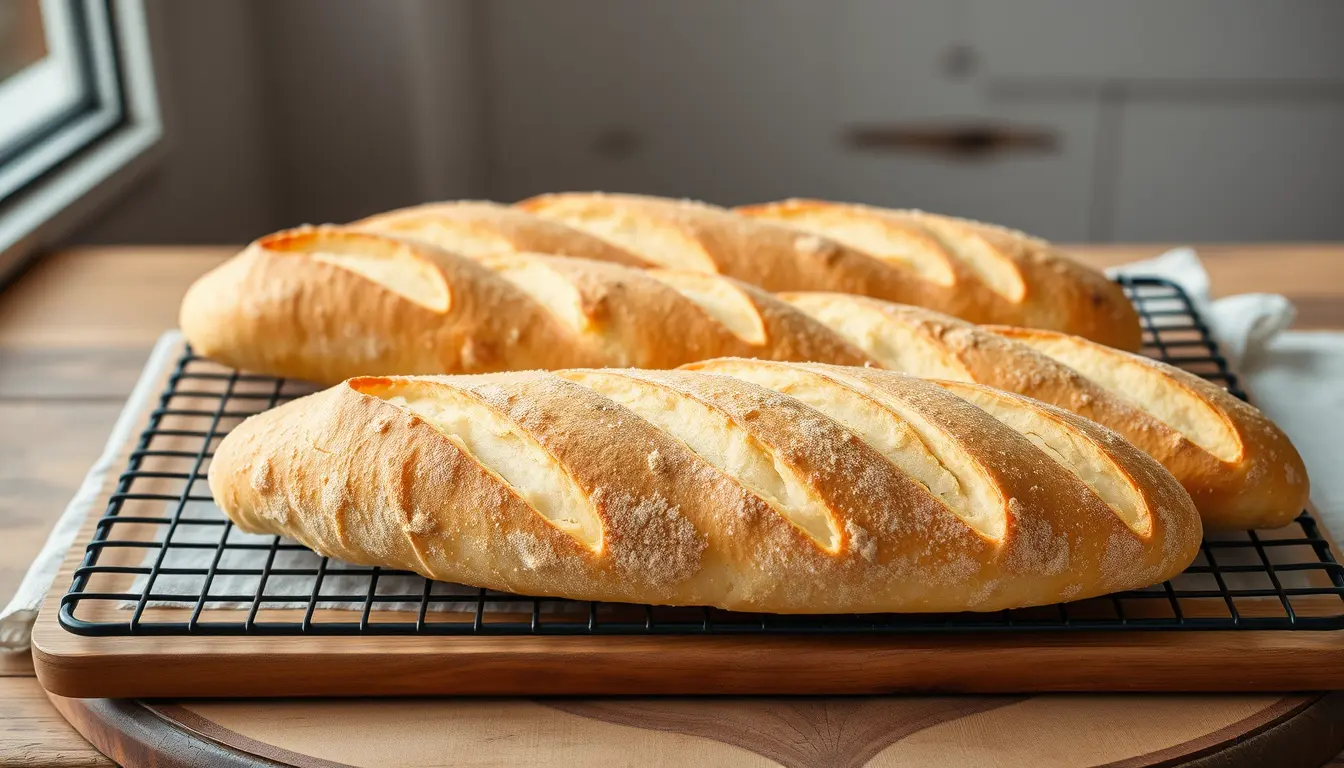
A sourdough baguette comes down to four things: a dough around 70 to 72% hydration, a gentle pre-shape into a short log, a final shape rolled tight and even to the length your oven can take, and long, shallow cuts that run almost along the loaf rather than across it. Proof the shaped baguettes in the folds of a floured cloth so they keep their height, give them plenty of steam, and bake them hot. Everything else is practice, and baguettes reward it quickly because you get three tries per bake.
Why baguettes are harder than a boule
A boule hides small shaping faults. Its round, tight skin holds the dough up, and a single cut gives the oven spring somewhere to go. A baguette has a much larger surface for its weight, so it dries out faster, bakes faster and shows every uneven patch. If one end is fatter than the other, it bakes unevenly. If the skin is slack, the loaf spreads sideways instead of rising. If the cuts are too deep or too square, the loaf opens like a row of separate buns instead of producing the raised, curling “ears” baguettes are known for.
The good news is that the dough itself is not exotic. Any well-fermented sourdough of moderate hydration will do. Very wet doughs, the kind that suit an open boule, are hard to roll into an even rope, so most home bakers settle between 68 and 72%.
Sizing the dough for your oven
Measure the longest straight line on your baking surface first. Most home ovens take a loaf of about 35 to 38 cm (14 to 15 in), a little more if you bake diagonally on a stone or steel. Three baguettes of about 350 g each fit that length well and bake side by side on a large tray.
To build that batch, enter 3 loaves at 350 g into the sourdough recipe builder with 72% hydration, 2% salt, 20% starter at 100% hydration and no whole wheat. It returns:
| Ingredient | Amount |
|---|---|
| Flour | 543 g |
| Water | 374 g |
| Ripe starter | 121 g |
| Salt | 12 g |
| Total dough | 1,050 g |
Inside those 121 g of starter sit 60 g each of flour and water, which is why the 72% figure rests on totals of 603 g of flour and 434 g of water. That detail matters when you compare recipes, because a recipe that ignores the starter’s water can look drier on paper than it really is.
If you’d rather check a recipe you already use, the sourdough hydration calculator works the other way round. A formula of 500 g flour, 340 g water, 100 g starter at 100% and 10 g salt reads 68% if you divide water by flour alone, but 70.9% once the starter is counted. With a target of 72% it suggests 346 g of water, just 6 g more. Small numbers like that are a reminder that the starter carries more water than people expect, a point dough hydration: what 65% vs 80% really means covers in more depth.
Bulk fermentation
Mix, rest, then give the dough three or four sets of stretches and folds in the first two hours. Baguette dough needs a little more strength than a rustic loaf, because the final shape stretches it into a long rope and a weak dough tears. Bulk is finished once the dough looks about 50% bigger, feels airy and has a domed, bubbly surface, which is often 4 to 6 hours at about 24 °C (75 °F), depending on your starter. If you’re unsure how to read those signs, see bulk fermentation: how to tell when it’s done.
Pre-shaping: a short log, not a ball
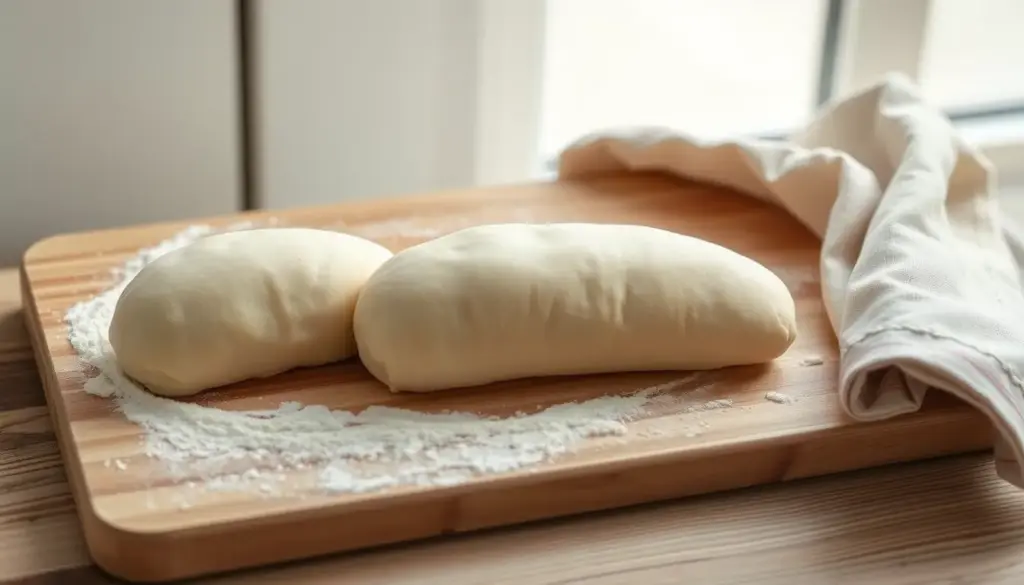
Divide the dough into three equal pieces by weight. Instead of rounding them, as you would for a boule, fold each piece into a loose rectangle and roll it gently into a short, fat log about 15 cm (6 in) long. Place it seam up, cover it, and rest it for 20 to 30 minutes. The rest lets the gluten relax, so the final shape stretches rather than snaps back.
The final shape, step by step
- Turn a log seam side up and press it gently into a rectangle, keeping most of the gas in the dough.
- Bring the long edge furthest from you a third of the way toward you, then seal it down with the heel of your hand.
- Turn the piece around and fold the other long side over to the middle, sealing again.
- Fold the whole piece in half lengthways and seal the seam firmly along its full length. You now have a tight cylinder.
- Roll the cylinder under both palms, starting in the middle and moving outward, to stretch it to length. Keep the pressure light and even. Finish with firmer pressure at the very ends to taper them.
If the dough resists before it reaches full length, cover it and wait five minutes, then roll again. Forcing it tears the skin, and a torn skin will not hold its shape in the oven.
Proofing in a couche
A couche is a heavy linen cloth dusted with flour. Lay the baguettes on it seam up and pull the cloth up into a pleat between each one, so every loaf sits in its own channel and can only rise upward. A floured tea towel over a rolled-up cloth or two does a similar job.
Proof for roughly 45 minutes to an hour at room temperature, or cover well and refrigerate overnight. The overnight route suits many bakers: the flavour deepens and a cold, firm baguette is much easier to score cleanly. Cold retard: proofing sourdough in the fridge explains how long that can safely run.
Scoring a baguette
Baguette cuts are different from the cuts on a round loaf. They run nearly parallel to the length, each cut starting where the previous one finished and overlapping it by about a third. Each cut sits close to the centre line, not across the loaf. For a 35 cm baguette, three to five cuts of 8 to 10 cm usually look right.
Two details make the difference. First, hold the blade at a low angle so it slices under the skin rather than straight down; this creates the flap that lifts into an ear. Second, keep the cuts shallow, often around 5 mm deep. Deep cuts on a thin loaf open too far and flatten it. For blade choice, angle and the general mechanics of scoring, the guide to scoring goes through the basics.
Steam and baking
Heat the oven to 250 °C (480 °F) with a stone, steel or heavy upturned tray inside for at least 45 minutes. Transfer the baguettes on a flipping board or a strip of parchment, score, and load them quickly. Add steam for the first 10 to 12 minutes, using a tray of boiling water on a lower rack or a covered roasting tin over the loaves. Then vent the oven, lower it to about 240 °C (465 °F) and bake for another 10 to 15 minutes, until the crust is a deep golden brown. Baguettes are thin, so they finish faster than you might expect, often in 22 to 28 minutes in total.
Let them cool on a rack for at least 20 minutes. The crust crackles as it cools, which is a good sign.
Common baguette mistakes
- Skipping the pre-shape rest. Dough that hasn’t relaxed fights the rolling and ends up short, thick and uneven.
- Pressing out all the gas. Firm, even pressure is right; flattening the dough like pizza is not.
- Uneven rolling. A thin middle and fat ends means the middle burns while the ends stay pale.
- Cutting across the loaf. Straight, crosswise cuts make the loaf look segmented and stop it from rising evenly.
- Too little steam. The crust sets before the loaf can expand, and the cuts stay closed.
- Overproofing. An overproofed baguette spreads when you move it and deflates when you cut it.
Baguette questions
Can I bake baguettes without a couche?
Yes. A thick, well-floured tea towel works, as does a baguette tray with perforated channels. The goal is simply to stop the loaves spreading sideways while they proof.
Why are my baguettes pale even after 25 minutes?
The oven is usually not hot enough, or the steam stayed in too long. Check the temperature with an oven thermometer and remove the steam tray once the first 10 to 12 minutes are up.
How long do sourdough baguettes stay fresh?
They’re at their best on the day of baking. Wrap any leftovers and freeze them, then warm them in a hot oven for a few minutes to revive the crust.
Should the dough be wetter for a more open crumb?
A little wetter can help, but it makes shaping much harder. Get comfortable at 70 to 72% first, then raise the water in small steps once the shaping feels easy.