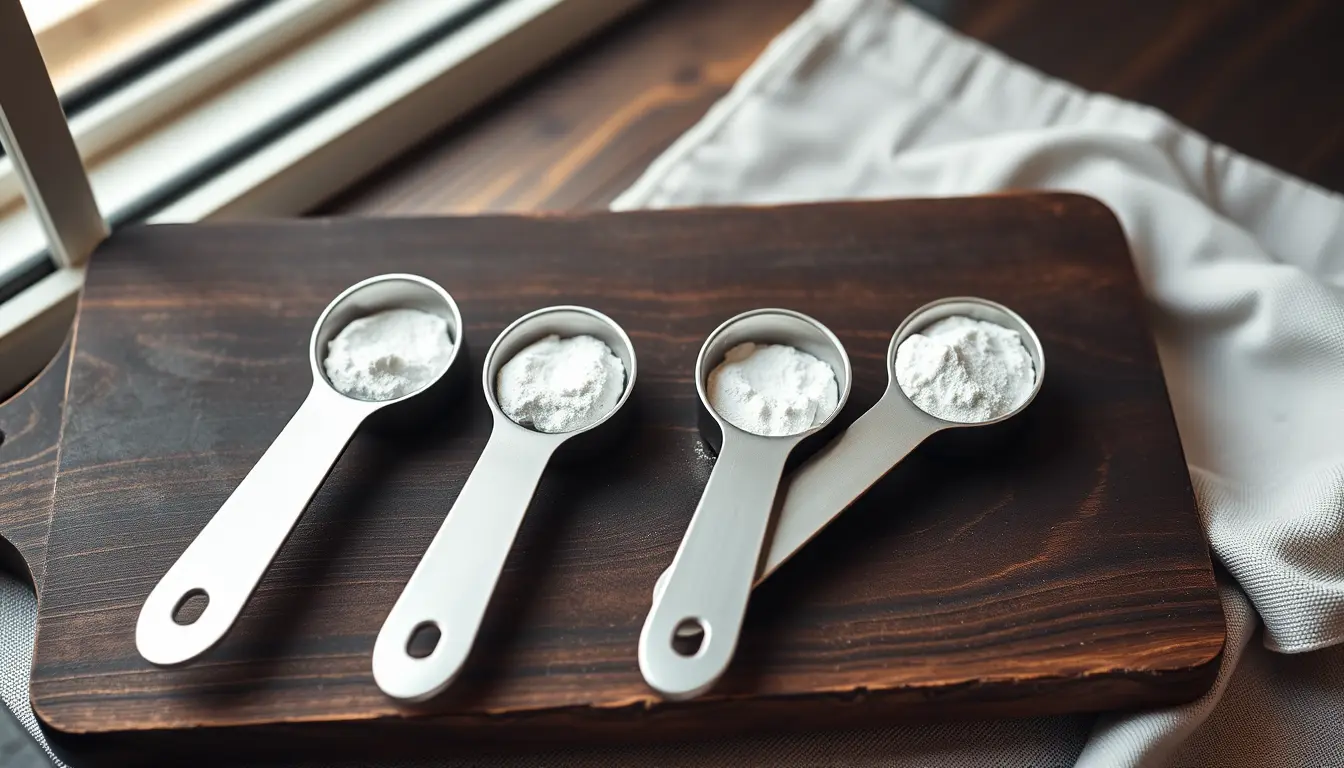
Here’s what a level teaspoon and tablespoon weigh for the small-measure ingredients bakers reach for most:
| Ingredient | 1 teaspoon | 1 tablespoon |
|---|---|---|
| Table salt | 6 g | 18 g |
| Baking soda | 6 g | 18 g |
| Baking powder | 4 g | 12 g |
| Instant yeast | 3.1 g | 9.3 g |
| Granulated sugar | 4.1 g | 12 g |
| Cornstarch | 2.3 g | 7 g |
| Cocoa powder, unsweetened | 1.8 g | 5.3 g |
Those are level US spoons, from the same weight chart the cups to grams converter uses. The first thing they show is that a teaspoon isn’t a fixed weight. A teaspoon of baking soda weighs half as much again as a teaspoon of baking powder, and a teaspoon of salt weighs more than three times as much as a teaspoon of cocoa. For the small amounts that make or break a bake, it pays to convert each ingredient separately.
Why the same spoon weighs different amounts
A spoon measures volume, and each ingredient packs a different weight into that volume. Two things decide it.
The first is density. Baking soda is a single, dense mineral salt. Baking powder is a blend of soda, a dry acid and a starch filler, which makes it lighter, so the same level spoon holds less.
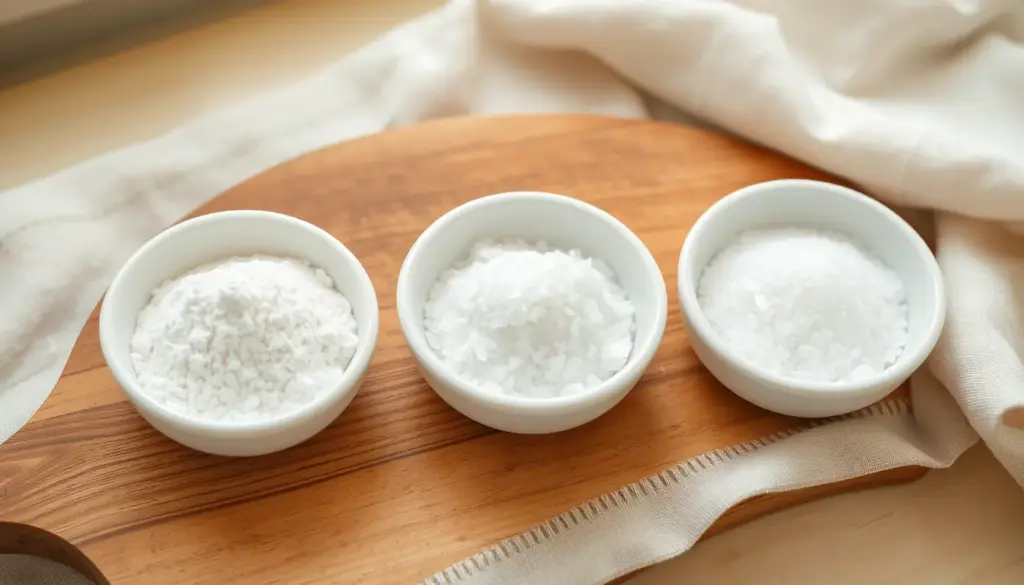
The second is crystal shape. Fine table salt has small, regular crystals that pack tightly with little air between them. Flaky and kosher salts have large, hollow or flat crystals that trap air, so a spoonful weighs much less.
Salt: the brand matters
Table salt is about 6 g per teaspoon. Kosher salt varies so much by brand that one figure can’t cover it. Diamond Crystal, with its light, hollow flakes, comes to roughly 3 g per teaspoon. Morton kosher salt, which is denser, is closer to 5 g. Flaky sea salts can be lighter still.
That’s why a recipe written with one salt can taste flat or harsh with another. If a recipe gives a weight, use it. If it gives spoons and names the salt, match the salt. If it gives spoons and no brand, assume table salt. For bread, where the usual amount is about 2% of the flour, our salt guide goes into more detail.
Leaveners
Baking soda and baking powder are used in such small amounts that a slightly heaped spoon can change the result. Common amounts from cake and muffin recipes, all level:
- ¼ teaspoon of baking soda is 1.5 g
- ½ teaspoon of baking soda is 3 g
- 1½ teaspoons of baking powder is 6 g
- 2 teaspoons of baking powder is 8 g
Too much soda tastes soapy and turns the crumb brownish. Too much powder can taste bitter and make a cake rise and then sink. Weighing them, or at least levelling the spoon carefully, avoids both.
Yeast
Instant yeast weighs about 3.1 g per teaspoon, so the standard 7 g packet is 2¼ teaspoons. Active dry and fresh yeast are a different story, because the three types differ in strength as well as weight.
The yeast converter handles both at once. One teaspoon of instant yeast, 3.11 g, equals 3.73 g of active dry, about 1¼ teaspoons, or 9.33 g of fresh yeast. Instant vs active dry vs fresh yeast explains the strength difference.
How you fill the spoon changes everything
The weights above assume a level spoon. In real kitchens, spoons are often dipped and shaken, or piled high.
- Level: dip or fill the spoon, then sweep the back of a knife across the top. This is what most recipes mean.
- Heaped or rounded: a mound above the rim. It can hold anywhere from half as much again to nearly double, depending on the ingredient and the spoon.
- Scant: slightly under level.
- Pinch and dash: traditionally a pinch is what you hold between finger and thumb. Some measuring spoon sets label a dash as ⅛ teaspoon and a pinch as 1/16.
Converting a recipe’s small amounts
Say a muffin recipe lists 1½ teaspoons of baking powder, ½ teaspoon of baking soda and ½ teaspoon of table salt. The converter gives 6 g, 3 g and 3 g. Write those weights on the recipe once, and you can weigh them straight into the bowl next time.
Check any ingredient and spoon size here:
If you scale a recipe up or down, convert first and scale the grams. How to halve or double a baking recipe explains why fractions of a teaspoon are easier to handle as weights.
Going the other way: grams to spoons
Bread recipes written in grams sometimes need translating back into spoons, for a friend without a scale or for a quick batch. Switch the converter to weight to volume and it gives the nearest practical measure:
- 10 g of table salt, the usual amount for 500 g of flour, is 1⅔ teaspoons.
- 9 g of table salt is 1½ teaspoons.
- 7 g of instant yeast is 2¼ teaspoons, one standard packet.
- 2 g of instant yeast, typical for a slow overnight dough, is ⅝ of a teaspoon.
- 25 g of granulated sugar is 2 tablespoons.
Amounts like ⅝ of a teaspoon show why bakers prefer weights for yeast. Few spoon sets include that size, and halving a ¼ teaspoon by eye is guesswork.
Spoon or scale?
Weighing is usually more reliable, but only if your scale can see the difference. Most kitchen scales read in 1 g steps. For 3 g of baking soda, that’s a possible error of a sixth either way, which is no better than a careful level spoon.
A small pocket scale reading to 0.1 g fixes that, and it’s inexpensive. Until you have one, a level spoon is a perfectly good way to measure anything under about 5 g, and a kitchen scale is better for everything above.
One more catch: Australian recipes use a 20 ml tablespoon, which holds four teaspoons instead of three. If a recipe comes from Australia, a tablespoon of salt or baking powder means a third more than the table above.
Small-measure mistakes
- Using kosher salt in a table salt recipe, spoon for spoon. The bake can come out noticeably under-seasoned.
- Heaping the leavening. A rounded spoon of soda can be enough to taste.
- Weighing tiny amounts on a 1 g scale. The display can’t show the difference.
- Swapping soda and powder by the spoon. They differ in strength as well as weight.
- Assuming every tablespoon is the same. Check where the recipe was written.
Spoon weight questions
Why does a tablespoon of baking soda weigh more than one of baking powder?
Baking soda is a single dense powder, while baking powder includes a dry acid and a light starch. Starch takes up space without adding much weight, so the same spoon holds about 18 g of soda but only 12 g of powder.
Can I use the spoons from my cutlery drawer?
Not for baking. A cutlery teaspoon can hold anywhere from about 2.5 to 7 ml depending on its shape, and a dessert or soup spoon is no closer to a measuring tablespoon. A set of measuring spoons is cheap and removes the guesswork.
Is a heaped teaspoon twice a level one?
Sometimes, but not reliably. Fine powders heap higher than coarse crystals, and a deep spoon heaps more than a shallow one. If a recipe asks for heaped spoons and gives no weight, weigh your own heaped spoon once and make a note of it.