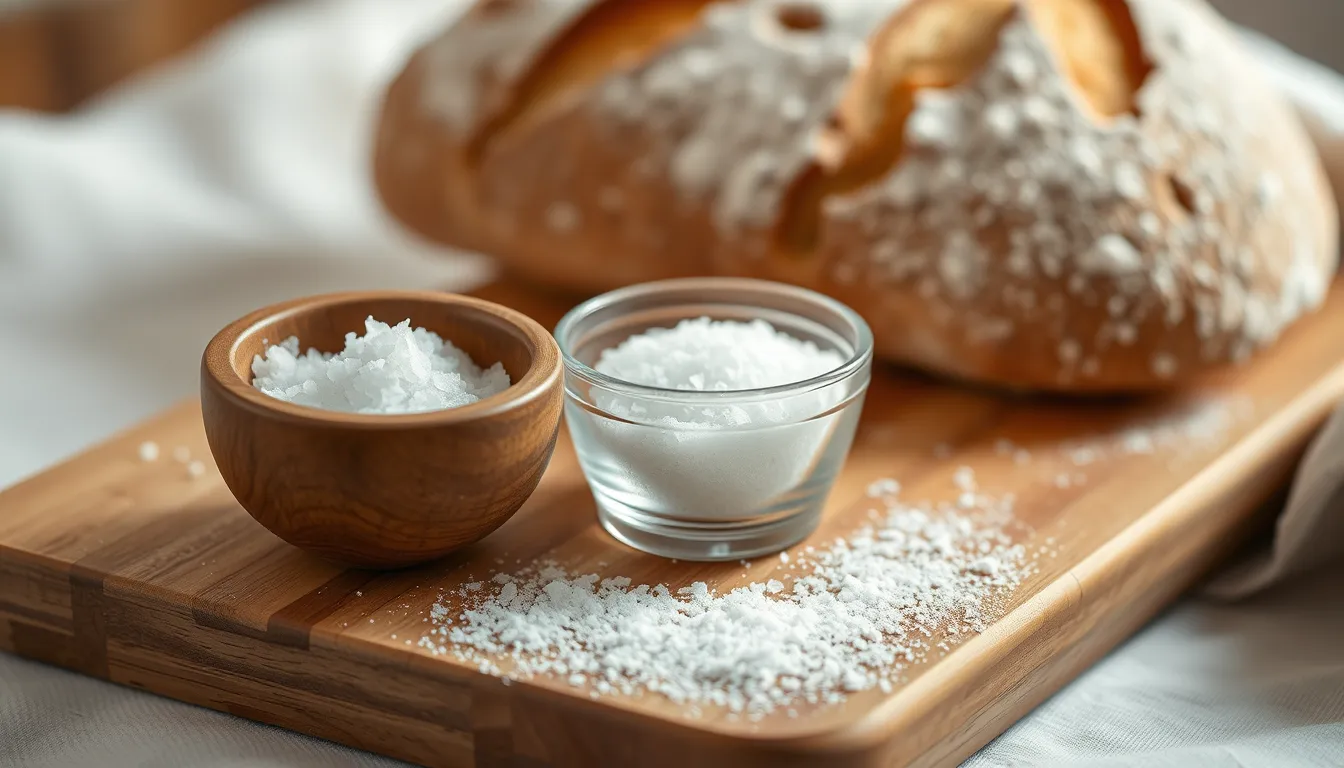
Most bread dough takes about 2% salt, measured against the weight of the flour. That works out to 10 g of salt for every 500 g of flour, or 20 g per kilo. Anywhere between 1.8% and 2.2% tastes properly seasoned to most people. Pizza dough often runs a little higher, around 2.5% to 3%, and sweet enriched doughs a little lower, around 1.5%.
The percentage stays the same however big the batch is, which is why bakers think about salt this way instead of in teaspoons.
Typical salt levels by bread
| Bread | Salt as % of flour | Notes |
|---|---|---|
| Lean loaves and sourdough | 1.8% to 2.2% | 2% is the usual default |
| Sandwich and tin loaves | 1.8% to 2% | Milk and butter soften the flavour slightly |
| Enriched doughs such as brioche | 1.2% to 1.8% | Sugar and butter carry the flavour |
| Focaccia | 2% to 2.5% | Plus flaky salt on top |
| Neapolitan-style pizza | 2.5% to 3% | Short, very hot bake |
| New York-style pizza | About 2% | Oil and sugar in the dough |
These are typical ranges, not rules. Salt is partly a matter of taste, and some regional breads sit well outside them; Tuscan bread traditionally has none at all. Neapolitan vs New York pizza dough explains why the two pizza styles differ.

What salt does in a dough
Salt is a small ingredient with several jobs.
Flavour
Bread made without salt tastes flat and slightly sweet, and the wheat flavour seems to disappear. Salt doesn’t make good bread taste salty; it makes it taste of bread.
Gluten strength
Salt tightens the gluten network. A salted dough feels firmer and less sticky and holds its shape better than the same dough without salt. Bakers who add salt after an autolyse often notice the dough tighten up within a minute of mixing it in.
Fermentation speed
Salt slows yeast and bacteria down. That is a useful brake. A dough without salt ferments noticeably faster, and it can overproof before you expect it.
Crust and keeping
Because fermentation is a little slower, more sugar is left in the dough at baking time, which helps the crust brown. Salt also attracts moisture, and well-salted bread tends to stay soft a little longer.
Checking a recipe with baker’s percentages
The easiest way to see whether a recipe’s salt is sensible is to turn it into percentages. The baker’s percentage calculator does this in one step.
Take a yeasted loaf made with 600 g of bread flour, 408 g of water, 9 g of salt and 6 g of instant yeast. Entered as weights, it shows the water at 68%, the yeast at 1% and the salt at 1.5%. That is on the light side for a lean loaf, which explains why it might taste a bit bland.
Switch to percentages to weights, keep 600 g of flour and set the salt to 2%. The calculator now gives 12 g of salt, with the water and yeast unchanged at 408 g and 6 g. Three extra grams is a small change on the scale and a clear one in flavour.
The same mode helps when you know the dough weight you want. Ask for 1,000 g of dough at 70% water, 2% salt and 0.8% instant yeast, scaled by dough weight, and it lists 579 g of flour, 405 g of water, 12 g of salt and 4.6 g of yeast.
Try it with your own recipe:
Salt in sourdough recipes
Sourdough adds a wrinkle, because the starter contains flour too. Enter 450 g of bread flour, 330 g of water, 100 g of starter and 10 g of salt, with the starter as its own row, and the calculator shows the salt at 2.2% of the flour you add. Count the 50 g of flour inside the starter as well, and it is exactly 2% of the 500 g total. Both figures describe the same dough; recipes differ in which one they print. Baker’s percentages explained simply covers the two conventions.
Weigh it, whatever kind you use
Different salts have very different crystal sizes, so a spoonful of one can weigh far more than a spoonful of another. By weight, they all season the dough the same way. Fine sea salt, table salt and fine kosher salt all work well in bread; fine crystals dissolve fastest and spread most evenly.
A scale that reads to the gram is enough for most loaves. For small batches, a pocket scale reading to 0.1 g makes it easier to hit the target. Why bakers weigh ingredients instead of using cups makes the wider case.
Save the flaky salt for sprinkling on focaccia, pretzels or the top of a loaf, where its texture is the point.
When to add the salt
For most yeasted doughs, add the salt with the flour at the start. Brief contact between salt and yeast in the bowl does no harm, but avoid dissolving yeast in salty water and leaving it to sit.
For doughs with an autolyse, mix the flour and water first, then add the salt with the starter or yeast. If the dough is stiff, dissolve the salt in a small splash of the recipe’s water so it spreads evenly. Squeeze and fold until you can no longer feel any grains.
Salt in the other parts of a recipe
Some recipes split the dough into stages, and the salt usually belongs in only one of them.
- Levains, poolish and sponges are normally made without salt, so the culture can work freely. The salt goes into the final dough.
- Soakers of seeds or cracked grain are sometimes made with a little of the recipe’s salt to slow any unwanted fermentation. Count it as part of the total, not on top.
- Toppings such as flaky salt on focaccia or coarse salt on pretzels are extra. They season the surface rather than the crumb, so leave the dough’s own salt as it is.
- Egg wash often gets a pinch of salt to thin the egg so it brushes on smoothly. It is too little to affect the bread’s seasoning.
Lower-salt bread
If you want to cut back, bread copes well with a gradual reduction. At 1.5% most loaves still taste good, especially with some whole grain, seeds or a long fermentation adding flavour. Below about 1.2%, the dough becomes stickier and faster to ferment, so shorten the timings and expect a softer shape. Lower it in steps across several bakes so your taste adjusts with it.
Salt mistakes
- Measuring by volume. Spoon weights vary widely between brands and crystal sizes.
- Forgetting it completely. The dough rises fast, feels slack and sticky, and the bread tastes flat.
- Adding it twice. It happens more than you would think. Weigh it into a small bowl and set it next to the flour before you start.
- Ignoring salty ingredients. Olives, cheese and cured meat all add salt. Reduce the dough’s salt slightly when a lot of them go in.
- Leaving undissolved clumps. They show up as salty pockets in the crumb.
Salt questions
I forgot the salt. Can I add it after mixing?
Yes, if you notice within the first hour or two. Sprinkle it over the dough with a small splash of water and squeeze it through with your hands until it disappears, then fold the dough a few times. Expect it to tighten up noticeably. Much later than that, it is better to bake as is and serve the bread with salted butter.
Does salted butter in a recipe change how much salt to add?
A little. Salted butter usually contains around 1.5% to 2% salt, so in a brioche with plenty of butter it adds up. If you use salted butter where a recipe specifies unsalted, reduce the added salt by a gram or two per 100 g of butter.
Is sea salt better for bread than table salt?
Not in any way you would taste once it is dissolved in a loaf. Gram for gram they season the dough the same. Choose a fine grind of whichever you like, and keep the expensive flaky salt for the top.
Do seeds or cheese in the dough need extra salt?
Seeds and grains soak up moisture and can make a loaf taste slightly bland, so some bakers add a little more salt to seeded doughs. Cheese does the opposite. Hard cheeses like Parmesan are salty, so reduce the salt when you add a good handful.