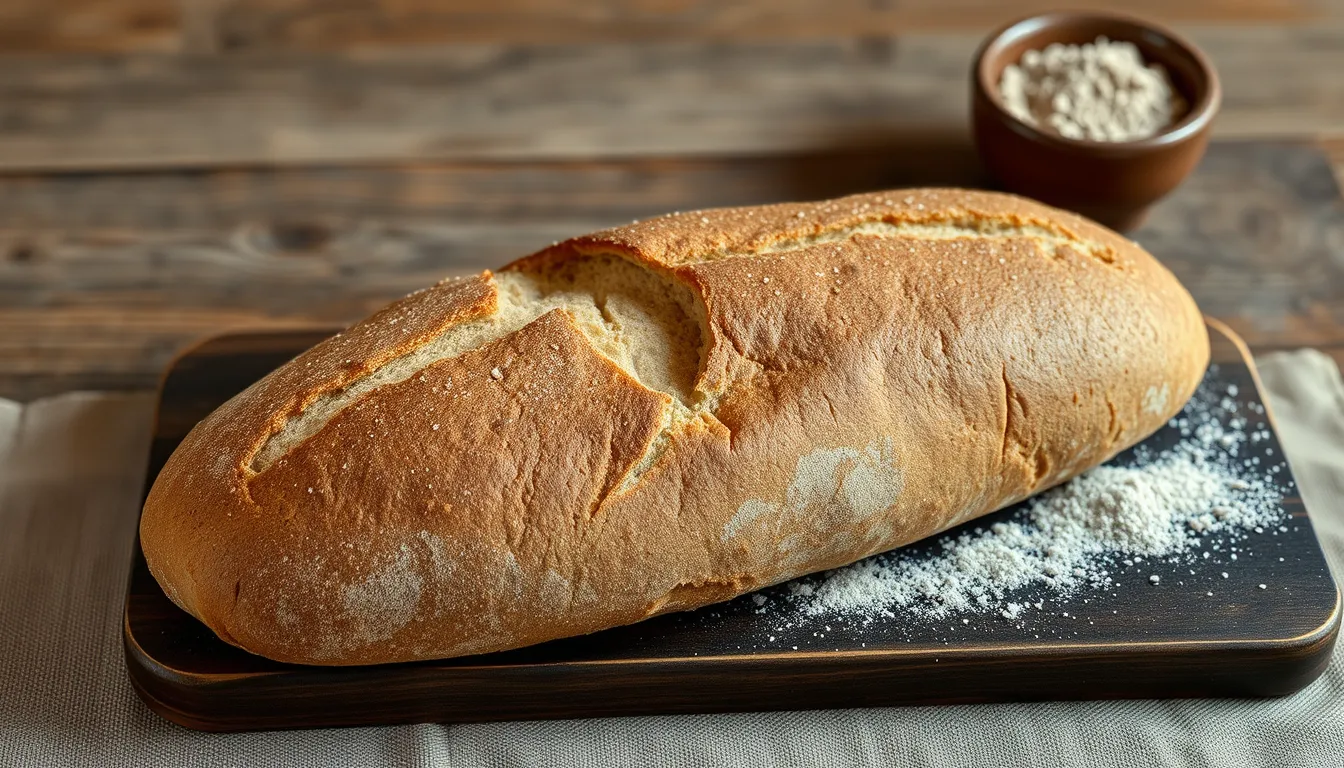
How sour a loaf tastes comes down mostly to three things: how long the dough ferments, how cool it is while it does, and how acidic the starter is when it goes in. Long, cool fermentation and a starter used after its peak give a sharp, tangy loaf. A shorter, warmer fermentation with a starter caught right at its peak gives a mild one. Flour, hydration and a night in the fridge push the flavour one way or the other, but those first three decide most of it.
That means you can steer the flavour on purpose. Here is where the sourness comes from, which settings move it, and how far to push each one.
Where the sour taste comes from
A sourdough culture is a partnership. Wild yeast makes most of the gas that raises the bread, while lactic acid bacteria make most of the flavour. Those bacteria produce two main acids:
- Lactic acid, which tastes soft and rounded, a bit like yogurt.
- Acetic acid, which tastes sharp and vinegary and is the part most people call “sour”.
The balance between them shifts with conditions. Warm, wet doughs tend to favour lactic acid, so they taste creamy and mild. Cooler doughs and stiff starters lean toward acetic acid, which reads as tang. Time matters on top of that: the longer the bacteria work, the more acid of either kind builds up.
So a “not sour enough” loaf usually fermented quickly and warmly, and a “too sour” loaf usually fermented slowly, coolly, or both.
A quick taste diagnosis
| What you taste | Likely reason | First change to try |
|---|---|---|
| Sharp, vinegary tang that lingers | Long cold proof, or a starter used well past its peak | Shorten the fridge time and mix when the starter peaks |
| Pleasantly sour but a little strong | Cool kitchen and a long bulk | Warm the dough by a couple of degrees |
| Bready, close to a yeasted loaf | Short, warm bulk and a freshly fed starter | Ferment cooler and longer, or add some whole grain |
| Very sour and the loaf spread or sank | Overfermentation | Shorten bulk before chasing flavour elsewhere |
Adjust a single setting each time you bake. Flavour is subtle, and if you move three settings at once you won’t know which one did the work.
Your starter sets the baseline
A ripe starter is already acidic, and it carries that acid into the dough. How much it carries depends on the feeding ratio and on how long after its peak you use it.
Say your recipe needs 120 g of starter, you want 30 g left in the jar, and the kitchen is at 25 °C (77 °F). In the sourdough starter feeding calculator, a 1:1:1 feed means 50 g each of starter, flour and water, peaking in about 3 h 30 min to 5 h 30 min. A 1:5:5 feed needs only 14 g of starter with 68 g each of flour and water, and it peaks in about 6 h 30 min to 9 h 45 min.
The second version starts with far less of the old, sour culture, and the fresh flour outweighs it roughly ten to one. Caught at its peak, it goes into the dough smelling sweet and yeasty rather than sharp. What starter feeding ratios actually do explains the other trade-offs between those two feeds.
To push the other way, keep a stiffer starter. Set a custom ratio of 1 part starter, 2 parts flour and 1 part water, and at 22 °C (72 °F) the calculator gives 38 g of starter, 75 g of flour and 38 g of water. The result sits at 60% hydration and peaks in about 5 h 45 min to 8 h 45 min. That firm, dough-like starter tends to develop more of the vinegary acetic side.
Plan either feed with your own amounts and kitchen temperature:
Timing adds a second dial. A starter used an hour or two after its peak, once the dome has started to sink, brings more acid than one used right at the top. It also brings a little less rising power, so don’t go much further than that.
Dough temperature and bulk time
This is the biggest lever for most home bakers, and it works through time. A cooler dough ferments slowly, and the bacteria get longer to build acid before the loaf is ready.
The bulk fermentation estimator shows how wide the gap can be. A dough with 25% starter at 25 °C is ready in about 3 h 45 min to 5 h 15 min, aiming for a rise of 50% to 75%. Drop to 10% starter at 21 °C (70 °F), with up to 30% whole grain, and the window stretches to about 7 h 15 min to 9 h 45 min, with a target rise of 75% to 100%.
The first dough will taste noticeably milder. The second has roughly twice as long for acid to accumulate, and the cooler temperature tilts the balance toward tang. Why dough temperature matters more than time covers how to hit the temperature you choose.
Note what less starter does here. It slows the dough down, which gives the bacteria more time, so a smaller starter percentage usually makes a sourer loaf, not a milder one. Many bakers expect the opposite.
The fridge adds tang
A shaped loaf resting overnight in the fridge keeps fermenting, very slowly. Yeast activity drops sharply in the cold while the bacteria carry on producing acid at a gentle pace, so a long cold proof is one of the most reliable ways to add sourness.
As a rough guide, 8 to 12 hours in a fridge at about 4 °C (39 °F) adds a mild tang, 16 to 24 hours makes it clearly sour, and two days gives a sharp loaf that some people love and others find too much. If your bread is too sour and you retard it overnight, try proofing at room temperature once and taste the difference.
Flour and hydration
Whole grain flours carry more minerals and more food for the bacteria, so they speed up acid production. Rye has the strongest effect. Swapping 10% to 20% of the white flour for whole wheat or rye, either in the dough or in the starter, gives a fuller, more sour flavour without changing the method.
Hydration nudges the balance too. Wetter doughs and liquid starters ferment faster and taste milder; stiffer doughs and stiff starters ferment more slowly and taste sharper. The effect is smaller than temperature, but it adds up.
Turning the dial
For a sourer loaf
- Keep the starter stiffer, around 50% to 60% hydration.
- Use it an hour or so past its peak.
- Use less of it, around 10% of the flour, so bulk runs longer.
- Keep the dough cooler, around 20 to 22 °C (68 to 72 °F).
- Add 10% to 20% rye or whole wheat.
- Proof the shaped loaf in the fridge for 16 to 24 hours.
For a milder loaf
- Feed at a higher ratio, such as 1:5:5, and mix when it peaks.
- Keep the starter at 100% hydration or a little wetter.
- Ferment warmer, around 25 to 26 °C (77 to 79 °F), with 20% to 25% starter.
- Stick mostly to white flour.
- Proof at room temperature, or keep the fridge proof short.
Common flavour mistakes
- Overproofing to chase sourness. Letting the dough run long at room temperature adds acid, but it also weakens the gluten. You get a sour, flat loaf. Use the fridge for extra time instead; how to tell when bulk fermentation is done helps you stop at the right point.
- Adding more starter to make it tangier. More starter speeds everything up and usually softens the flavour.
- Using a sluggish, hungry starter for a mild loaf. A starter left unfed for days is full of acid. Give it a feed or two before a bake where you want gentle flavour.
- Judging a warm loaf. Flavour changes as the bread cools and settles. Taste it once it has cooled completely.
Sourness questions
Why does the same recipe taste different in summer and winter?
Because the kitchen changes the dough temperature, and that changes the balance of acids. A summer dough ferments fast and warm and tastes milder, while the same dough in a cold winter kitchen runs slowly and picks up more tang. A thermometer and a steady target temperature keep the flavour consistent through the year.
Is there a shortcut to a sour flavour?
Some bakers add a little vinegar, citric acid or sour salt to the dough. It gives a sour taste, but a flat, one-note one, and acid added at the start can weaken the gluten. A longer fridge proof and a spoonful of rye in the starter give a rounder flavour with less risk.
Is a very sour loaf a sign that something went wrong?
Not on its own. If the loaf rose well, has an open crumb and a good crust, strong sourness is simply a flavour result. It only points to a problem when it comes with a flat shape, a pale crust or a gummy, collapsed crumb, which suggest the dough fermented too far.
Does the bread get more sour as it sits?
Many bakers notice the tang is stronger the day after baking. Nothing new is being produced, but as the crumb firms and the aroma of fresh baking fades, the acidity is easier to taste. If a loaf seems a touch too sour on day two, it was probably close to your limit on day one as well.