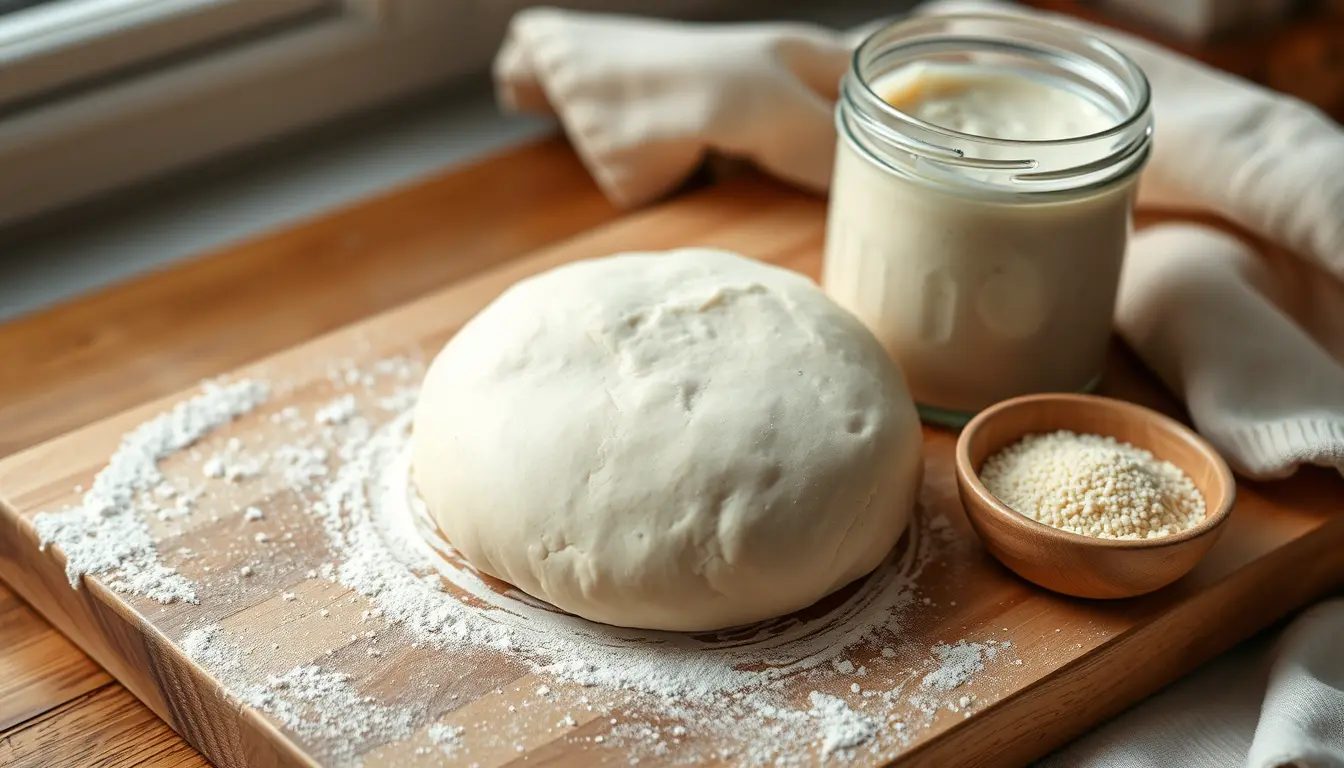
Yes, your starter can raise pizza dough on its own, and the crust is worth the extra hours: more flavour, a crisper bite and a rim that blisters nicely. The method is simple. Swap the yeast for ripe starter at about 10 to 20% of the flour for a same-day dough, or 5 to 10% for a dough that will rest in the fridge. Then take the flour and water the starter brings out of the recipe so the hydration stays the same, and plan for a slower rise than yeast.
Nothing else about pizza changes. You still mix, ball, rest and stretch the same way. What changes is the clock, and that’s where most sourdough pizza goes wrong.
How much starter to use
Starter is a much slower leavening than commercial yeast, so the amount you use sets the whole timetable. These ranges assume an active starter at 100% hydration and a dough around 22 to 24 °C:
| Plan | Starter, % of flour | Rough timing |
|---|---|---|
| Same day, warm kitchen | 10 to 15% | Mix in the morning, bake in the evening |
| Same day, cool kitchen | 15 to 20% | Allow most of the day |
| One to three days in the fridge | 5 to 10% | A few hours out, then cold |
More starter isn’t always better. Above about 20%, the dough ferments fast and turns sour and slack, and on a warm day it can run past its best before dinner. If you want more flavour, a longer, cooler ferment gives it without the acidity.
Converting a yeast recipe you already like
If you have a yeast pizza recipe you trust, keep its proportions and swap only the leavening. The yeast to sourdough converter removes the flour and water that come in with the starter.
Take a yeasted dough of 600 g of flour, 390 g of water and 15 g of salt, which is 65% hydration and 2.5% salt. For a dough headed for the fridge, set the starter to 10%. The converter gives 60 g of starter, 570 g of flour and 360 g of water, with the salt unchanged at 15 g. The hydration stays at 65%, because the starter’s own 30 g of flour and 30 g of water make up the difference.
For a same-day dough, change the starter to 15%: 90 g of starter, 555 g of flour and 345 g of water. Leave the yeast out completely.
The same approach works for bread. How to convert any yeast recipe to sourdough covers the method in more depth, including enriched doughs.
Starting from scratch instead
If you don’t have a recipe to convert, the pizza dough calculator can build one from the number and size of your dough balls, with sourdough starter chosen as the leavening. For four 260 g balls at 65% hydration with 2.5% salt, 15% starter at 100% hydration and 2% extra for losses, it gives:
- 586 g of flour to add
- 364 g of water to add
- 95 g of starter
- 16 g of salt
That’s 1,061 g of dough, or about 265 g per ball. Set the starter to 8% for a cold ferment and it becomes 608 g of flour, 386 g of water and 51 g of starter, with the salt and ball weight unchanged.
Getting the starter ready
The starter should be active and close to its peak, the same as for bread. Feed it the night before at about 1:5:5 so it’s ready by mid-morning, or 1:2:2 in the morning for an afternoon mix. A starter that’s well past its peak, or one straight from the fridge, leaves the dough slow and flat.
Unfed discard won’t give you a reliable rise on its own. Save it for crackers or flatbreads.
A same-day schedule
Here’s a plan with 15% starter in a kitchen around 24 °C. The bulk fermentation time estimator puts a dough like this at about 5 h 15 min to 7 h at that temperature. For pizza, you split that time between the bulk and the rise after balling.
- 9:00: mix the dough and rest it for 30 minutes.
- 9:30 to 11:00: give it two or three sets of folds, then leave it covered.
- About 13:00: once it has grown by roughly a third to a half, divide and ball it.
- 13:00 to 17:00: let the balls rise, covered, until soft and puffy.
- Around 17:00: heat the oven and start stretching.
In a cooler kitchen, push each step later, or use the extra starter from the table above.
A cold-ferment schedule
- Day 1, evening: mix with 5 to 10% starter and give it a couple of sets of folds.
- Two to three hours later: ball the dough and put it in the fridge in lidded containers.
- Day 2, 3 or 4: take the balls out two to four hours before baking.
- Bake when the balls have warmed through and relaxed.
Sourdough balls usually need a bit longer on the bench after the fridge than yeasted ones. Cold fermentation for pizza dough covers containers, timing and the signs of a dough that has gone too far.
Handling and baking
A sourdough pizza dough is often softer and more extensible than a yeasted one, especially after a long cold rest. Stretch it gently, keep the rim untouched, and flour the bench lightly. If a ball fights back and shrinks, cover it and give it another 15 minutes.
Long ferments use up much of the dough’s sugar, so in a home oven the crust can bake up a little paler. A preheated steel or stone helps, as does switching the grill on for the final minute.
Steering the flavour
Sourdough pizza can taste anywhere from gently wheaty to distinctly tangy, and you have a fair amount of control over where it lands.
- For a milder crust, use a young starter right at its peak, keep the amount at the low end of the range, and let the fridge do most of the work. A long, cold rest builds depth without much sourness.
- For more tang, use a little more starter and let the balls rise somewhere warm, or use a starter that is slightly past its peak.
- For balance, a day in the fridge with 8 to 10% starter suits most people.
Tomato sauce and cheese soften the acidity a lot, so a dough that tastes sharp on its own often reads as savoury once topped. Why is my sourdough too sour, or not sour enough? explains the same levers for bread.
Sourdough pizza mistakes
- Swapping yeast for starter without changing anything else. The dough ends up wetter than intended. Subtract the flour and water the starter carries.
- Using a sluggish starter. The dough never really rises, and the crust bakes dense.
- Too much starter for a long day. By evening the balls are slack, sticky and sour.
- Rushing the bench time after the fridge. Cold balls tear and spring back when stretched.
- Judging by the clock. Watch for puffy, relaxed balls with small bubbles under the surface.
Sourdough pizza questions
Does the starter need a feed after the fridge?
Not directly. Cold, unfed starter is too slow and too acidic to raise the dough reliably. Give it one or two feeds at room temperature first, and use it when it has risen and domed.
Can I add a little commercial yeast as well?
Yes. A pinch of instant yeast, around 0.1% of the flour, alongside the starter makes the timing more predictable while keeping most of the sourdough flavour. Many pizzerias work this way. It’s no longer a pure sourdough, but it’s a practical option on a busy day.
Why are my dough balls slack and sticky by the evening?
They have fermented too far. Cut the starter, use cooler water, or put the balls in the fridge for part of the day to slow them down. A slightly lower hydration helps on warm days as well.