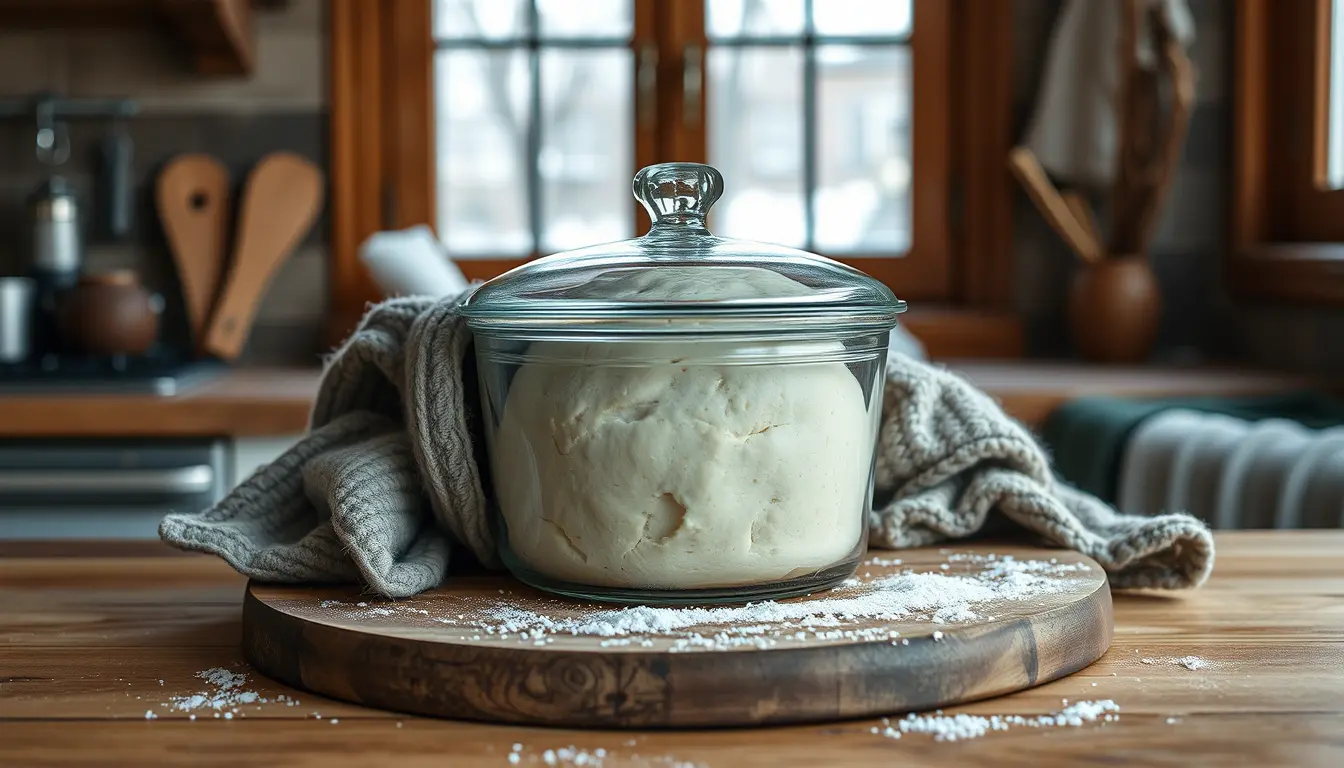
Sourdough in a 16 °C kitchen isn’t broken, just slow. The culture still works, but at a fraction of the pace most recipes assume, so a bulk ferment listed as five hours can take ten. To bake well in the cold, warm the dough at mixing, give it a steady warm place to sit, and judge the end of bulk by how much the dough has grown rather than by the time on the recipe.
Why bother warming it at all, if the dough gets there eventually? Because time isn’t the only thing that changes. A long, cold bulk builds more of the sharper acids, and a dough that’s still cool when the recipe says “shape” is usually underfermented. Dense, tight loaves in winter almost always trace back to that.
How cold changes the dough
Fermentation roughly halves in speed for every 6 to 7 °C drop in dough temperature. A dough sitting at 18 °C takes a little under twice as long as the same dough at 24 °C. Cold dough also feels stiffer and less sticky, which can fool you into thinking it’s stronger and further along than it is.
The cold also changes flavour. Cooler doughs lean toward acetic acid, which tastes tangier and more vinegary. Some bakers love the result. If you’d rather keep it milder, the goal is to keep the dough itself in the low to mid twenties, even when the room is not.
Step 1: warm the mix
The water is the quickest way to raise the dough’s starting temperature, but in a really cold kitchen it can’t do the job alone. The dough water temperature calculator makes the limit obvious.
Take a midwinter morning with the kitchen at 16 °C, flour from the cupboard at 16 °C and a levain at 20 °C, mixed by hand, aiming for 25 °C. The calculator asks for water at 46 °C and warns that water above 40 °C can weaken yeast and starter. Pouring that much heat onto the culture in one go is a gamble.
The better fix is to warm the other ingredients. Leave the flour in a warm spot for a few hours so it comes up to around 20 °C, and build the levain somewhere warm so it’s at about 24 °C when you use it. Now the calculator asks for 38 °C water: warm to the touch, and safe for the culture.
If you can’t warm the flour, aim a degree or two lower, say 24 °C, and accept a longer bulk. That is better than very hot water.
Step 2: find a warm corner
Once mixed, the dough drifts toward the temperature around it. Over an eight-hour bulk in a cold room, a dough that started at 25 °C can lose several degrees. A steady spot at 24 to 26 °C keeps it on track. Good candidates include:
- The oven, switched off, with the light on. Many ovens reach the high twenties or more this way. Prop the door open slightly if it runs too warm, and stick a note on the door so nobody preheats it with the dough inside.
- A cool box or insulated bag with a jar of hot water tucked beside the dough container. Swap the water every couple of hours.
- The top of the fridge, where warm air from the back often collects. Gentle, but useful.
- Near a radiator or boiler cupboard, never directly on it. The side facing the heat warms much faster than the rest.
- A seedling heat mat under a folded towel, with the container on top.
- A proofing box, if you bake often enough to justify one. It holds a set temperature with no guesswork.
Test any new spot before trusting it with dough. Put a glass of water there for an hour, then check its temperature. That tells you what the dough will actually experience, which is often quite different from the air reading.
Step 3: use a bit more starter
More starter shortens bulk, which is useful when the room keeps pulling the dough back. Raising it from 20% to 30% of the flour makes a real difference. With the dough at 20 °C, the bulk fermentation time estimator puts a 20% dough at about 7 h to 9 h 30 min, and a 30% dough at about 6 h to 8 h.
Warmth still does more. The same 20% dough at 24 °C needs only about 4 h 45 min to 6 h 15 min. So treat extra starter as a helper, and warmth as the main fix.
Step 4: let the rise decide
In a cool dough, fermentation keeps working slowly after shaping, so bulk needs to go further than it would in summer. Below about 22 °C, the estimator’s target rise is around 75 to 100%. Look for a dough that is clearly domed, jiggles as a whole, shows bubbles along the sides and feels airy rather than dense.
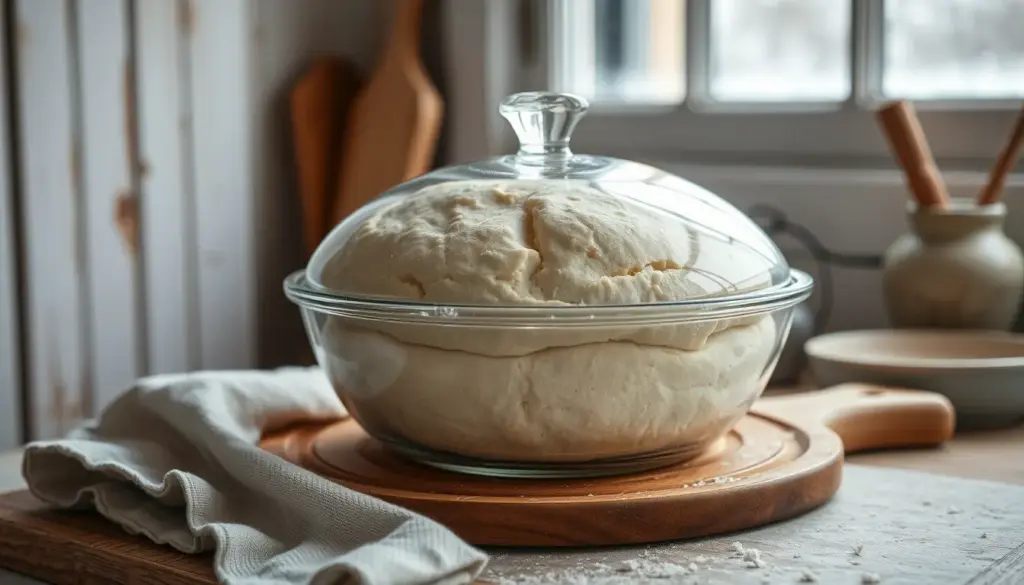
If the time has run out and the dough hasn’t grown enough, give it longer. Shaping on schedule but too early is the classic cause of a tight, heavy winter loaf. How to tell when bulk is done describes each sign in more detail.
Keep the starter warm too
A starter that lives in a cold kitchen slows down just like the dough. It may take 12 hours or more to peak, and a sluggish starter makes a sluggish levain. Sourdough starter not rising? lists cold as the first thing to check.
- Feed it with water at around 27 to 30 °C.
- Keep the jar in your warm spot after feeding.
- Use a lower ratio, such as 1:2:2, so it peaks sooner.
- A spoonful of whole grain flour in the feed perks it up.
The final proof
After shaping, you have two routes. Proof the loaf in the warm spot, which can take two to four hours in winter, using the poke test to judge it. Or put it in the fridge overnight as usual. A cold room changes little about a fridge proof, so that half of the process stays predictable.
Planning around a cold day
A cool kitchen can work in your favour for an overnight bulk. With 10% starter and the dough holding at about 18 °C, the estimator gives about 11 h to 15 h. Mix in the evening, leave it somewhere that stays near 18 °C, and it’s often ready to shape by the next morning. Check it as soon as you’re up, since an unexpectedly mild night speeds it up. Why dough temperature matters more than time goes deeper into this kind of planning.
Cold kitchen mistakes
- Very hot water to make up for everything. Over about 40 °C, it stresses the culture where it lands.
- Setting the bowl on a radiator. The bottom overheats while the top stays cold.
- Ending bulk on time instead of on rise. A cold dough needs more growth, not less.
- Forgetting the oven has dough in it. A note on the door saves a lot of grief.
- Adding water because the dough feels stiff. Cold dough firms up. It will loosen as it warms.
Winter baking questions
Can I let bulk run overnight in a cold room?
Yes, and it’s a handy way to bake. Use a small amount of starter, around 5 to 10%, and check the temperature where the dough will sit. Below about 16 °C, timing estimates become much less reliable, so check it first thing.
Does a cold kitchen change how much water the dough needs?
Not really, though the dough will feel firmer. Cold dough is stiffer to handle, so many bakers mistake it for a dry dough. Keep to the recipe, and judge the hydration once the dough has warmed through.
Should I warm the dough or add starter first?
Warm it first. Raising the dough by four or five degrees saves more time than adding a third more starter, and it keeps the flavour milder. Add starter on top only if your warm spot can’t hold the dough above about 22 °C.