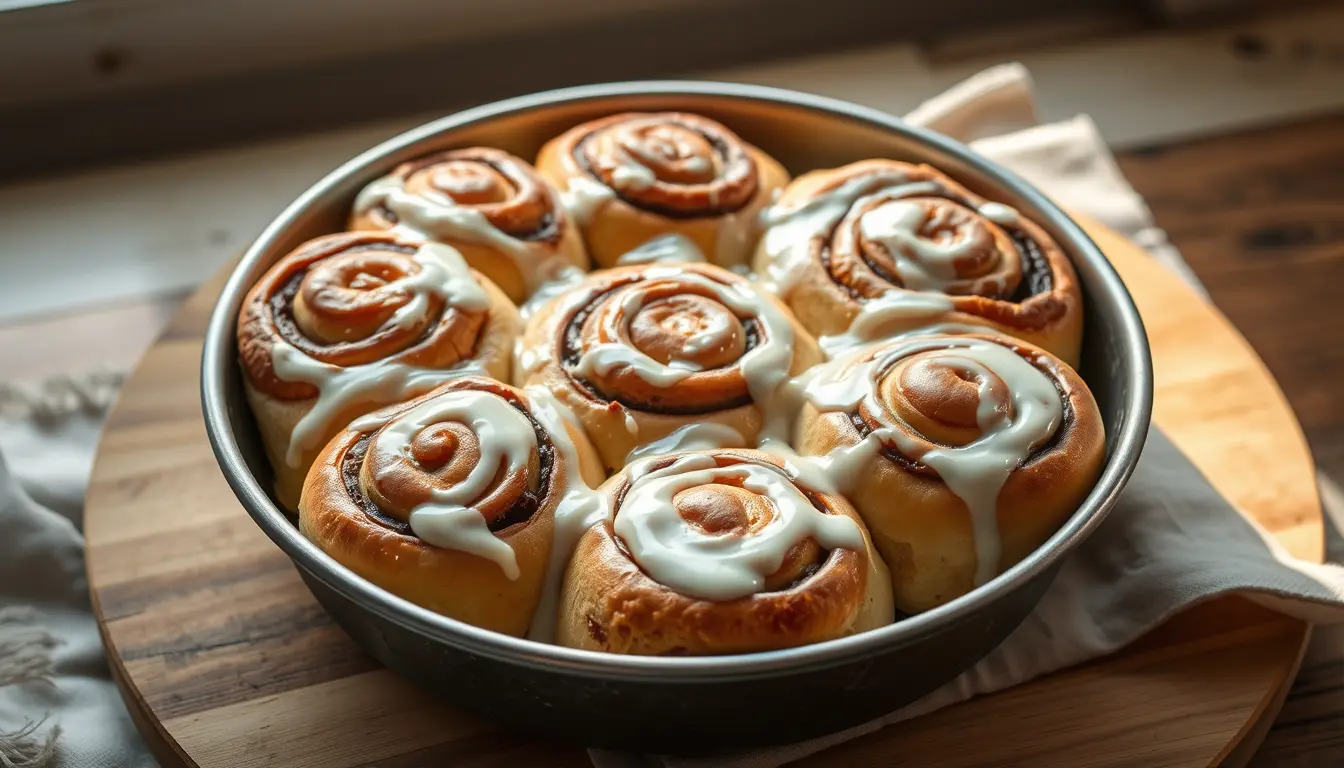
Sourdough cinnamon rolls take longer than a sourdough loaf, often noticeably so. Expect the first rise to run roughly one and a half to two times as long as a lean dough with the same starter and temperature, and the shaped rolls to need two to four hours to proof. The most reliable plan is to mix in the afternoon, let the dough rise somewhere warm until it has grown by about half and feels airy, shape and fill the rolls in the evening, and rest them in the fridge overnight. In the morning, let them proof in a warm spot until they are puffy and pressed together, then bake.
That schedule also keeps the long, slow part of the process in the fridge, which is the cautious choice for a dough full of milk, butter and eggs.
Why enriched dough is slow
The general effects of milk, butter, eggs and sugar on bread are covered in enriched doughs explained. For a sourdough, a few of them matter more than they do with commercial yeast.
- Sugar pulls water away from the culture. Above roughly 10% of the flour weight, the dissolved sugar makes it harder for wild yeast and bacteria to take up water, and they slow down. Commercial yeast copes better, and special strains exist for sweet doughs, but a sourdough culture has no such help.
- Butter softens the gluten. Fat lubricates the gluten strands, so the dough holds gas less firmly and rises more slowly even when fermentation is going well.
- Cold ingredients lower the dough temperature. Milk and eggs straight from the fridge can bring the dough several degrees below where you want it.
- The culture has less free water. Enriched doughs are usually lower in liquid than lean loaves once eggs and butter are counted, and a firmer dough ferments more slowly.
None of that stops the dough from rising. It just changes the clock, and how you read the dough.
Making the most of the starter
You can win back some of the lost speed:
- Use more starter than a loaf would. Around 25 to 30% of the flour is common for sweet sourdough.
- Use it right at its peak. A tired starter struggles even more in sugary dough. Feed it so it peaks just as you mix.
- Warm the dough. Use room-temperature eggs and milk warmed to about 30 °C, and aim for a dough of 25 to 27 °C after mixing.
- Add the butter late. Mix everything else until the dough is smooth and stretchy, then work in soft butter a piece at a time.
Some bakers build a stiff, slightly sweetened levain for these doughs, which seems to help the culture adjust. It’s optional, and opinions differ on how much it matters.
Estimating the first rise
The bulk fermentation time estimator is built for lean dough, so its figure is a starting point, not a forecast. With 25% starter in mostly white flour, it gives about 3 h 30 min to 4 h 45 min at 26 °C (79 °F) and about 4 h 15 min to 5 h 45 min at 24 °C (75 °F).
For a cinnamon roll dough with 10 to 15% sugar and a similar share of butter, plan on roughly one and a half to two times the lean figure. That multiplier is an approximate rule of thumb, not a measured value. At 26 °C that means something like 5 to 9 hours. That’s a wide range on purpose, because the exact sugar, butter and starter strength all move it. Watch the dough rather than the clock: it is ready to shape when it has grown by about 50 to 75%, feels soft and airy, and shows bubbles on the sides of the container.
The sourdough schedule planner can still help with the starter, since the feed doesn’t depend on the dough’s sugar. Use it to time a feed that peaks when you plan to mix, then extend the dough stages yourself.
A realistic overnight schedule
This plan aims for rolls on a Saturday morning, in a warm spot of about 25 to 26 °C.
| When | Step |
|---|---|
| Friday, 8:00 AM | Feed the starter so it peaks around early afternoon |
| Friday, 1:30 PM | Mix the dough without the butter, then add the butter gradually |
| Friday, 1:30 to 3:30 PM | Two or three sets of folds, 30 to 45 minutes apart |
| Friday, 3:30 to about 8:00 PM | Rise, covered, in a warm spot until about 50 to 75% bigger |
| Friday, around 8:00 PM | Roll out, spread the filling, roll up and cut 12 rolls into a buttered pan |
| Friday, around 8:30 PM | Cover and refrigerate overnight, about 8 to 12 hours |
| Saturday, 7:00 AM | Move the pan to a warm spot to proof |
| Saturday, about 9:30 AM | Bake at 180 °C (350 °F) for 25 to 35 minutes |
If the dough is slow on Friday evening, it can go into the fridge in bulk and be shaped in the morning instead. Cold dough is firm and easy to roll, though the morning proof will take a little longer.
A note on food safety
Long counter rises with milk and eggs are a common part of home baking, and the acidity of a sourdough helps. Food safety advice on perishable ingredients is stricter, though, and recommendations vary. The cautious approach is to keep room-temperature stages to the time the dough actually needs, avoid leaving it out overnight in a warm kitchen, and do the long rest in the fridge. The schedule above follows that approach.

Telling when the rolls are proofed
Cold rolls need time to warm through and grow before they bake. Two to four hours is typical in a warm spot, longer in a cool kitchen. They are ready when:
- They have swelled by about half and are pressing against each other.
- The spirals have opened slightly and the cut sides look puffy.
- A gentle press on the side of a roll leaves a dent that fills back slowly.
- The pan jiggles a little when you nudge it.
Underproofed rolls stay tight, bake dense, and often push their centres up into a peak. Overproofed ones look slack, smell boozy and may sink as they bake. If you’re unsure, bake slightly early rather than late; a little underproofing is the smaller problem in a sweet dough.
Baking and finishing
Bake the rolls on a middle rack until they are deep golden and the centre of a middle roll reaches about 88 to 90 °C (190 to 194 °F). Sugar browns quickly, so cover the pan loosely with foil if the tops colour before the centre is done. Ice them while they are warm so the glaze melts slightly into the swirls.
Cold retard: proofing sourdough in the fridge explains more about what the cold does to a shaped dough, and how to convert any yeast recipe to sourdough helps if you want to adapt a favourite yeasted roll recipe.
Cinnamon roll mistakes
- Using the lean-loaf timing. Bulk often runs hours longer. Plan for it.
- Cold milk and eggs. The dough starts too cool and stalls.
- A starter past its peak. Sugar slows a weak culture even more.
- Too much filling butter. Melted filling leaks out and fries the bottoms. A soft paste of butter, sugar and cinnamon stays in place better.
- Baking straight from the fridge with no proof. The rolls stay tight and dense in the middle.
Sourdough cinnamon roll questions
Can I bake the rolls straight from the fridge?
Only if they have already proofed fully overnight, which can happen in a fridge that runs on the warm side. Most of the time, they need a couple of hours in a warm spot first. Check the signs above rather than relying on the clock.
Why did the filling melt out of the bottom?
Usually the filling was too runny, or the rolls were cut and packed too loosely. Use soft rather than melted butter, roll the dough snugly, and leave only a small gap between rolls in the pan.
Can I freeze the shaped rolls?
You can, but a sourdough culture recovers slowly after freezing, and the rolls may proof unevenly. Freezing the baked rolls is more reliable. Reheat them, wrapped in foil, in a moderate oven.