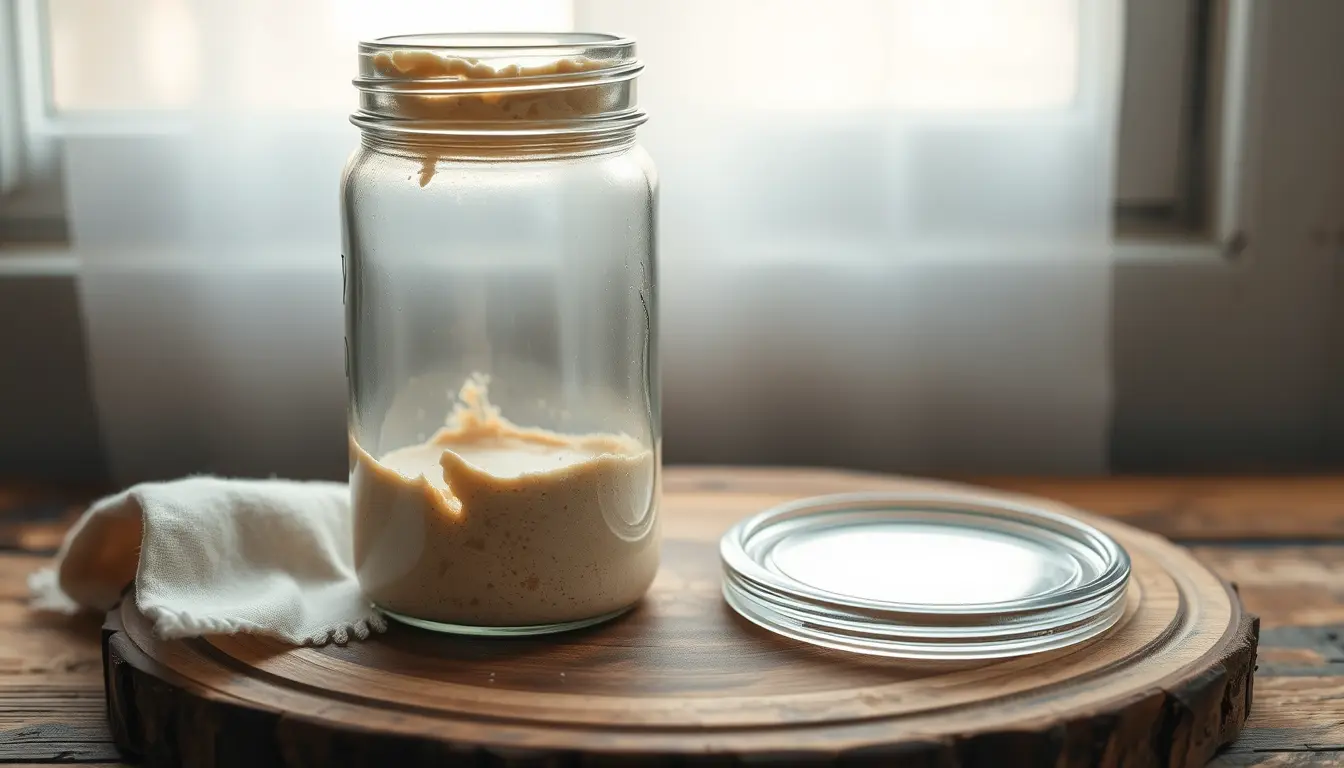
You don’t have to throw starter away every time you feed it. With the scrapings method, you stop keeping a full jar of starter at all. After you take what a recipe needs, the few grams clinging to the jar become your starter. They go into the fridge, lid on, until the next bake. A day before you bake again, you feed those scrapings with just enough flour and water to build the exact amount the recipe calls for, plus a little extra that stays behind in the jar. Nothing gets poured off, because there is never more starter than you are about to use.
It suits people who bake once a week or every two weeks and are tired of feeding a jar between bakes. It asks for a little more planning than the usual routine, and the first build after a long rest can be slow.
Why ordinary feeding makes discard
A typical routine keeps 100 g or more of starter and feeds it 1:1:1. To keep the jar the same size, most of it has to go before each feed. Over a month, that adds up to several hundred grams of flour poured out or turned into pancakes.
The scrapings method avoids it by keeping the culture tiny between bakes and only growing it when you need it. The bacteria and yeast don’t need a big population to survive; a thin coating on the glass holds plenty of both. What they need is a large, well-timed feed before you bake.
How the method works
- Bake as usual. Weigh out the starter or levain your recipe needs and add it to the dough.
- Leave the jar unwashed. About 5 to 10 g of starter will still cling to the sides and base. That is your culture.
- Close it and refrigerate. A tight lid matters, since a film this thin dries out fast.
- Rebuild before the next bake. Add fresh flour and water to the jar, enough to produce the full amount your next recipe needs plus a few grams to leave behind.
- Use it at its peak, then repeat from step 2.
Some bakers scrape the residue into a small pot instead of leaving it in the big jar. That works too, and it makes the amount easier to see.
Working out the rebuild
Because you start from only a few grams, the feed has to be a big one. Say your recipe needs 100 g of ripe starter and you want about 5 g left behind. In the sourdough starter feeding calculator, enter 100 g for the recipe, 5 g extra to keep, and a 1:10:10 ratio at a room temperature of 22 °C. It gives:
- Starter: 5 g
- Flour: 50 g
- Water: 50 g
- Total: 105 g, at 100% hydration
- Peak: about 11 h to 16 h 30 min
That timing is handy. Feed the scrapings after dinner and the starter is ready by the next morning or lunchtime. If your recipe needs more, change the first number and the calculator scales the feed. A 1:10:10 ratio stays practical as long as the scrapings weigh at least a few grams.
Weigh the jar empty once and write the weight on the lid. Then you can put the jar on the scale, subtract that figure, and know exactly how much residue you have.
When the scrapings have rested a while
After a week in the fridge, scrapings usually bounce back in one feed. After two or three weeks, they are cold, acidic and slow, and a single big feed may not peak when you expect. Give them two smaller steps instead.
At 22 °C, a first feed of 5 g of scrapings with 15 g of flour and 15 g of water (1:3:3) makes 35 g and peaks in about 7 h 30 min to 11 h 15 min. Then feed all 35 g with 35 g of flour and 35 g of water. That 1:1:1 feed gives 105 g, peaking in about 5 h to 7 h 15 min. You still end up with exactly enough for the recipe plus the residue, and nothing has been thrown out.
A spoonful of whole wheat or rye in the first feed helps a tired culture recover faster.
What changes compared with a full jar
- Planning. You can’t decide to bake on a whim, because there is no ripe starter waiting. Most bakers settle into feeding the night before mixing.
- Acidity. Scrapings left for weeks are sour. The first loaf after a long gap can taste tangier, and some bakers do two builds to soften it.
- Drying. If the jar isn’t sealed, the residue forms a hard crust. A dry crust is usually still alive underneath, but it takes longer to revive.
- Mould. A small culture has less acidity protecting it. Check before each build, and if you see fuzzy growth or pink or orange streaks, start again from a backup.
Keeping a backup is wise anyway. Spread a little ripe starter thinly on parchment, let it dry completely and store the flakes in a sealed jar. How to store a sourdough starter explains drying in detail.
If you do end up with spare starter
Builds don’t always land exactly, and some days you will have 20 or 50 g left over. Rather than letting it pile up in the fridge, use it in a recipe the same week. The sourdough discard converter takes the flour and water out of the recipe so it stays balanced. For pancakes made with 200 g of flour and 250 g of milk, adding 60 g of leftover starter at 100% hydration means using 170 g of flour and 220 g of milk.
What to do with sourdough discard has plenty of ideas for those leftovers, and what starter feeding ratios actually do explains why big ratios like 1:10:10 take longer to peak.

A weekly routine that works
For a loaf every Saturday, the method settles into a simple rhythm. On Friday evening, take the jar from the fridge, weigh the scrapings and feed them for the amount Saturday’s recipe needs plus a few grams. On Saturday morning, the starter is at or near its peak. Weigh out what the dough needs, leave the residue in the jar, put the lid on and return it to the fridge. Between bakes, it needs no attention at all.
If a week gets busy and you skip a bake, nothing is lost. The scrapings wait for the following week, perhaps with a two-step build if the gap stretches to three weeks.
Scrapings-method mistakes
- Washing the jar by habit. Once it is clean, your starter is gone. Leave it until the rebuild.
- Leaving the lid loose. The thin film dries out and goes dormant.
- Expecting a peak on schedule after a long rest. Use two builds after more than a couple of weeks.
- Building with nothing left over. If the build only covers the recipe, there is no residue for next time. Always add a few grams extra.
Scrapings method questions
How long can the scrapings sit in the fridge?
Two to three weeks is comfortable, and many cultures survive longer. Beyond a month, revive them with two or three feeds before trusting them in a loaf, or fall back on a dried backup.
Can I use the scrapings method with a stiff starter?
Yes. Set the starter hydration in the calculator to match, for example 60%, and build with less water. Stiff residue dries out more slowly in the fridge, which some bakers find an advantage.
Do I ever need to clean the jar?
Every few weeks, scrape the residue into a clean jar so old crust doesn’t build up around the rim. Do the transfer just before a rebuild, when you are about to feed it anyway.