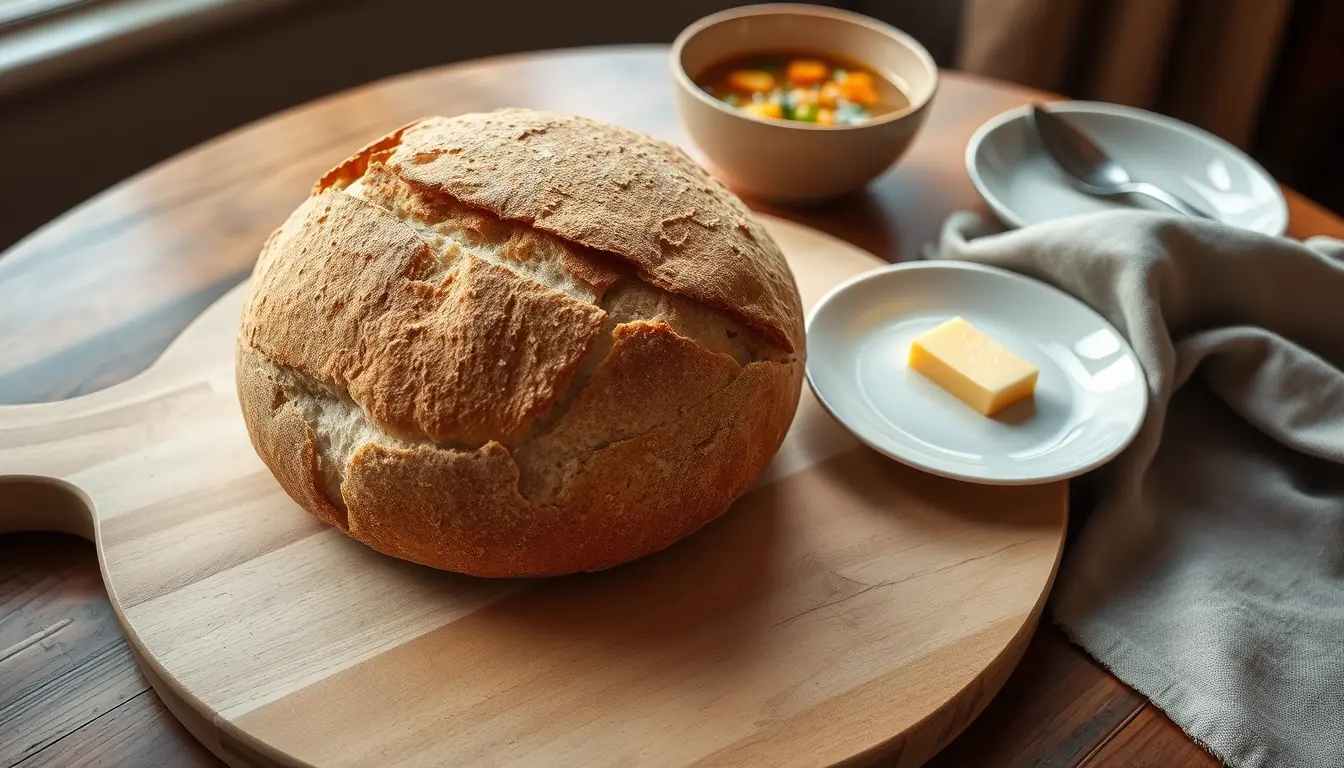
Yes, you can bake a good sourdough loaf in a single day. Feed the starter first thing in the morning, mix once it peaks, keep the dough at around 25 °C (77 °F), and use a little more starter than an overnight recipe would, about 20 to 25% of the flour. Shape in the late afternoon, proof the loaf on the counter for an hour or two, and it can be out of the oven by early evening. From the first feed to a cooling loaf takes roughly 11 to 13 hours, most of it hands-off.
What you give up is the fridge. A cold proof makes scoring easier and adds tang, but it isn’t required for good bread. Many bakeries proof at room temperature every day.
What makes a one-day loaf possible
Sourdough is slow because a starter holds far fewer yeast cells than a spoonful of commercial yeast, and wild yeast works at a gentler pace. To fit everything into daylight hours, you shorten the two longest stretches, bulk fermentation and the final proof. Three levers do that.
- Warmth. Within the normal range, fermentation time roughly halves for every 6 to 7 °C of extra warmth. Dough at 25 °C gets through bulk well ahead of dough at 21 °C.
- More starter. A bigger share of starter gives the dough a head start, so it reaches the end of bulk sooner.
- A room-temperature proof. A shaped loaf on the counter needs one to two hours, not a night in the fridge.
Each lever has a limit. Above about 27 °C the dough turns sticky and sour quickly, and much more than 30% starter can leave it slack before it has built enough strength. Used together in moderation, they are plenty.
A sample timeline
Here are the settings entered into the sourdough schedule planner: bake at 6:00 PM, room temperature 25 °C, 25% starter, a 1:1:1 starter feed, a 30-minute autolyse, and the shaped loaf proofed at room temperature. It returns this plan:
| Time | Step |
|---|---|
| 6:55 AM | Feed the starter 1:1:1 (peaks in about 3 h 30 min to 5 h 30 min) |
| 10:55 AM | Autolyse: combine the flour and water and leave it for 30 minutes |
| 11:25 AM | Mix in the starter and salt |
| 11:55 AM | First of four sets of stretch and folds, every half hour until 1:25 PM |
| 3:55 PM | Bulk ends, pre-shape |
| 4:25 PM | Shape, then proof on the counter for about 1 h 15 min to 2 h |
| 5:00 PM | Preheat the oven |
| 6:00 PM | Bake |
| 6:45 PM | Out of the oven |
The bulk estimate behind that plan is about 3 h 45 min to 5 h 15 min, and the whole bake spans 11 h 45 min. Move the bake time and every step moves with it, so you can line the plan up with your own day.
If your kitchen is cooler than 25 °C, enter the real figure. A couple of degrees lower stretches the plan by an hour or more, which can push the first feed before 6 AM. Warming the dough, as described below, is usually easier than getting up earlier.
Getting the starter ready on time
A same-day bake depends on a starter that is lively from the first feed. If yours lives in the fridge, take it out the evening before and feed it, then feed it again in the morning. A starter that has already had one warm feed peaks sooner and more predictably.
A 1:1:1 feed suits this plan because it peaks within a few hours in a warm room. A 1:5:5 feed would need half a day and push the mix into the afternoon. The trade-off between ratio and timing is laid out in what starter feeding ratios actually do.
Use the starter at or just before its peak, when it is domed, well risen and full of bubbles. One that has already collapsed will still raise the dough, but more slowly, and that eats into time you don’t have.
Keeping the dough warm
On a one-day schedule, the temperature of the dough matters far more than the temperature of the room. Aim for a reading of 24 to 26 °C straight after mixing.
- Mix with water at around 30 to 32 °C if your flour and kitchen are cool.
- Ferment the dough somewhere that holds warmth: an oven with only the light on (test it with a thermometer, since some run hot), a microwave with a mug of hot water beside the bowl, or the top of the fridge.
- Use a straight-sided container so you can read the rise at a glance.
To work out the water temperature for a target dough temperature, see why dough temperature matters more than time.
The bulk fermentation time estimator shows how much two degrees are worth. With 20% starter in mostly white flour, it gives about 4 h 45 min to 6 h 15 min at 24 °C, and about 3 h 45 min to 5 h 15 min at 26 °C. Raise the starter to 30% at 26 °C and the estimate drops to about 3 h 15 min to 4 h 15 min.
Judging the end of bulk
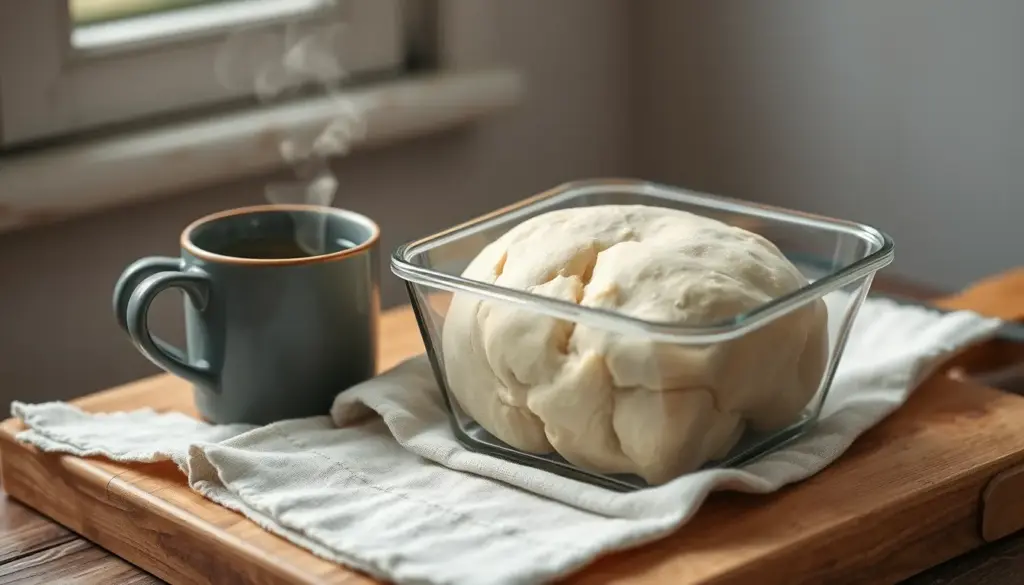
Warm dough changes quickly, so check it more often than you would on a slow overnight bulk. At 24 to 26 °C, look for a rise of about 50 to 75%, a domed surface with bubbles along the edges, and a dough that wobbles as one mass when you shake the container. Don’t wait for it to double in a warm kitchen. By the time it does, it has usually gone too far.
The signs are covered in detail in bulk fermentation: how to tell when it’s done. For a same-day loaf, the main habit is to start checking an hour before the earliest time the estimator gives.
Shaping and the counter proof
Shape a little tighter than you would for a fridge proof. A loaf that won’t be firmed up by cold needs extra surface tension to keep its height when it leaves the basket.
Proof it in a floured banneton, or a bowl lined with a floured tea towel, covered and in the same warm spot. At about 25 °C, expect one to two hours. Press a floured fingertip about 1 cm into the side. If the dent fills back slowly and leaves a shallow mark, bake it. If it pops straight back, give it longer. If it stays put, bake it at once.
Warm, soft dough is harder to score than a cold one. Turn it onto parchment, dust the top lightly with flour, and make one confident cut with a very sharp blade. If you want a firmer surface, 20 to 30 minutes in the freezer just before baking helps without upsetting the plan.
Baking and cooling
Bake as you would any loaf, ideally in a preheated Dutch oven: lid on for the first 20 minutes, then lid off until the crust is deep brown. Then leave it on a rack for at least an hour before cutting. That cooling hour is part of the bake, so count it into your plan if the bread is for dinner.
Same-day mistakes
- Starting with a sluggish starter. If the morning feed takes eight hours to peak, the whole day slips. Wake it up the night before.
- Measuring the room instead of the dough. A warm kitchen doesn’t guarantee warm dough if the flour and water went in cold.
- Piling in starter to save time. Past about 30%, the dough can turn slack and sour before it is strong enough to shape well.
- Waiting for a doubled dough. In a warm bulk, a doubled dough usually means an overproofed loaf.
- Cutting the loaf while it is hot. The crumb is still setting, and a loaf cut early turns gummy.
Same-day sourdough questions
Will a same-day loaf be milder than an overnight one?
Usually, yes. A warm, quick fermentation favours the softer lactic acids, and there is no long cold spell to build sharper acetic notes. Plenty of people prefer it that way. For more tang, use a starter slightly past its peak or swap 10 to 15% of the flour for whole grain.
What if bulk is still going when I need to go to bed?
Shape the loaf once it has risen enough, cover it and put it in the fridge overnight. It has simply become an overnight bake, which is no failure. Bake it straight from the fridge in the morning.
Can I add whole grain flour to a same-day dough?
Yes. Up to about 20% whole wheat or rye works well, and it speeds fermentation a little, so begin checking the dough sooner. Add a splash more water as well, since whole grain flour absorbs more than white.