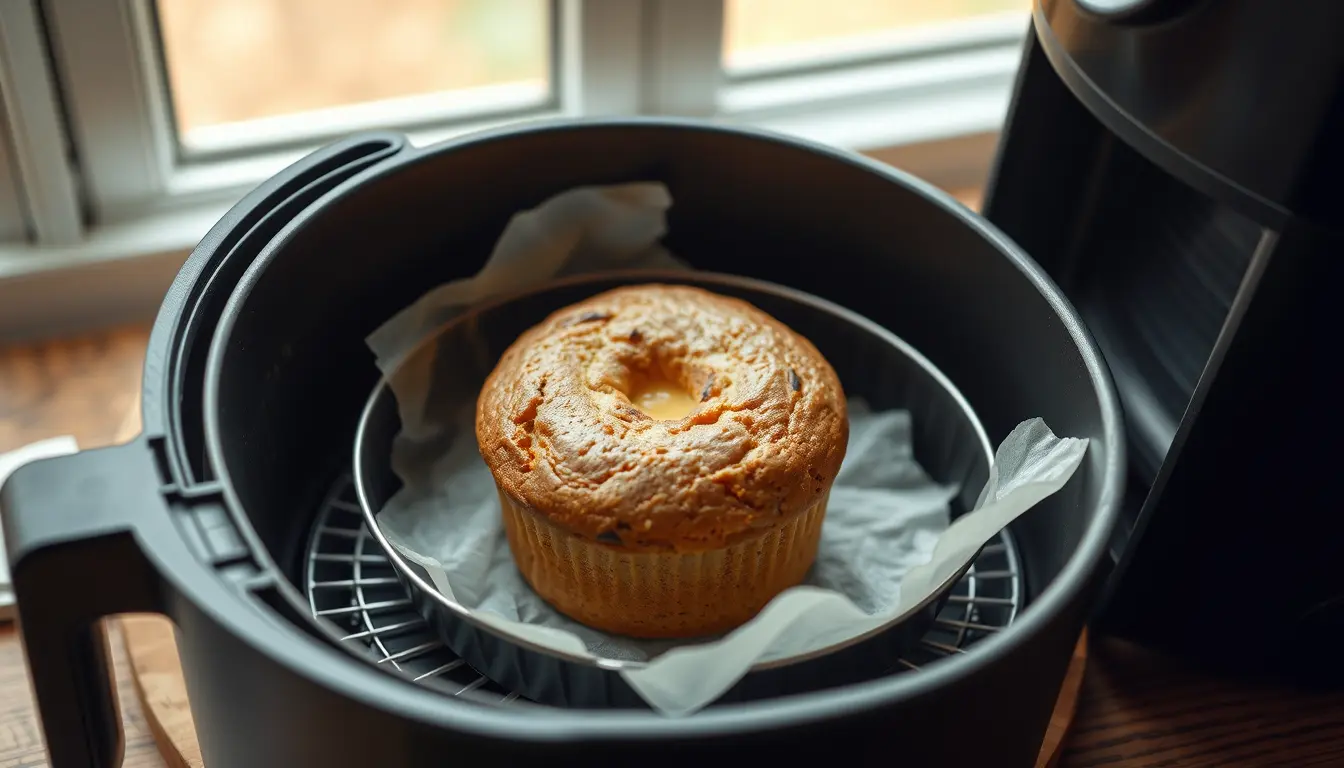
In a toaster oven without a fan, keep the recipe’s temperature, but start checking well before the stated time and shield the top with foil if it browns too quickly, because the heating elements sit very close to the food. In a convection toaster oven or an air fryer, start about 15 °C (25 °F) below the conventional recipe and begin checking about 20% before the original time. Both figures are approximate. Use small pans that leave room for air to move, and put an oven thermometer inside the first few times, since small appliances often run hotter or cooler than the dial says. Treat every first bake as a test.
Why small appliances bake differently
A full-size oven surrounds the food with a large volume of hot air at some distance from the elements. A toaster oven or air fryer squeezes everything into a small box.
- Close elements. The top heating element may be only a few centimetres above a cake. Radiant heat browns the surface long before the middle sets.
- Strong airflow. Air fryers and convection toaster ovens blow hot air hard across the food, which speeds up browning and drying.
- Fast swings. Small ovens heat up quickly but also cycle on and off sharply, so the actual temperature wanders.
- Small capacity. Pans must be smaller, which changes depth and baking time.
Setting the temperature
The oven temperature converter converts any recipe temperature to fan and convection settings. Enter 350 °F and it gives:
- 177 °C conventional, shown as 180 °C on a dial
- 157 °C for a fan oven
- 325 °F for a convection oven
- Gas mark 4
For 375 °F it shows 191 °C, 171 °C for fan and 350 °F for convection. The convection figure, 25 °F lower, is a sensible approximate starting point for an air fryer or a convection toaster oven. In Celsius that is about 15 °C lower, slightly gentler than the converter’s fan setting, which follows the UK habit of 20 °C. For a toaster oven with no fan, use the conventional figure.
Some air fryers need an even lower setting for cakes, because the fan is so close and so strong. If the top sets and cracks while the middle is still liquid, lower the temperature by another 10 °C next time. Fan vs conventional oven temperatures explains why a fan changes the heat.
Checking the real temperature
Small ovens are often less accurate than full-size ones. Place an oven thermometer on the rack, set the appliance to 180 °C, and read the thermometer after preheating and again 10 minutes later. If it reads 15 °C high or low, adjust your setting to match. Air fryer baskets are harder to test this way; a small, flat thermometer that fits inside works, otherwise rely on early checks.
Starting points for common bakes
These are approximate starting points, not tested recipes. Check early and note what works in your appliance.
| Bake | Conventional oven | Toaster oven, no fan | Air fryer or convection toaster |
|---|---|---|---|
| Cookies | 180 °C, 10 to 12 min | 180 °C, check at 8 min | 165 °C, check at 8 min |
| Muffins | 190 °C, 18 to 22 min | 190 °C, check at 14 min | 175 °C, check at 14 min |
| Brownies, 15 cm (6 in) pan | 175 °C, 25 to 30 min | 175 °C, check at 20 min | 160 °C, check at 20 min |
| Scones | 210 °C, 12 to 15 min | 210 °C, check at 10 min | 195 °C, check at 10 min |
Use the usual tests for doneness: golden edges for cookies, a clean skewer for muffins and brownies, and a firm, browned base for scones.
Choosing pans
The pan has to fit with space around it. In a toaster oven, leave at least 2 to 3 cm (1 in) between the pan and the walls and keep the top of the food well below the upper element. In an air fryer, the pan must sit in the basket without blocking airflow around the sides.
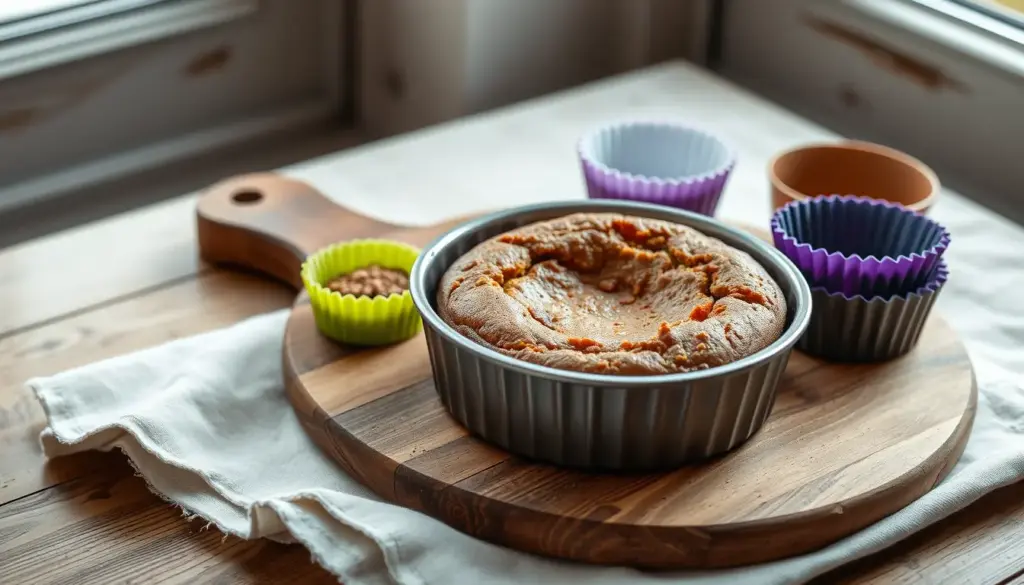
- Small metal cake pans, 15 cm (6 in) round or similar, work in many air fryers and toaster ovens.
- Ramekins and oven-safe mugs suit single portions.
- Silicone cups are handy for muffins and are easy to lift out.
- Glass and ceramic are fine if they are oven-safe and don’t come close to the elements.
When you swap to a smaller pan, you’ll usually need less batter. How to convert a cake recipe to a different pan size shows how to scale it, and how to halve or double a baking recipe helps with the ingredients.
What bakes well in a small oven
Some bakes suit a toaster oven or air fryer far better than others.
- Good fits: cookies in small batches, muffins and cupcakes, brownies and blondies in a small pan, scones, biscuits, individual crumbles, and reheating bread or pastries.
- Possible with care: small loaf cakes, mini quiches and small rolls. Cover the tops as they brown and check the centres.
- Better in a full oven: tall cakes, large loaves of bread, sheet-pan bakes, meringues and anything that needs long, very gentle, even heat.
A small appliance is also useful for test batches. Bake two cookies from a new dough or one cupcake from a batter to check the flavour and the timing before you heat the big oven for the rest.
Stopping the top burning
Browning on top is the most common problem. A few fixes:
- Use the lowest rack position in a toaster oven.
- Cover the top loosely with foil once it reaches the colour you want, crimping it to the pan so it can’t lift.
- Lower the temperature by 10 °C and allow more time.
- Fill pans less deeply so the middle cooks faster.
Safety in a small appliance
- Read your appliance’s manual on foil and parchment. Some air fryer makers advise against covering the basket base.
- Never put loose parchment or foil in an air fryer without food on top to hold it down. The fan can lift it into the heating element.
- Don’t preheat an air fryer with parchment inside.
- Keep the appliance a few centimetres from walls and cupboards, with nothing on top of it.
- Use oven gloves. The outside of a toaster oven gets very hot, and air fryer baskets hold heat.
Small-oven baking mistakes
- Using the full-size oven time. Small bakes in small ovens often finish much sooner.
- Ignoring the fan. Air fryer bakes need a lower setting than the recipe gives.
- Trusting the dial. Check it with a thermometer.
- Overfilling the pan. The batter rises into the element zone and burns.
- Crowding the basket. Air can’t move, so the bake browns unevenly.
Toaster oven and air fryer questions
Do I need to preheat an air fryer for baking?
For baked goods, a short preheat of three to five minutes usually helps the bake start evenly. Some models don’t require it, so check the manual, but for cakes and muffins, preheating gives more predictable results.
Can I bake a loaf of bread in a toaster oven?
Small loaves, yes, if the risen dough stays well below the top element. A full 9 × 5 in loaf usually rises too close to the heat. Bake rolls or a small loaf instead, and tent with foil early.
Why are the bottoms of my toaster oven bakes burning?
The lower element is close to the pan. Use a light-coloured pan, place it on the middle rack if there is one, or set a second baking sheet underneath as a heat shield.
Can I use glass bakeware in an air fryer?
Only if the dish is oven-safe, fits the basket with space around it, and isn’t exposed to sudden temperature changes. Never move cold glass straight into a hot appliance. Metal and silicone are usually easier choices, because they heat quickly and are lighter to lift out of a hot basket.