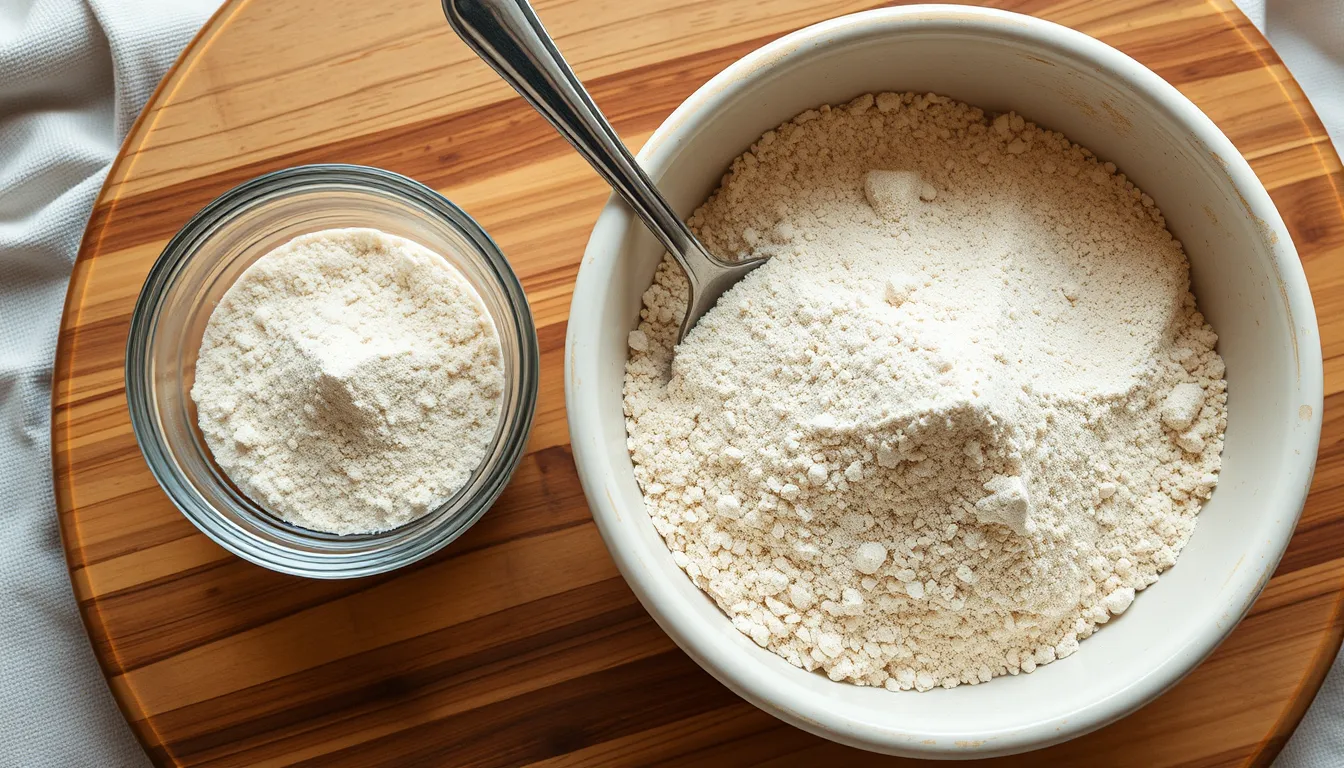
Vital wheat gluten is the natural protein of wheat, separated from the starch and dried into a fine, pale beige powder. It is roughly 75% to 80% protein, where ordinary flours sit somewhere around 9% to 14%, so a small amount makes a dough much stronger. It is worth using when your flour is too weak for the bread you want to bake: plain or all-purpose flour standing in for bread flour, whole wheat loaves that struggle to rise, chewy bagels, and doughs heavy with seeds, fruit or cheese.
It isn’t a flour in its own right, and because it is concentrated gluten, it is completely unsuitable for anyone who avoids gluten.
How it is made
Mix wheat flour with water, knead it into a dough, then rinse that dough repeatedly. The starch washes away, and what is left is a stretchy, rubbery mass of gluten. Dry that gently and mill it, and you have vital wheat gluten.
The word “vital” means the gluten still works. It has been dried at a temperature low enough that it can form a stretchy network again once it meets water in a dough.
What it does in a dough
Gluten is what lets bread dough stretch, trap gas and hold its shape. Adding more of it has several effects:
- Strength. The dough holds its shape better and resists tearing.
- Rise. More gluten traps more gas, so loaves stand taller.
- Chew. The crumb becomes springier and more resilient, which is exactly what bagels and New York-style pizza need.
- Water absorption. Gluten soaks up water, roughly one and a half times its own weight or a little more, so the dough may need a splash extra.
The effect is concentrated. Swapping 2% to 3% of the flour weight for vital wheat gluten raises the protein of the mix by about 1.2 to 2 percentage points, depending on the flour you start with.
When it helps
Weak flour in place of bread flour
Most people first buy a bag for this reason. Plain flour in the UK often carries only about 9% to 10% protein, noticeably less than bread flour. For 500 g of bread flour at 12.7% protein, using a plain flour at 9.5%, the bread flour substitute calculator gives 476 g of plain flour and 24 g of vital wheat gluten, which is 4.89% of the blend. Bread flour vs all-purpose flour looks at when that swap is worth making and when plain flour is fine on its own.
Whole wheat loaves
Bran cuts through gluten strands, so a whole wheat dough is weaker than its protein figure suggests. A little extra gluten helps it rise higher and hold a better crumb.
For a sandwich loaf with 300 g of whole wheat at 13.5% protein and the rest all-purpose at 10.5%, you can aim the whole blend at 13%. In the flour protein blend calculator, choose weights for a target protein, set a total of 1,000 g, enter the whole wheat as a fixed third flour, and use all-purpose and vital wheat gluten at 75% as the other two. It returns 675 g of all-purpose, 25 g of gluten and the 300 g of whole wheat. Without the gluten, the same 700 g of all-purpose plus 300 g of whole wheat comes out at only 11.4%.
A loaf made entirely of whole wheat benefits too. For 600 g of whole wheat at 13.5%, a target of 15% calls for 585 g of whole wheat and 15 g of gluten.
Set your own flours and target:
Bagels and chewy pizza
Bagels are meant to be dense and chewy, and many recipes call for high-gluten flour at around 14% protein. If you only have bread flour at 12.7%, the blend calculator asks for 979 g of bread flour and 21 g of gluten to make 1,000 g at 14%. That is just 2.1% gluten, and the difference in chew is easy to notice.
Doughs with lots of add-ins
Seeds, grains, dried fruit, nuts and cheese all interrupt the gluten network. A spoonful of gluten helps a heavily loaded dough hold together and rise, instead of baking into a low, crumbly loaf.
How much to use
Each bake is different, but these ranges, as a share of the total flour weight, are sensible places to start:
| What you are making | Typical amount |
|---|---|
| Plain or all-purpose flour brought up to bread flour | 2% to 5%, depending on the flour |
| Loaves with 30% to 100% whole wheat | 1% to 3% |
| Bagels and chewy pizza from bread flour | 1.5% to 3% |
| Doughs loaded with seeds, fruit or cheese | 1% to 2% |
The calculators give an exact figure when you know the protein of your flour. Without it, start at the low end of the range and increase by half a percent between bakes.
When to leave it out
- Cakes, cookies, pastry and quick breads. These want tenderness, not strength. Gluten makes them tough.
- Soft rolls and enriched doughs. A little extra chew is rarely what brioche or milk bread needs.
- When your flour is already strong. Adding gluten to a good bread flour for a standard loaf gives a tighter, rubbery crumb rather than a better one.
- As a cure for bad fermentation. If a loaf is flat because it overproofed, extra gluten won’t fix it.
More is not better. Beyond about 5% of the flour weight, most breads start to turn rubbery and tough, with a crumb that springs back like a sponge.
How to add it
- Weigh it on a scale. It is light and fluffy, and a spoonful can vary a lot.
- Whisk it through the dry flour before any liquid goes in. Dropped straight into water, it forms rubbery lumps that never disperse.
- Add a little more water, starting with about the same weight as the gluten and adjusting by feel.
- Mix and fold as usual. The dough may feel tight at first; a 20 to 30 minute rest before the first fold helps it relax.
If you are working in sourdough, the extra water changes the dough’s true hydration. The sourdough hydration calculator keeps track of it, including the starter.
Buying and storing
Vital wheat gluten is sold in bags or tubs in larger supermarkets, health food shops and baking suppliers. Check the label: some products sold as “gluten flour” are a blend of gluten and ordinary flour, with a lower protein content.
Keep it airtight in a cool, dry cupboard. It lasts for many months. If it smells musty or stale, replace it.
Common gluten mistakes
- Adding it by volume. Spoon measures of a fluffy powder are unreliable.
- Using too much. A few percent is enough. More makes bread tough.
- Forgetting the extra water. Without it, the dough feels firm and bakes into a tight crumb.
- Using it instead of proper dough development. Folds or kneading are still needed to organise the gluten. How much folding or kneading a dough needs is covered in stretch and folds vs kneading.
If a loaf is still heavy after the flour is sorted, the cause is usually fermentation; why is my sourdough dense? works through the rest.
Vital wheat gluten questions
Is it the same thing that seitan is made from?
Yes. Seitan is made by mixing vital wheat gluten with water and seasonings, then simmering or steaming it. The same bag works for both, though for bread you only ever need a small amount.
Can I add it to my sourdough starter?
There is no benefit. A starter doesn’t need extra strength, only food. Save the gluten for the dough itself.
Can I rescue a dough that is already mixed?
Not easily. Sprinkling gluten onto a finished dough tends to leave dry, rubbery streaks. If a dough is too weak, give it an extra set or two of folds, shape it firmly and bake it in a tin. Add the gluten to the flour next time.