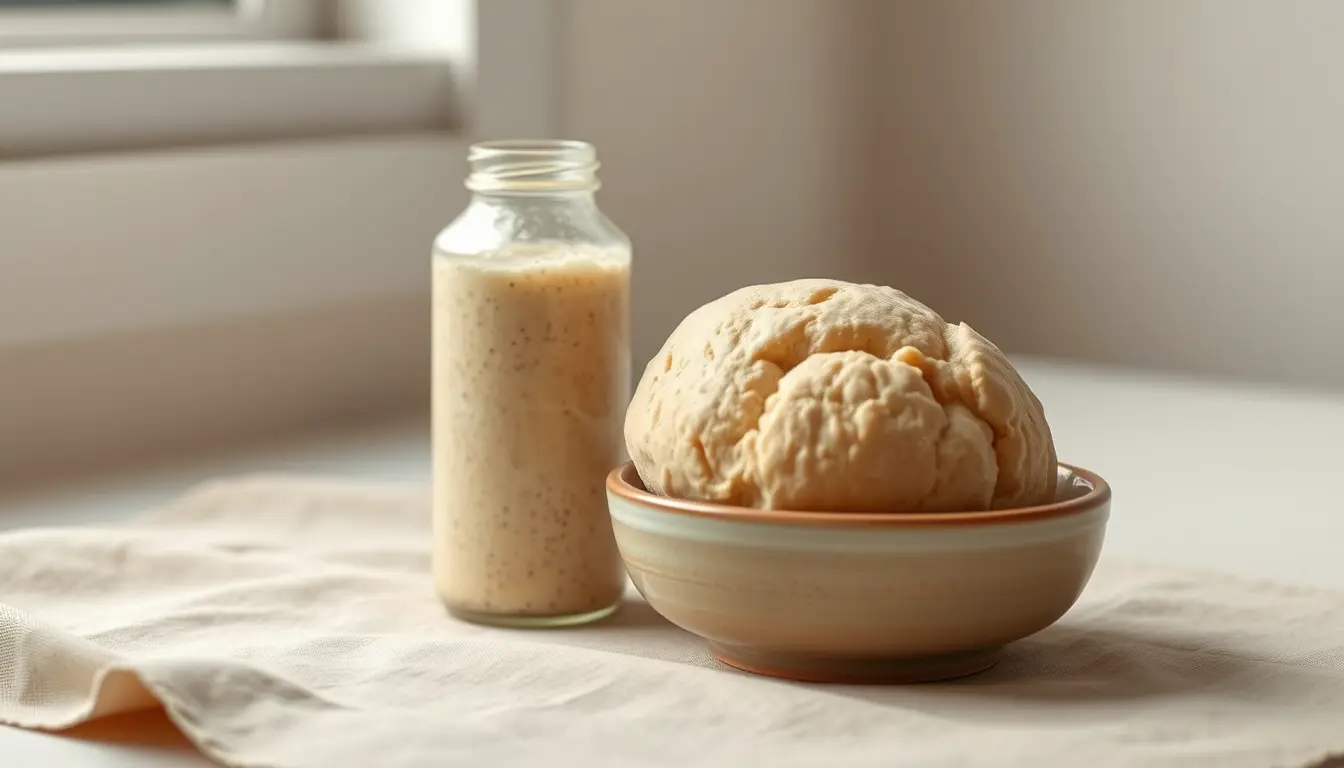
Most home recipes are written for a liquid levain, a batter-like mix of equal flour and water. If you keep a stiff levain instead, or want to try one, you can’t just drop it in at the same weight. The reliable method is to match the flour, not the weight: use enough stiff levain to carry the same amount of flour as the original, then add the water it no longer brings to the dough. The overall recipe stays the same, and only the timing and flavour shift.
That one rule covers almost every recipe. Below is the arithmetic, a worked example, how to build the stiff levain, and what to expect when you bake.
What each levain carries
A levain is just flour and water, so its hydration tells you how they’re split. That split is what has to be accounted for in a swap.
| Levain | Hydration | Flour inside | Water inside |
|---|---|---|---|
| 100 g liquid levain | 100% | 50 g | 50 g |
| 100 g stiff levain | 50% | about 67 g | about 33 g |
| 75 g stiff levain | 50% | 50 g | 25 g |
| 80 g liquid levain | 100% | 40 g | 40 g |
| 60 g stiff levain | 50% | 40 g | 20 g |
Notice that 75 g of a 50% levain holds the same 50 g of flour as 100 g of a 100% one. That is the swap in a nutshell. The stiff version is lighter because it carries less water.
Two ways to swap, and which to choose
Match the flour (recommended)
Use the weight of stiff levain that contains the same flour, then add the missing water to the dough. The amount of flour that has already fermented, the part that does the leavening and sets the pace, stays the same as in the original recipe.
Match the weight
Use the same weight of stiff levain and adjust the dough’s own flour and water to keep the totals level. This works, but the stiff levain now carries more flour than before, so the dough ferments faster and tastes a little more sour. It’s a fine choice if you want that. It just changes the recipe’s character.
A worked example
Take a straightforward loaf: 450 g of bread flour, 300 g of water, 100 g of liquid levain at 100% hydration and 10 g of salt. Put those into the sourdough hydration calculator and it confirms 500 g of total flour, 350 g of total water and 70% overall hydration, with 10% of the flour already fermented in the levain.
Now swap in a 50% stiff levain, matching the flour:
- Levain: 75 g of stiff levain, which carries 50 g of flour and 25 g of water.
- Dough water: 300 g plus the 25 g the levain no longer brings, so 325 g.
- Flour and salt: unchanged, 450 g and 10 g.
The calculator gives the same 500 g of flour, 350 g of water and 70% overall. Nothing about the finished dough’s hydration has moved.
Matching the weight instead would mean 100 g of stiff levain, about 433 g of flour and 317 g of water in the dough. Totals still land on roughly 70%, but the levain now holds about 13% of the total flour instead of 10%.
Building the stiff levain
The levain builder works backwards from the amount you need, and it accounts for the water and flour already in your starter. For the example above, ask it for 75 g at 50% hydration, with 10 g extra so you can scrape the jar without coming up short. With a 100% starter fed at 1:3 and a kitchen at 22 °C, it gives:
- 16 g of starter
- 49 g of flour
- 20 g of water
That makes 85 g, holding 57 g of flour and 28 g of water in total, and the builder estimates a peak in about 6 h 45 min to 10 h. Use 75 g in the dough and keep the rest.
Mixing a stiff levain feels very different. It’s closer to a small, firm dough than a batter, so knead it in the bowl for a minute until no dry flour is left, then shape it into a ball and cover it.
How a stiff levain behaves
Stiff levains ferment more slowly and more evenly than liquid ones, and they hold their peak for longer. That makes them more forgiving if you’re late getting to the dough. They also tend to push flavour toward the sharper side. Levain vs starter compares the styles side by side, and our guide to sourness explains why firmness changes the taste.
The builder’s peak estimate is based on the feeding ratio and temperature. A firm levain often lands toward the later end of the range, so start checking at the early end and judge by eye: ready when it has roughly doubled, feels domed and airy, and smells pleasantly sour.
Getting it into the dough
A stiff levain doesn’t stir into water the way a liquid one does. Two approaches work well:
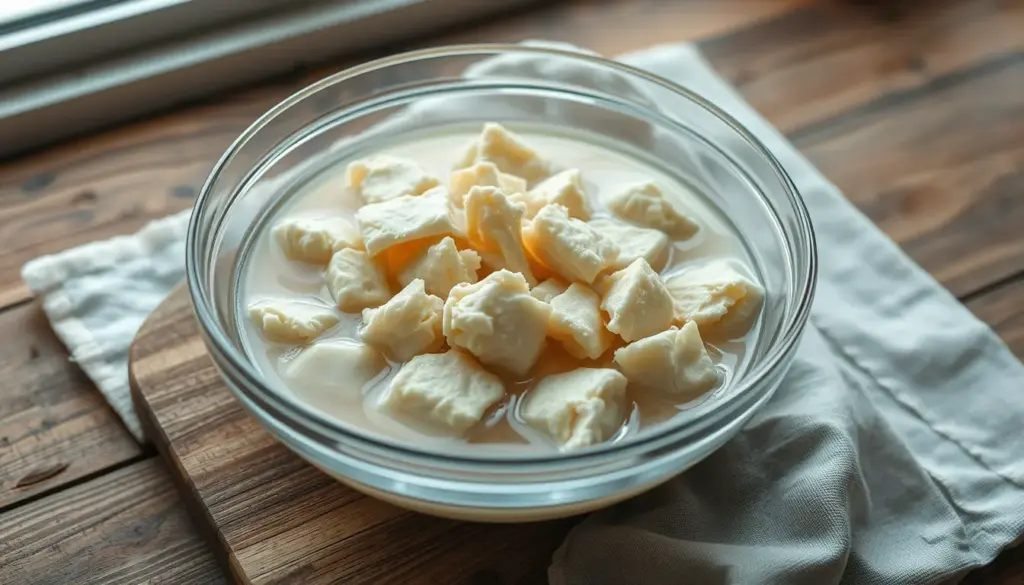
- Tear the levain into small pieces and drop them into the dough water. Leave them for a few minutes, then squeeze and swish until the water turns milky and only small lumps remain.
- Or add the torn pieces straight to the dough after the flour and water have rested, and pinch them through with wet hands until evenly spread.
Expect bulk to run a little slower than the original recipe at first, then catch up. Judge it by rise and feel, as always.
Swapping the other way
The same logic works in reverse. If a recipe asks for 60 g of stiff levain at 50%, that’s 40 g of flour and 20 g of water. A liquid levain with the same flour weighs 80 g, but brings 40 g of water, which is 20 g more. Take those 20 g out of the dough water. Expect a faster, milder ferment.
Keeping a stiff starter, not just a levain
Some bakers keep the starter itself stiff, which is handy for longer gaps between feeds. To convert a 100% starter in one step, the starter feeding calculator can do the sum with a custom ratio. Feeding it 1 part starter, 2 parts flour and 0.75 parts water gives 50% hydration. For 50 g that’s 13 g of starter, 27 g of flour and 10 g of water.
Once the starter is at 50%, feed it 1:2:1 to keep it there. Set the seed hydration to 50% and the calculator confirms it: 13 g of starter, 25 g of flour and 13 g of water, peaking in about 5 h 45 min to 8 h 45 min at 22 °C.
Swap mistakes
- Using the same weight without adjusting anything. The dough ends up drier than intended, by roughly 17 g of water per 100 g of levain.
- Forgetting the extra water. Match the flour, then add the missing water, or the dough will feel stiff from the start.
- Using a stiff levain long before it’s ready. It looks less dramatic than a bubbling batter. Wait for a clear dome and an airy texture.
- Adding it in one solid lump. It takes ages to disperse and leaves dense streaks in the crumb.
Stiff levain questions
Does the salt need changing?
No. Salt is based on the total flour, and matching the flour keeps that total the same. Even with the weight-matching method, the change is too small to matter.
Can I use a stiff levain for a same-day bake?
Yes, as long as you build it the night before. Because it ferments slowly, an overnight build at room temperature is often ready by mid-morning, which suits a dough mixed after breakfast.
Will the crumb look different?
Usually only slightly. Some bakers find a stiff levain gives a bolder, slightly more open crumb, and others see no difference. Fermentation, shaping and baking matter far more than the levain’s style.