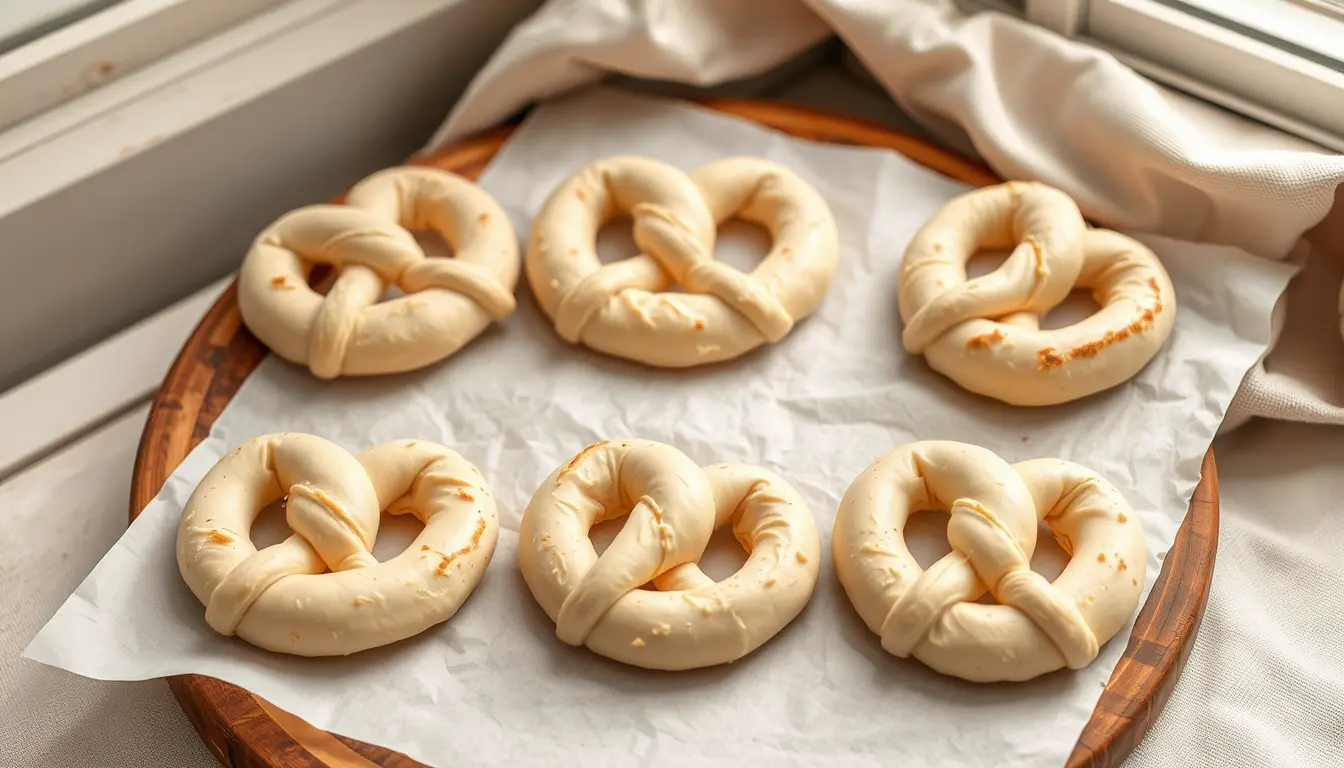
Soft pretzels get their deep brown, glossy crust and distinctive flavour from a quick dip in an alkaline bath before baking. At home, that bath is usually baking soda dissolved in simmering water, often somewhere around 50 to 80 g per litre in published recipes. Each pretzel goes in for about 20 to 30 seconds, then onto a tray, a sprinkle of coarse salt and into a hot oven. The alkaline surface browns far faster than plain dough, which is why a pretzel tastes and looks so different from a bread roll made from almost the same dough.
Why an alkaline bath browns so well
Browning in baking comes largely from the Maillard reaction, in which proteins and sugars react under heat to form colour and flavour. That reaction runs faster in alkaline conditions. Dough is normally slightly acidic or close to neutral. Dip it in an alkaline solution, and the surface layer changes enough to brown deeply in the short time a pretzel spends in the oven.
Baking soda is mildly alkaline on its own, which is also why it reacts with acids in batters, as baking powder vs baking soda explains. The bath also gelatinises the outer layer of starch, much like boiling a bagel. That gives the thin, shiny, slightly chewy skin. Traditional German bakeries use a dilute solution of food-grade lye (sodium hydroxide), which is far more alkaline than baking soda. Lye is caustic and needs careful handling, protective gloves and eyewear, so baking soda is the usual home choice. It gives a lighter brown and a milder flavour, but still a very recognisable pretzel.
The dough
Pretzel dough is firm and fairly low in water, so it rolls into long, smooth ropes that hold a crisp outline. A little butter softens the crumb and a little sugar helps the colour. This batch makes eight pretzels:
- 500 g bread flour
- 300 g warm water
- 25 g soft butter
- 10 g brown sugar or barley malt syrup
- 10 g salt
- 5 g instant yeast
In the baker’s percentage calculator it reads:
| Ingredient | Weight | Baker’s % |
|---|---|---|
| Bread flour | 500 g | 100% |
| Water | 300 g | 60% |
| Soft butter | 25 g | 5% |
| Brown sugar | 10 g | 2% |
| Salt | 10 g | 2% |
| Instant yeast | 5 g | 1% |
| Total | 850 g | 170% |
At 60% hydration the dough is smooth and only slightly tacky. Wetter dough rolls out unevenly and loses its shape in the bath.
If you use a different yeast, the yeast converter gives the equivalents for 5 g of instant yeast: 6 g of active dry yeast or 15 g of fresh. By volume, 5 g of instant is about 1⅝ tsp.
Mixing, rising and shaping
Knead the dough until smooth and elastic, about 8 to 10 minutes by hand. Cover and let it rise for about an hour at warm room temperature, until puffy but not fully doubled. Pretzels don’t need a big rise; a slightly underproofed dough holds its shape best through the bath.
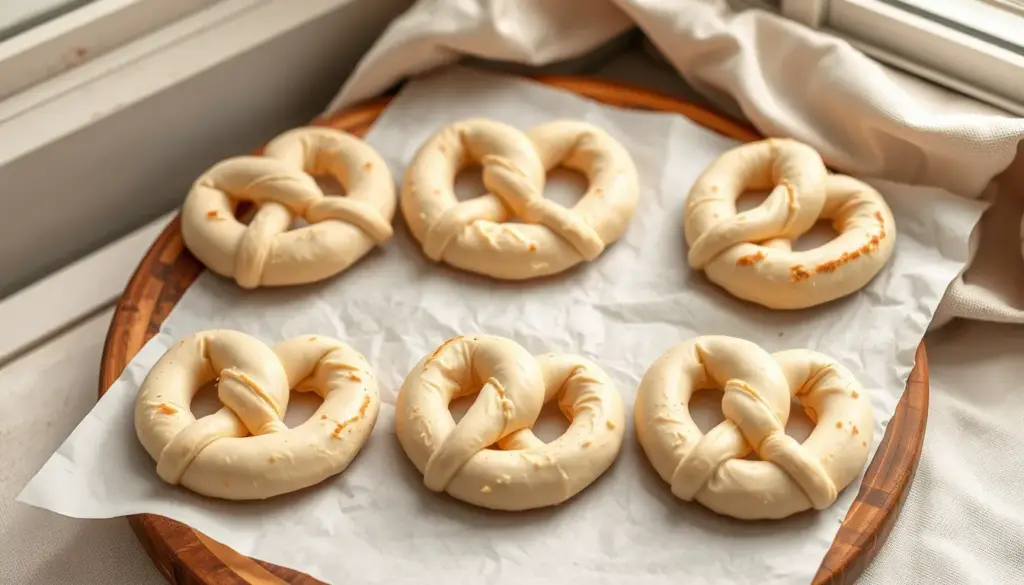
Divide the dough into eight pieces of about 105 g and rest them for 10 minutes. Roll each piece into a rope about 60 cm (24 in) long, thicker in the middle and tapering toward the ends. To form the classic shape, lift the ends into a U, cross them over each other twice, then fold the twisted ends down and press them onto the base of the U.
Set the shaped pretzels on a lightly oiled or parchment-lined tray and refrigerate them, uncovered, for 30 minutes to an hour. A cold, slightly dry surface makes them much easier to handle in the bath and helps them keep a crisp outline.
Making the baking soda bath
Use a wide stainless steel pot. Avoid aluminium: alkaline solutions react with it and can discolour the pot and leave a metallic taste.
For a typical home bath, bring about 2 litres of water to a simmer. Add the baking soda slowly, a spoonful at a time. It foams up as it dissolves, so pour too fast and it can boil over. The cups to grams converter puts ½ cup of baking soda at 144 g and ¼ cup at 72 g, so ½ cup in 2 litres sits at roughly 70 g per litre. Recipes vary, and the strength is a matter of taste: more soda gives a darker colour and a stronger flavour. These figures are approximate.
Keep the water at a steady simmer, not a rolling boil.
Dipping
- Lower one or two pretzels into the bath on a wide slotted spatula.
- Leave them for about 20 to 30 seconds, gently spooning the solution over any part that floats above the surface.
- Lift them out, let them drain briefly, and place them on a parchment-lined tray. Parchment works better than bare metal here, since the wet, alkaline surface tends to stick.
- Sprinkle with coarse pretzel salt straight away, while the surface is still damp.
Wear an oven glove and work carefully. The solution is hot and a pretzel slips easily from a spatula. Avoid splashes on your skin and eyes, and rinse any splashes off with plenty of water.
Baking
Bake at 220 to 230 °C (425 to 450 °F) for about 12 to 15 minutes, until deep, glossy brown. A few minutes extra darkens them further if you like a stronger colour. Many bakers cut a short, shallow slash across the thickest part of each pretzel before baking; it opens into a pale stripe that shows off the contrast. Cool them on a rack for 10 minutes before eating.
A simple timeline
Pretzels fit into an afternoon. Mix and knead the dough, then let it rise for about an hour. Divide, rest and shape, which takes around 20 minutes for eight pretzels once you’ve got the hang of it. While the shaped pretzels chill, heat the oven and bring the bath to a simmer. Dipping and topping take about 10 minutes, and baking another 15. From the first stir to a warm pretzel is roughly two and a half hours. For a deeper flavour, the shaped pretzels can rest in the fridge overnight, covered, and go into the bath straight from the cold.
Baked baking soda
For a darker colour and a flavour closer to lye pretzels, some bakers bake baking soda before using it. Spread it on a foil-lined tray and bake at about 120 °C (250 °F) for an hour. Heat drives off water and carbon dioxide and turns sodium bicarbonate into sodium carbonate, which is more strongly alkaline.
Baked soda is more irritating to skin than ordinary baking soda. Wear gloves when handling it and the bath, keep it away from children, and label the container clearly so it’s never mistaken for regular baking soda.
Pretzel mistakes
- Overproofing. Puffy pretzels lose their shape in the bath and bake up bready.
- Too wet a dough. Ropes stretch unevenly and the shape blurs.
- Leaving them in the bath too long. A minute or more can give a bitter, metallic taste.
- Using an aluminium pot or tray. The alkaline solution reacts with the metal.
- Salting too late. Once the surface dries, the salt won’t stick.
For a closely related bake with a plain water boil, homemade bagels shows how a firm dough behaves in hot water.
Pretzel questions
Can I make pretzel buns or bites with the same dough?
Yes. Shape the dough into balls or short pieces, give them the same bath, and bake slightly longer for buns, about 15 to 20 minutes.
Why do my pretzels taste soapy?
The bath was too strong or the pretzels stayed in it too long. Use less baking soda, shorten the dip, and let excess solution drain off before baking.
Can I reheat soft pretzels?
Yes. Warm them in a hot oven for 4 to 5 minutes. A light spritz of water before heating helps the crust soften again.
Do I have to use pretzel salt?
No. Coarse sea salt, sesame seeds or everything seasoning all work. Fine table salt dissolves into the damp surface and tastes very salty.