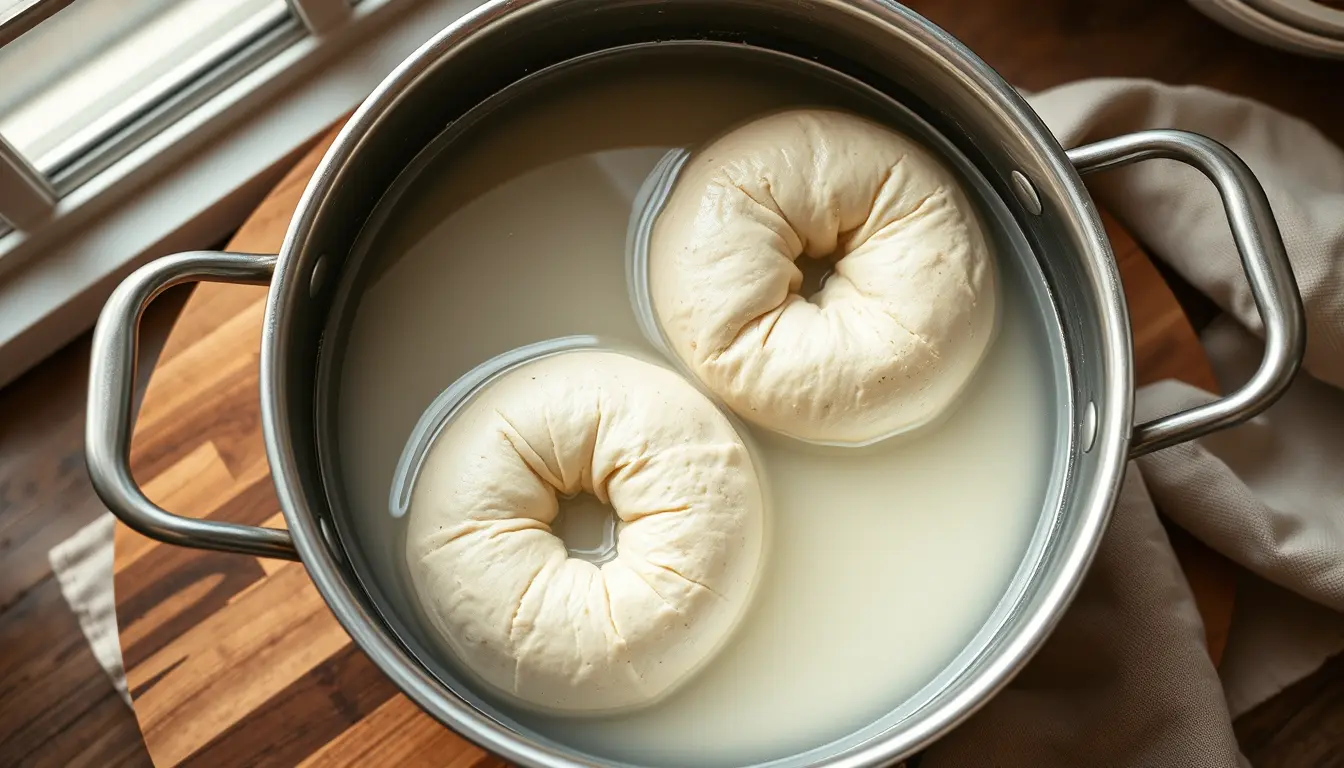
Good homemade bagels rest on three steps. First, a stiff dough of strong flour at about 55 to 58% hydration, which gives the dense, chewy crumb. Second, a brief boil of 30 to 60 seconds per side, which sets the outside before baking and creates the shiny, slightly tough crust. Third, a hot oven at around 220 to 230 °C (425 to 450 °F). An overnight rest in the fridge between shaping and boiling isn’t strictly required, but it improves the flavour and the blistered surface, and it splits the work over two days.
The dough: firm on purpose
Most bread doughs sit between 62 and 75% hydration. Bagel dough is much drier, which is why it feels stiff, almost like modelling clay. That firmness keeps the shape round through boiling and gives the close, chewy texture that sets a bagel apart from a roll with a hole.
Here is a typical formula for eight bagels:
- 500 g high-gluten or strong bread flour
- 285 g water
- 15 g barley malt syrup
- 10 g salt
- 4 g instant yeast
Entered into the baker’s percentage calculator, with the flour typed as flour, water as liquid and the rest as other ingredients, it shows:
| Ingredient | Weight | Baker’s % |
|---|---|---|
| High-gluten flour | 500 g | 100% |
| Water | 285 g | 57% |
| Barley malt syrup | 15 g | 3% |
| Salt | 10 g | 2% |
| Instant yeast | 4 g | 0.8% |
| Total | 814 g | 162.8% |
That makes eight bagels of about 100 g each, with a little to spare for what sticks to the bowl. Change the water to 290 g and the yeast to 3 g, as some recipes do, and it reads 58% hydration with 0.6% yeast.
Percentages make it easy to change the batch. For twelve bagels, switch the calculator to percentages and set the flour to 750 g; every other ingredient follows. If percentages are new to you, start with baker’s percentages explained simply.
Flour and malt
Strong flour matters more for bagels than for most breads. High-gluten flour, often around 14% protein, gives the most chew, and bread flour works well too. All-purpose flour makes a softer bagel. If that’s all you have, a spoonful of vital wheat gluten helps, as what is vital wheat gluten explains. Bread flour vs all-purpose flour compares the two in more detail.
Barley malt syrup adds a faint, toasty sweetness and helps the crust brown. If you can’t find it, honey or brown sugar works in the dough, though the flavour is a little different.
Yeast amounts
The formula uses 4 g of instant yeast. If you have a different type, the yeast converter gives the equivalents: 4.8 g of active dry yeast (about 1½ tsp) or 12 g of fresh yeast. For instant yeast by volume, 4 g is about 1¼ tsp.
With an overnight rest in the fridge, this amount gives a good rise without overproofing. For a same-day bagel with no fridge stage, many recipes use a little more, closer to 1% of the flour.
Mixing a stiff dough
Stiff dough is hard work. In a stand mixer, keep to the lowest speeds and mix in a batch no larger than the manual allows for stiff dough, often well below its limit for soft dough. If the motor strains, finish by hand. By hand, expect about 10 to 12 minutes of firm kneading on an unfloured counter. The dough should end up smooth and tight, without dry flecks.
Let the dough rest, covered, for about 30 minutes to an hour at room temperature. It won’t rise much, and that’s fine.
Shaping
Divide the dough into eight 100 g pieces and rest them for 10 minutes so they relax. Then pick one of two methods:
- Rope and join: roll each piece into a rope about 25 cm long, wrap it around your hand so the ends overlap under your palm, and roll the joint firmly on the counter to seal it.
- Poke and stretch: shape a tight ball, push your thumb through the middle, and widen the hole gently to about 4 cm. It shrinks as the bagel rises.
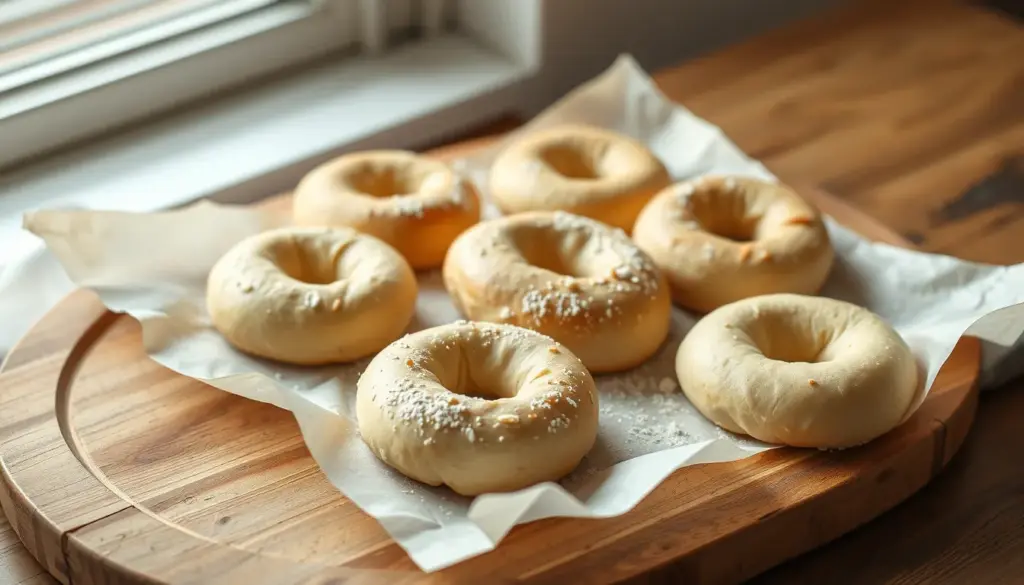
Place the bagels on a tray lined with parchment and dusted with semolina or cornmeal, cover well, and refrigerate overnight, about 12 to 18 hours.
Checking they’re ready to boil
Here the float test earns its place. Drop one bagel into a bowl of cold water. If it floats within about ten seconds, the batch is ready to boil. If it sinks, pat it dry, return it to the tray, and check again after 20 to 30 minutes at room temperature.
Boiling
Bring a wide pot of water to a gentle boil and stir in a tablespoon or two of barley malt syrup or a spoonful of baking soda. Both help colour the crust. Lower in two or three bagels at a time without crowding them.
- 30 seconds per side gives a thinner, crisper crust.
- 60 seconds per side gives a thicker, chewier one.
Lift them out with a slotted spoon, let them drain briefly on a rack, then add toppings such as sesame, poppy seeds or coarse salt while the surface is still wet. Work carefully: the water is at a full boil and a wet bagel slips easily.
Baking
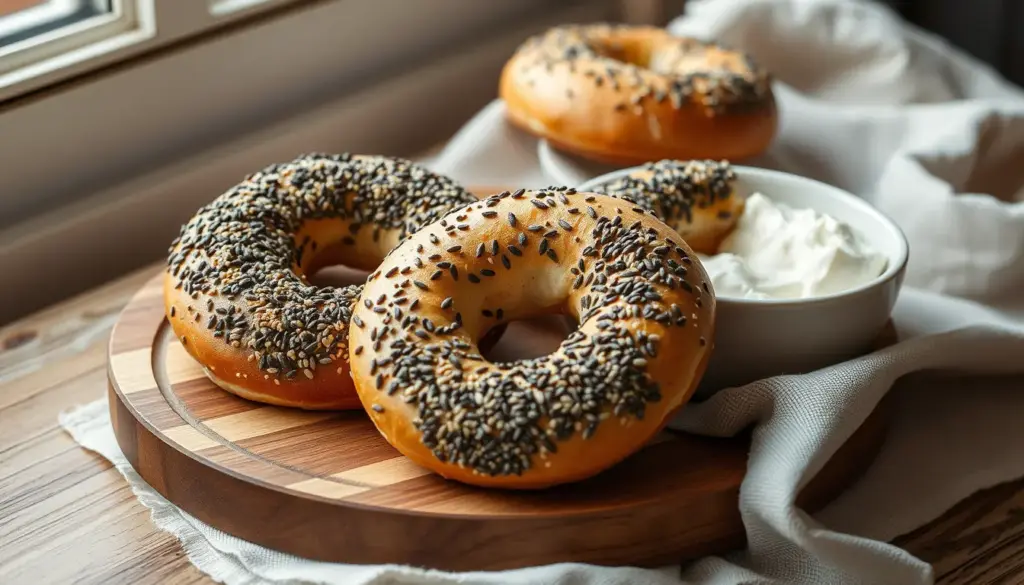
Bake on the parchment-lined tray at 220 to 230 °C (425 to 450 °F) for about 18 to 22 minutes, until deep golden brown. Turning the tray halfway helps them colour evenly. Let them cool for at least 20 minutes before slicing, since the crumb is still setting.
A two-day timeline
Bagels split comfortably over two days, with most of the work on the first.
- Day 1, evening: mix and knead the dough, about 15 minutes in all.
- 30 to 60 minutes later: divide, rest briefly and shape the bagels.
- Straight after shaping: cover the tray and refrigerate overnight.
- Day 2, morning: heat the oven, bring the water to the boil and float-test one bagel.
- About 45 minutes later: boil, top and bake, ready for a late breakfast.
If you’d rather bake the same day, let the shaped bagels rise at room temperature for about an hour, until they pass the float test, then boil and bake. The flavour is milder and the crust a little less blistered, but they’re still very good.
Bagel mistakes
- Making the dough too wet. It feels easier to work but gives a puffy, bread-like bagel.
- Underkneading. Stiff dough needs real effort to become smooth. A rough dough gives a craggy surface.
- Boiling too long. Several minutes in the water makes a thick, leathery skin and can wrinkle the surface.
- Crowding the pot. The water stops boiling and the bagels stick together.
- Skipping the float check. Overproofed bagels deflate and wrinkle in the water.
Bagel questions
Why did my bagels wrinkle after boiling?
They were usually overproofed, so the weakened structure collapsed as the outside set. A very long boil can also do it. Check them with the float test earlier next time, and keep the boil to a minute per side or less.
Can I make bagels with sourdough starter?
Yes. Replace the yeast with about 20% starter and allow longer for the first rest, often a few hours, before shaping and refrigerating. Remember to take the starter’s flour and water out of the formula to keep the hydration where it should be.
How should I store homemade bagels?
They’re best on the day they’re baked. Keep leftovers in a paper bag for a day, or slice and freeze them, then toast straight from frozen.