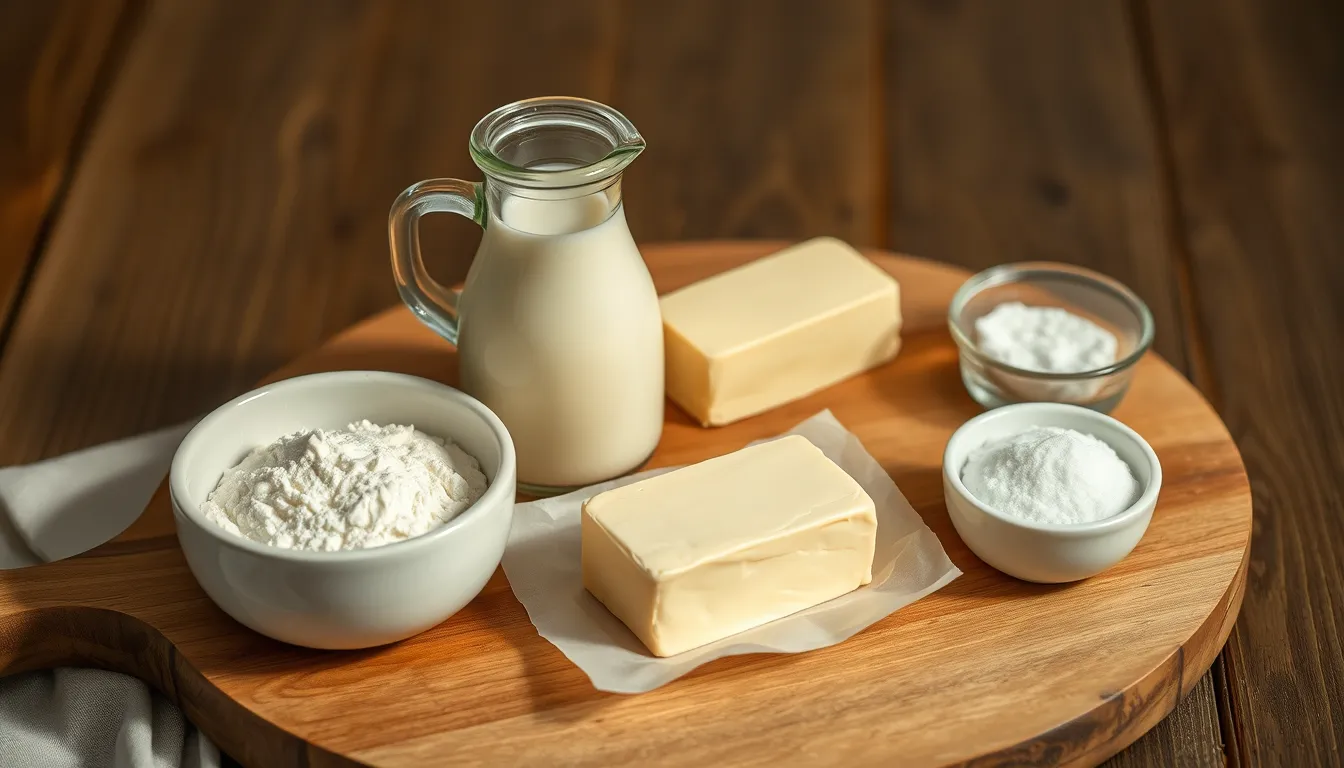
A lidded 13 × 4 × 4 in Pullman pan takes about 950 g of dough, and the smaller 9 × 4 × 4 in size about 660 g. Both figures come from filling a closed pan at roughly 280 g of dough per litre of pan volume. That is a good deal less than an open tin of the same size would take, because the lid stops the loaf from doming above the rim. With the right amount, the dough just fills the corners under the lid and bakes into a neat block with flat sides and a fine, even crumb.
Too much dough and the crumb gets squashed or the lid is forced up. Too little and the corners stay rounded. Here is how to get it right for your pan and your dough.
Dough weights for common pans
These figures come from the loaf pan dough calculator, using its standard densities of 280 g per litre with the lid on and 400 g per litre with it off.
| Pan | Volume | With the lid | Without the lid |
|---|---|---|---|
| 13 × 4 × 4 in | 3.41 L | 954 g | 1,363 g |
| 9 × 4 × 4 in | 2.36 L | 661 g | 944 g |
| 30 × 10 × 10 cm | 3 L | 840 g | 1,200 g |
| 20 × 10 × 10 cm | 2 L | 560 g | 800 g |
The gap between the two columns is large. A 9 × 4 × 4 in pan baked open wants 944 g, but lidded it needs only 661 g, about 30% less.
Why a lidded pan needs less dough
In an open tin, the dough rises above the rim and bakes into a dome. The extra dough goes upward, into the space above the pan.
A Pullman lid removes that space. As the loaf springs in the oven, it presses against the lid and spreads into the corners instead. The right amount of dough does exactly that and no more: it reaches the lid, fills the corners and stops. The result is the flat top and sharp edges that give the pan its name in bakeries, pain de mie in French, and the square slices that suit sandwiches and toast.
Add too much and the dough has nowhere to go. It compresses into a tight, dense crumb, especially near the top, or pushes the lid up and squeezes out along the edges.
Measuring a Pullman pan at home
Pullman pans vary more than their labels suggest. Measure the inside at the rim for length and width, and the inside depth. If the sides slope, the pan holds a bit less than those measurements imply.
For the most accurate number, measure the volume directly. Line the pan with a food bag if it has any gaps, set it on a scale, zero it, fill it with water to the rim and read the weight. Each gram of water is one millilitre of volume, so 2,360 g of water means a 2.36 L pan.
Enter your pan’s size, choose the lidded style, and the calculator does the rest:
A European pan measuring 30 × 10 × 10 cm, for example, gives 840 g lidded. Two smaller 20 × 10 × 10 cm pans need 560 g each, or 1,120 g of dough in total.
Adjusting for your dough
The 280 g per litre figure suits a typical soft sandwich dough. Your dough may rise more or less.
- Rich, soft doughs with plenty of butter, milk and sugar rise high and fill the pan easily. If they tend to push the lid, try around 260 g per litre. For a 9 × 4 × 4 in pan, that is 614 g.
- Whole grain and denser doughs rise less. Try around 300 g per litre, which asks for 708 g in the same pan.
The calculator has a field for your own dough density, so once you know what suits your recipe, you can reuse it for any pan. Change it in steps of about 10% between bakes.
From dough weight to ingredient list
Once you know the dough weight, baker’s percentages turn it into a recipe. Say you want a classic milk loaf in the 9 × 4 × 4 in pan. Write the formula as 100% bread flour, 65% milk, 10% butter, 6% sugar, 2% salt and 1.5% instant yeast, then use the baker’s percentage calculator in percentages-to-weights mode, scaled to 661 g of total dough.
It gives 358 g of bread flour, 233 g of milk, 36 g of butter, 21 g of sugar, 7.2 g of salt and 5.4 g of instant yeast. Add a few grams to allow for dough left in the bowl, then weigh the dough before it goes into the pan and trim it to 661 g.
A strong bread flour helps here. It gives the loaf enough structure to hold its square shape without sagging; bread flour vs all-purpose flour covers the difference.
Proofing and baking with the lid
- Grease the pan and the underside of the lid. Butter or a light spray of oil both work. Dough that sticks to the lid tears the top of the loaf.
- Shape it evenly. Roll the dough into a tight log the length of the pan, or divide it into two or three equal pieces, roll each one up and lay them side by side. Even shaping fills the corners evenly.
- Proof with the lid slightly open. Slide the lid most of the way on so you can see the dough. It is ready when the top is about a finger’s width below the rim and springs back slowly when pressed.
- Close it and bake. Slide the lid shut and bake at about 190 to 200 °C (375 to 390 °F) for 30 to 40 minutes, depending on the size.
- Check the colour. Slide the lid off near the end. If the top is pale, give it 5 to 10 minutes more uncovered.
- Turn it out promptly. Remove the loaf from the pan straight away and cool it on a rack, so the sides don’t turn soggy from trapped steam.
Reading the shape
| What you see | Likely cause | Next time |
|---|---|---|
| Rounded top corners, gaps under the lid | Too little dough, or underproofed | Add about 10%, or proof a little longer |
| Dense, compressed band near the top | Too much dough | Reduce by about 10% |
| Lid pushed up, dough squeezed out | Much too much dough, or overproofed | Reduce the dough and close the lid earlier |
| Pale, soft sides | Loaf left in the pan to cool | Turn it out as soon as it comes from the oven |
Pullman mistakes
- Using an open-pan recipe as written. It will usually overfill a lidded pan.
- Closing the lid too late. If the dough has already reached the lid before baking, it will be overproofed by the time it springs.
- Skipping the grease on the lid. The top tears and sticks.
- Guessing the dough weight. Weigh the whole batch and trim it to the target.
If you also bake in ordinary open tins, how much dough for a 9×5 loaf pan covers the other side of the calculation.
Pullman pan questions
Can I bake a Pullman loaf without the lid?
Yes. It bakes like any open tin, with a domed top, and it needs more dough to fill it, about 40% more at the calculator’s standard densities. Choose the open style in the calculator and it gives the new weight.
Does a smaller Pullman pan need less baking time?
Yes. A 9 × 4 × 4 in loaf usually needs 5 to 10 minutes less than a 13 × 4 × 4 in one at the same temperature, since the heat has less distance to travel to the centre. Go by the colour when you slide the lid off, or check that the middle of a soft sandwich loaf has reached about 90 °C (195 °F).
How do I keep the lid from sticking?
Grease it well, and let the loaf cool for a minute or two before sliding the lid off. If it still sticks, run a thin spatula along the edge. A light dusting of flour over the grease helps with very soft doughs.