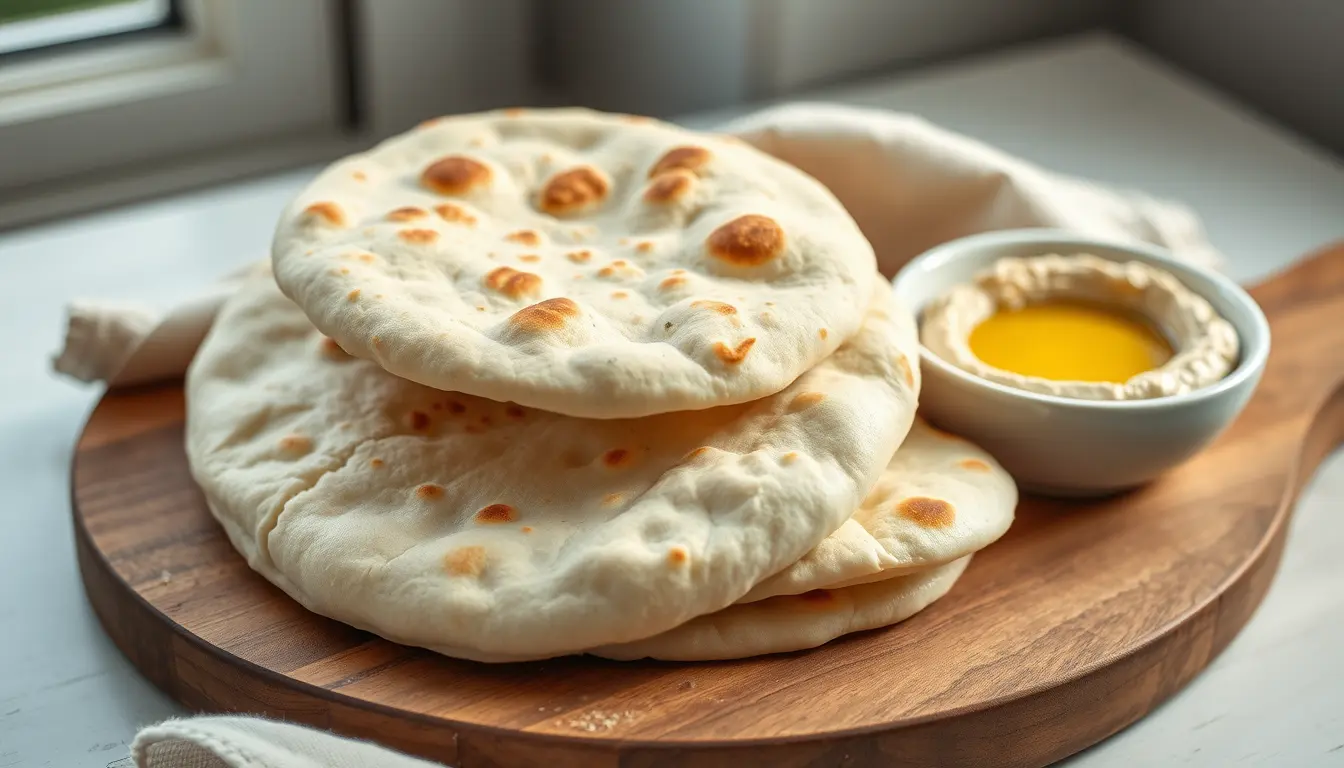
Pita puffs because intense heat turns the water inside a thin, evenly rolled round of dough into steam faster than the outside can set. The steam pushes the top and bottom layers apart and forms the pocket. To make sure it happens, roll the dough to an even thickness of about 5 mm, keep the surface from drying out or tearing, and bake on a surface that has been preheated until it’s very hot, around 250 to 260 °C (480 to 500 °F). If any of those three things is missing, you get flatbread instead of a pocket.
The science of the pocket
When a pita hits a very hot stone, steel or pan, two things happen at once. The bottom surface sets almost instantly, and the water inside the dough starts turning to steam. The top surface sets a moment later. Between them, the dough is still soft. As the steam expands, it needs somewhere to go, and the weakest point is the soft middle layer, so the round splits horizontally and balloons.
That’s why pita needs both high heat and an even, unbroken skin. Low heat lets the whole round set slowly, so steam escapes gradually through the crumb instead of building up. A tear or a thin patch acts like a release valve: the steam escapes there and the pita stays flat or puffs only partly.
The dough
Pita dough is a simple, moderately hydrated yeast dough. Here’s a batch for eight pitas:
- 500 g bread flour (or all-purpose)
- 325 g warm water
- 15 g olive oil
- 10 g salt
- 5 g instant yeast
In the baker’s percentage calculator that reads:
| Ingredient | Weight | Baker’s % |
|---|---|---|
| Bread flour | 500 g | 100% |
| Water | 325 g | 65% |
| Olive oil | 15 g | 3% |
| Salt | 10 g | 2% |
| Instant yeast | 5 g | 1% |
| Total | 855 g | 171% |
At 65% hydration, the dough is soft enough to roll easily but firm enough to hold an even thickness. The oil keeps the bread supple after baking. Much wetter doughs tear when you roll them; much drier ones puff less because they hold less water to turn into steam.
For a bigger batch, change the calculator’s mode to percentages and enter a new flour total. Twelve pitas take about 750 g of flour, and the other amounts adjust to match.
Mixing and rising
Mix until the dough is smooth and elastic, about 8 to 10 minutes by hand or 5 to 6 minutes in a mixer. Cover and let it rise until roughly doubled, typically 1 to 1½ hours at a warm room temperature. Why is my yeast bread not rising can help if it’s still sluggish after two hours.
Dividing and rolling
Divide the 855 g of dough into eight pieces of about 105 g. Round each one into a smooth ball and rest them, covered, for 15 to 20 minutes. Resting relaxes the gluten so the dough rolls out without shrinking back.
Roll each ball into a round about 18 cm (7 in) across and 5 mm (just under ¼ in) thick. Even thickness matters more than a perfect circle. Roll from the centre outward, turning the dough a quarter turn between strokes, and avoid rolling over the edges, which squashes them thin.
Use as little flour as possible on the counter. A heavy dusting of flour on the surface can stop the round from sealing smoothly, and a dry crust forms before the steam can build.
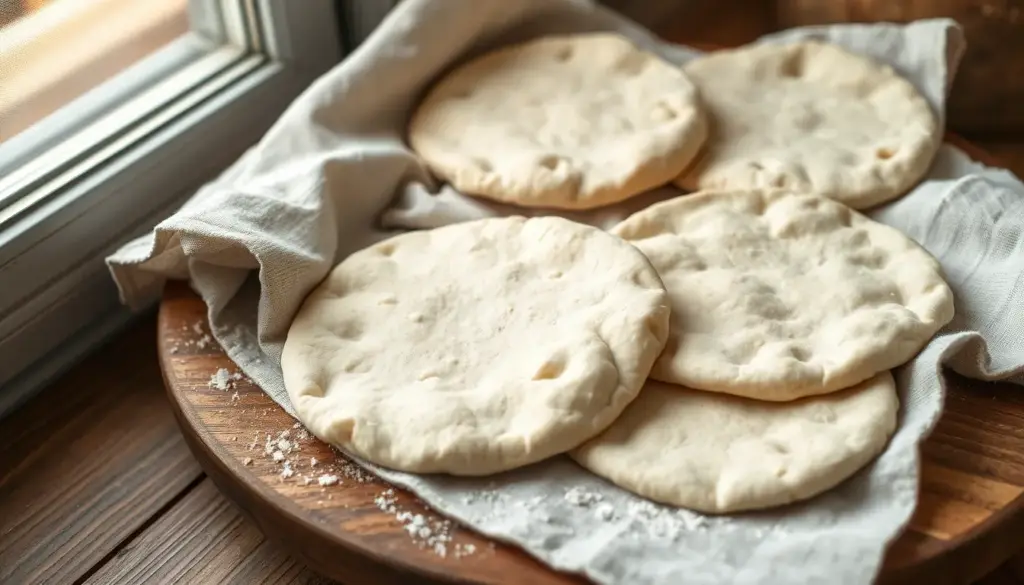
Cover the rolled rounds with a cloth and let them rest another 10 minutes. This short rest lets the surface recover from rolling and gives a more reliable puff.
Getting the heat right
Put a baking stone, steel or heavy upturned baking tray on a rack in the lower third of the oven and heat it at the oven’s top setting, often 250 to 260 °C, for at least 45 minutes. The oven air reaching temperature isn’t enough; the surface needs to soak up heat too.
Recipes often give the temperature in either scale. In the oven temperature converter, 260 °C is 500 °F, or 240 °C in a fan oven. 250 °C works out to 482 °F, which most dials round to 475 °F. If your oven only reaches 250 °C, that’s fine; just give the stone longer to heat. Fan vs conventional oven temperatures explains why fan settings are usually lower.
Baking
Slide two or three rounds onto the hot surface, using a peel or a sheet of parchment. They should start to puff within about 1 minute and be fully ballooned in 2 to 3 minutes. Take them out as soon as they’re puffed and just barely coloured in spots. Overbaked pita turns crisp and cracks when folded.
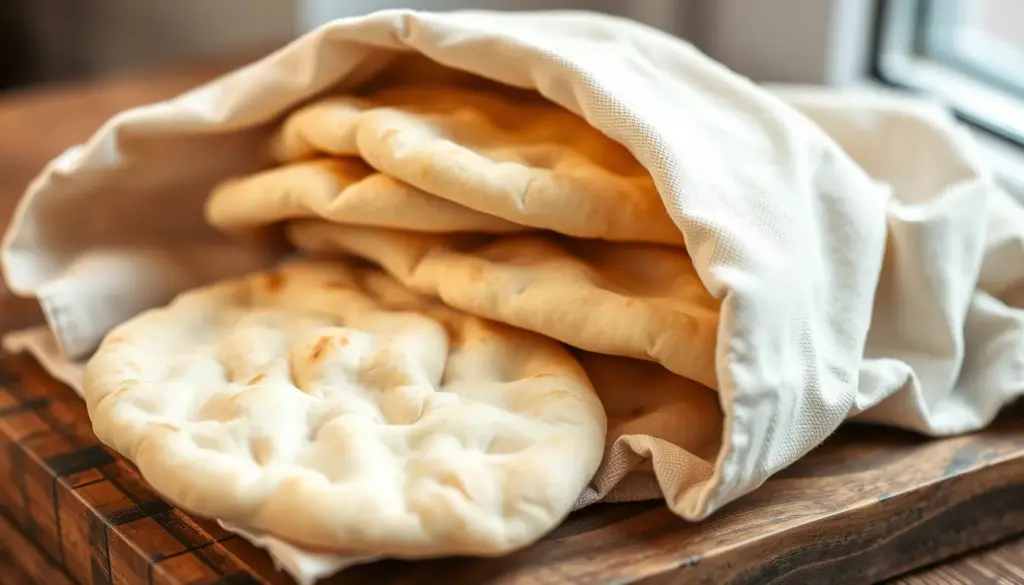
Stack the baked pitas inside a clean tea towel as they come out. The trapped steam keeps them soft and pliable.
Making pita ahead
The dough is happy to wait. After mixing, give it 30 minutes at room temperature, then cover it and refrigerate it for up to a day. The slow, cold rise adds flavour, and chilled dough holds its shape well under the rolling pin. Let the divided balls warm up for about 30 to 45 minutes before rolling, since very cold dough resists and shrinks back.
Rolled rounds are less patient. Once rolled, they should be baked within about 20 minutes, while the surface is still soft. If you’re feeding a crowd, roll and bake in waves rather than rolling everything first. Baked pita freezes well, so a double batch is rarely wasted.
The stovetop method
A heavy cast iron pan works too. Heat it over medium-high heat until very hot, about 5 minutes. Lay a round in the dry pan, cook for about 30 seconds until bubbles appear, flip it, and cook for about a minute until it puffs. Flip again for a final 30 seconds. Stovetop pitas often puff a little less evenly than oven-baked ones, and pressing gently on a rising bubble with a folded towel can encourage the pocket to spread.
Why your pita didn’t puff
- The surface wasn’t hot enough. The most common cause by far. Preheat longer.
- Uneven rolling. Thin spots let the steam escape before the pocket forms.
- A tear or a crease. Any opening acts as a vent. Reroll torn rounds after a short rest.
- A dried-out surface. Uncovered rounds form a dry skin. Keep them under a cloth.
- Too much flour on the counter. Excess flour can stop the dough from forming a smooth, sealed surface.
- Dough rolled too thick. Thick rounds set from the outside before the steam builds up enough pressure.
Pita questions
Can I make whole wheat pita?
Yes. Replace up to half the flour with whole wheat and add about 20 to 30 g more water. Bran makes the dough slightly weaker, so the pockets may be a little less even.
Why did my pita puff in the oven and then go flat?
That’s normal. The pocket deflates as the steam cools, but it stays separated, so you can still open it once it’s cool enough to handle.
How should I store pita?
Keep cooled pita in a sealed bag for a day or two, or freeze it. Warm frozen pita for a minute in a hot pan or oven to soften it again.
Can I bake pita on a pizza steel?
Yes. A steel holds even more heat than a stone, which helps pita puff quickly. Pizza stone vs pizza steel compares the two.