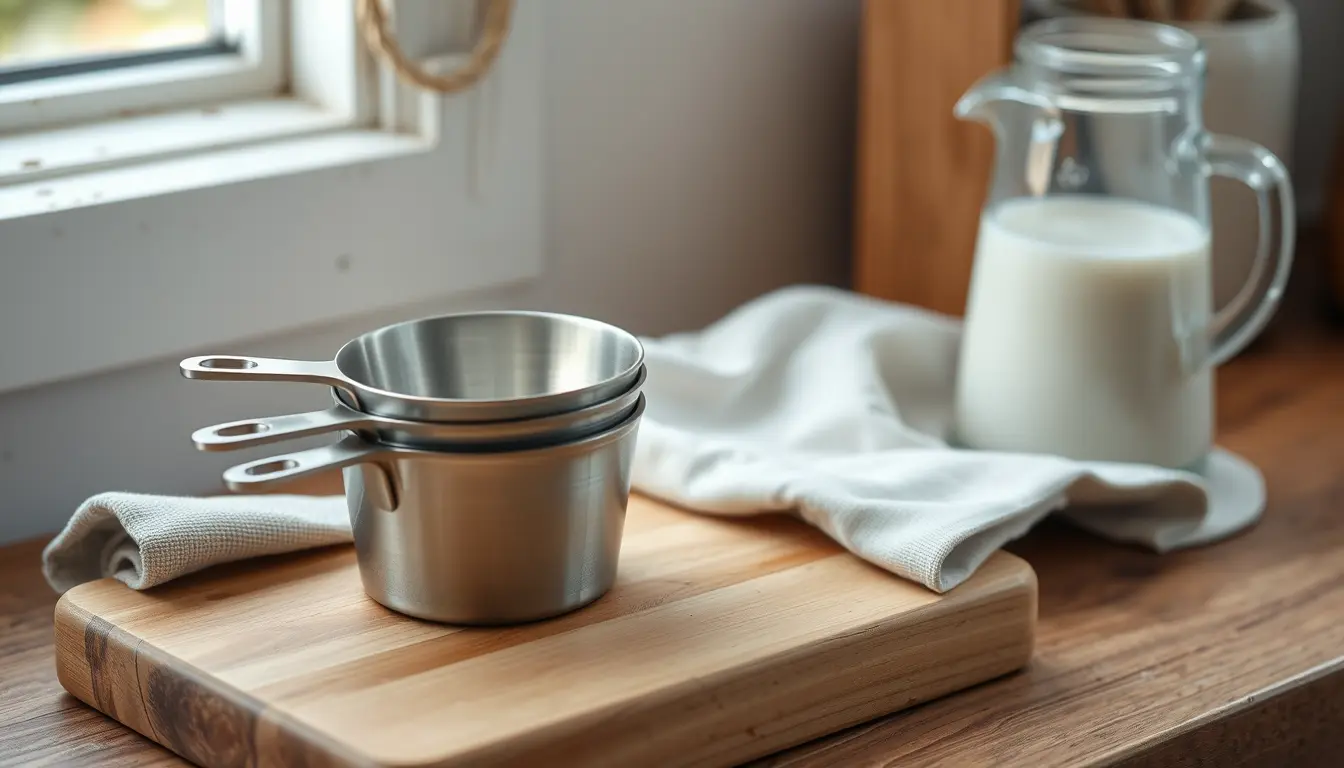
It matters, though less for liquids than for flour. Both kinds of cup hold the same volume when used properly. The trouble is that each is designed for a different way of filling and reading. A dry cup is meant to be heaped and levelled off flat at the rim. A liquid cup is meant to be filled to a line below the rim and read at eye level. Use one the other way round and you lose accuracy: usually a little with liquids, and often a lot with flour.
If you bake from American recipes regularly, it’s worth having both, and knowing which ingredients belong in which.
How the two cups are built
| Feature | Dry measuring cups | Liquid measuring cup |
|---|---|---|
| Shape | A nest of cups, each holding one amount | One jug with several lines marked on the side |
| Rim | Flat and level, so you can sweep off the excess | Space above the top line, plus a spout |
| Material | Usually metal or opaque plastic | Usually clear glass or plastic |
| How you read it | Full to the brim, levelled | Liquid surface at the line, seen from the side |
A US cup is 236.6 ml in both cases. A US recipe that says “1 cup” means that volume whether you’re measuring milk or flour. What changes is how reliably you can hit it.
Liquids in a dry cup
Filling a dry cup to the very brim with milk is fiddly. Liquid domes slightly above the rim, then spills the moment you move the cup. Most people stop a little short to avoid the mess, and walking a brim-full cup across the kitchen loses a little more.
The result is usually a few per cent less liquid than the recipe intended. In a soup that’s nothing. In a cake batter it’s a small but real change, and if every liquid in the recipe comes up short in the same way, it adds up.
Flour in a liquid cup
This one causes far bigger errors. A liquid cup has no flat rim at the measuring line, so you can’t sweep the flour level. Instead you tap or shake it down until it looks right, and that packs it tight. Spooned and levelled into a dry cup, all-purpose flour weighs about 120 g per cup. Shaken down to a line, it can weigh noticeably more, sometimes 15% or above.
That’s the difference between a tender cake and a dry one. Why bakers weigh ingredients instead of using cups shows how much spooning and scooping alone can shift a cup of flour, before the wrong cup is even involved.
Which cup for which ingredient
| Ingredient | Best cup | Notes |
|---|---|---|
| Water, milk, juice, oil | Liquid | Read at eye level |
| Flour, sugar, cocoa | Dry | Spoon in, then level |
| Brown sugar | Dry | Pack it firmly unless the recipe says otherwise |
| Yogurt, sour cream, peanut butter | Dry | Too thick to level themselves in a jug |
| Chocolate chips, nuts, oats | Dry | Fill loosely and level |
| Honey, maple syrup, molasses | Either, greased | Or weigh them |
Reading a liquid cup properly
- Set the jug on a flat counter, not in your hand.
- Pour until the liquid is near the line.
- Bend down so your eyes are level with the marking.
- Water curves up slightly where it touches the side. Read the flat centre of the surface, not the edges.
- Add or pour off a little and check again.
Looking down from above makes the liquid seem higher than it is, so most people underfill when they read a jug from standing height.
Sticky liquids
Honey, golden syrup, maple syrup and molasses cling to the cup, and a surprising amount can stay behind. Give the cup a light coat of oil or a quick spray first, and it slides out cleanly. Better still, weigh them straight into the bowl.
Weights from the cups to grams converter make that easy:
- ¼ cup of honey is 84 g
- ¼ cup of molasses is 85 g
- ⅓ cup of maple syrup is 104 g
Syrups are much heavier than water for the same volume, so a cup of honey weighs 336 g while a cup of water weighs 237 g.

Thick and chunky ingredients
Yogurt, sour cream, peanut butter, mashed banana and vegetable shortening don’t level themselves, so they go in a dry cup. Spoon them in, pressing down with the back of the spoon to push out air pockets, then sweep the top flat with a knife. Scrape the cup clean with a small spatula, since a surprising amount clings to the sides.
Shortening has an old trick of its own. Pour 1 cup of cold water into a liquid cup, then add spoonfuls of shortening, pushing them under the surface, until the water reaches the 1½ cup line. You now have exactly ½ cup of shortening. Pour off the water and the fat comes out in one piece.
Chopped nuts, chocolate chips and dried fruit sit loosely with air between the pieces. Fill the cup without pressing, and level it by eye. Small differences here change the texture of a cookie far less than the same error in flour.
Check your own cups
Cheap cups aren’t always accurate, and old ones can be well off. Here’s a quick test with a kitchen scale:
- Put a cup or jug on the scale and set it to zero.
- Fill it with cold water exactly as you would for a recipe.
- Read the weight.
Water weighs 1 g per millilitre, so a US cup should read about 237 g, and ¾ cup about 177 g. If you have metric cups, which hold 250 ml, expect 250 g, and 125 g for a metric half cup against 118 g for a US one. If yours is several grams out, you know which way your recipes have been leaning. Use the converter to check any other amount:
When it really matters
- Cakes, cookies, muffins and quick breads. The balance of flour, liquid and leavening is tight, so an extra 15% of flour shows up as a dry, domed or cracked bake.
- Bread dough. A few grams of water either way barely matters. Extra flour from a packed cup matters more, making the dough stiffer.
- Custards, sauces and glazes. Liquids drive the texture, so measure them carefully at eye level.
- Soups and stews. No need to worry.
For sugar specifically, how much a cup of sugar weighs covers white, brown and powdered.
Measuring mistakes
- Dipping the cup into the flour bag. It packs the flour in. Spoon it into the cup instead.
- Reading the jug from above. The liquid looks higher than it really is.
- Using a liquid jug for flour. There’s no way to level it.
- Holding the jug in the air while you pour. It tilts, and the reading shifts.
- Mixing cup sets. Metric and US cups look alike but hold different amounts.
Measuring cup questions
Can I use a mug or teacup as a cup?
Not reliably. Mugs vary from well under 250 ml to well over 350 ml. If a recipe is vague and written for a household cup, as older family recipes often are, use a proper measuring cup and adjust by feel.
Do I measure oil in a liquid or dry cup?
Liquid, read at eye level. For small amounts, measuring spoons are fine. Oil coats the cup, so scrape it out with a spatula, or weigh it: ½ cup of vegetable oil is 109 g.
Why does my jug show 240 ml or 250 ml at the one-cup line?
Rounding. US nutrition labels use 240 ml as a cup, and metric cups are 250 ml. The traditional US cup is 236.6 ml. For home baking, the 1 to 6% gap rarely matters as long as you use the same cup throughout a recipe.
Are measuring spoons for liquids or dry ingredients?
Both. Fill them level to the rim for dry ingredients and just to the brim for liquids. They’re small enough that the difference is tiny.