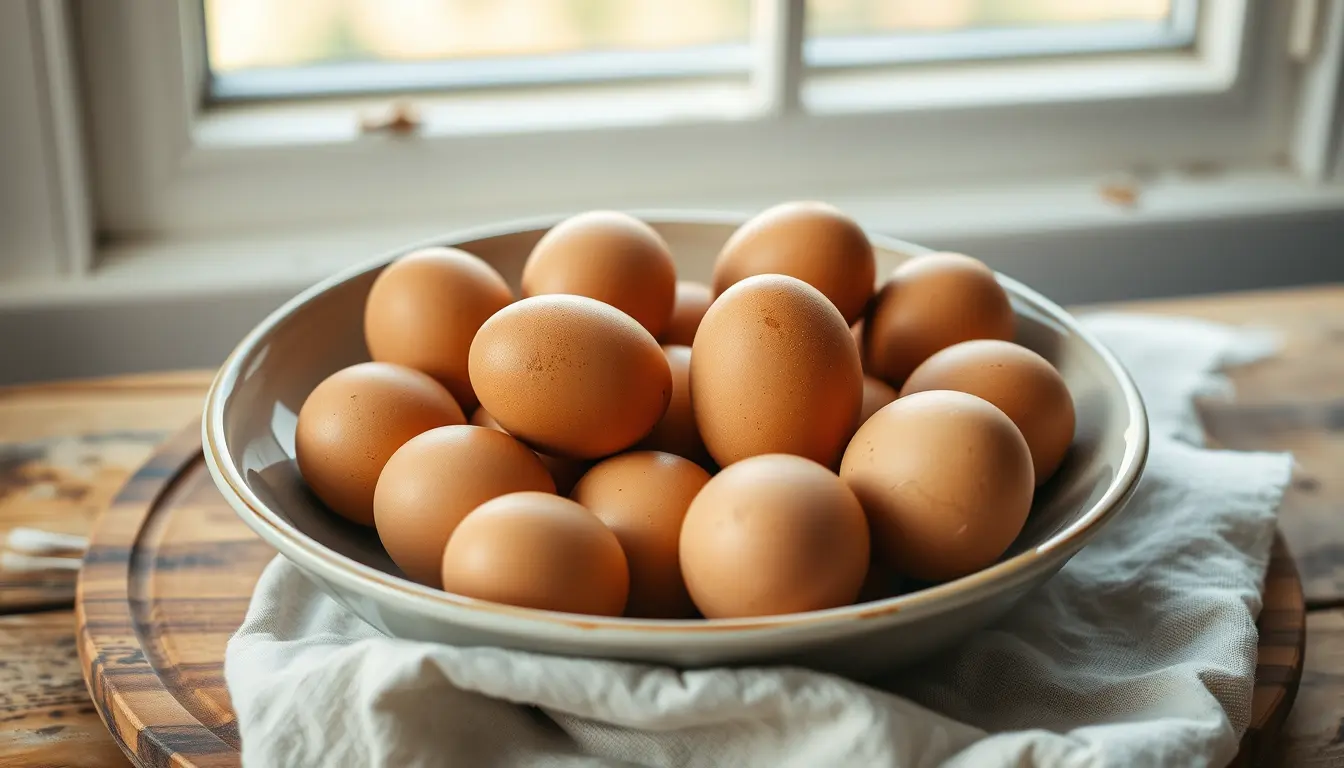
Most recipes written in the US assume large eggs, which weigh about 50 g out of the shell. Medium eggs come to roughly 44 g, extra-large to about 56 g and jumbo to about 63 g. For one or two eggs, you can swap sizes freely; the difference is a spoonful. From three eggs upwards, or in custards and sponges where eggs do most of the work, weigh them instead. And be careful with recipes from elsewhere: a UK or EU “medium” egg is close to a US large, and a UK “large” is closer to a US extra-large.
How US egg sizes are defined
In the US, egg sizes are set by the minimum weight of a dozen in the shell, not by each egg. That means individual eggs in a carton vary, but the average is guaranteed.
| US size | Minimum per dozen, in shell | Average per egg, in shell | Approximate, out of shell |
|---|---|---|---|
| Small | 18 oz (510 g) | 42.5 g | 38 g |
| Medium | 21 oz (595 g) | 49.6 g | 44 g |
| Large | 24 oz (680 g) | 56.7 g | 50 g |
| Extra-large | 27 oz (765 g) | 63.8 g | 56 g |
| Jumbo | 30 oz (850 g) | 70.9 g | 63 g |
The shell and membrane account for roughly 11 to 12% of an egg’s weight, which is how the last column is worked out. All the shelled figures are approximate, rounded and conservative, and real eggs can sit a few grams either side.
Most of the extra weight in a bigger egg is white. A large egg is roughly 33 g of white and 17 g of yolk. The yolks of larger eggs are only slightly bigger.
UK, EU and other size names
The UK and the EU grade each egg individually by its weight in the shell:
| UK and EU size | Weight per egg, in shell | Closest US size |
|---|---|---|
| Small | under 53 g | Small to medium |
| Medium | 53 to 63 g | Large |
| Large | 63 to 73 g | Extra-large |
| Very large | 73 g and over | Jumbo |
So when a British recipe asks for “3 medium eggs”, US large eggs are the right match. If it asks for large eggs, use US extra-large, or weigh about 56 to 65 g per egg out of the shell. Australia, Canada and other countries use their own bands, so check the carton for the weight per egg or per dozen. US, UK and Australian recipe measurements compared covers the other differences in imported recipes.
Swapping sizes by weight
The safest way to swap sizes is to work out the weight the recipe expects, then crack enough eggs to reach it. Assuming the recipe means US large eggs:
| Recipe asks for | Approximate target, shelled | Medium (44 g) | Extra-large (56 g) | Jumbo (63 g) |
|---|---|---|---|---|
| 1 large | 50 g | 1.1 | 0.9 | 0.8 |
| 2 large | 100 g | 2.3 | 1.8 | 1.6 |
| 3 large | 150 g | 3.4 | 2.7 | 2.4 |
| 4 large | 200 g | 4.5 | 3.6 | 3.2 |
| 6 large | 300 g | 6.8 | 5.4 | 4.8 |
When the count lands between whole eggs, crack one more, beat them together and pour off the excess. For one or two eggs in a cake or cookie dough, rounding to the nearest whole egg is fine. In custards, curds, sponges and soufflés, where eggs set the structure, use the weight.
Handling fractions of an egg
Fractional eggs also turn up when you scale recipes. The recipe scaler deals with them by giving a weight. Scale a recipe containing “3 eggs” and “1 egg yolk” by 1.5, and it returns:
- 4½ eggs, with the note: beat 5 and use 225 g
- 1½ egg yolk, with the note: beat 2 and use 26 g
The scaler works from US large eggs: 50 g for a whole egg, 17 g for a yolk and 33 g for a white. If your eggs are a different size, ignore the count and follow the weight in the note. That way, the recipe gets exactly what it needs regardless of what’s in your carton.
How to halve or double a baking recipe has more on scaling eggs in muffins, cookies and cakes.
How to weigh eggs
- Put a small bowl on the scale and press tare.
- Crack the eggs into the bowl.
- Beat them with a fork until the yolks and whites are evenly mixed.
- Pour or spoon out the amount you need into the recipe.
For separated eggs, weigh the whites and yolks in separate bowls. Leftover raw egg keeps covered in the fridge for a day or two. Use it in scrambled eggs, an omelette or an egg wash.
When egg size matters most
- Custards and curds. The ratio of egg to liquid decides whether they set. Too little egg leaves them runny.
- Sponge cakes. Whipped eggs provide the rise. Fewer grams of egg means less volume.
- Enriched bread dough. Eggs count as part of the liquid, so a larger egg makes a softer, stickier dough. Weighing pays off here as it does elsewhere; see why bakers weigh ingredients instead of using cups.
- Gluten-free baking. Eggs often provide much of the structure.
In brownies, cookies and most muffins, a few grams either way rarely shows.
Whites and yolks on their own
Recipes that call for separated eggs need the same care. For a large egg, the white is roughly 33 g and the yolk roughly 17 g. Bigger eggs add more white than yolk, so a recipe asking for “4 egg whites” might need only three if your eggs are jumbo, while “4 yolks” from jumbo eggs is only slightly more than from large ones.
When weight matters, as in meringues, macarons and custards, weigh separated whites and yolks just as you would whole eggs. Separate each egg over a small cup before adding it to the main bowl, so a broken yolk can’t spoil a whole batch of whites. Even a trace of yolk can stop whites whipping well.
Leftover whites freeze well. Freeze them in a lidded container, label the weight, and thaw them overnight in the fridge. Yolks don’t freeze as easily on their own, so plan a custard or a curd for those.

Egg size mistakes
- Reading a UK recipe’s sizes as US sizes. Three UK large eggs are noticeably heavier than three US large ones.
- Swapping a whole carton’s worth by count. Six jumbo eggs instead of six large adds nearly 80 g.
- Guessing at half an egg. Beat and weigh it instead.
- Weighing with the shell on. Shell weight varies. Weigh the cracked egg.
Egg size questions
Do brown and white eggs weigh the same?
Colour has nothing to do with size or weight. A large brown egg and a large white egg are graded the same way, and they bake identically.
Can I use duck eggs or other large eggs in baking?
Yes, by weight. Duck eggs are often around 70 to 90 g in the shell, with a larger yolk and a slightly firmer white. Weigh out the amount the recipe expects, and expect a richer result.
How do I swap eggs in a recipe that only gives grams?
That’s the easiest case. Ignore the size on the carton, crack and beat enough eggs to reach the weight, and use exactly that. It’s the most accurate approach of all.
Can I use liquid egg from a carton?
Yes, in most baking. Use the conversion on the carton, which is often about 3 tablespoons per egg, or weigh it: about 50 g replaces one large egg. Liquid egg whites work for most recipes that use whites, though some brands whip less well, so test them before a meringue.