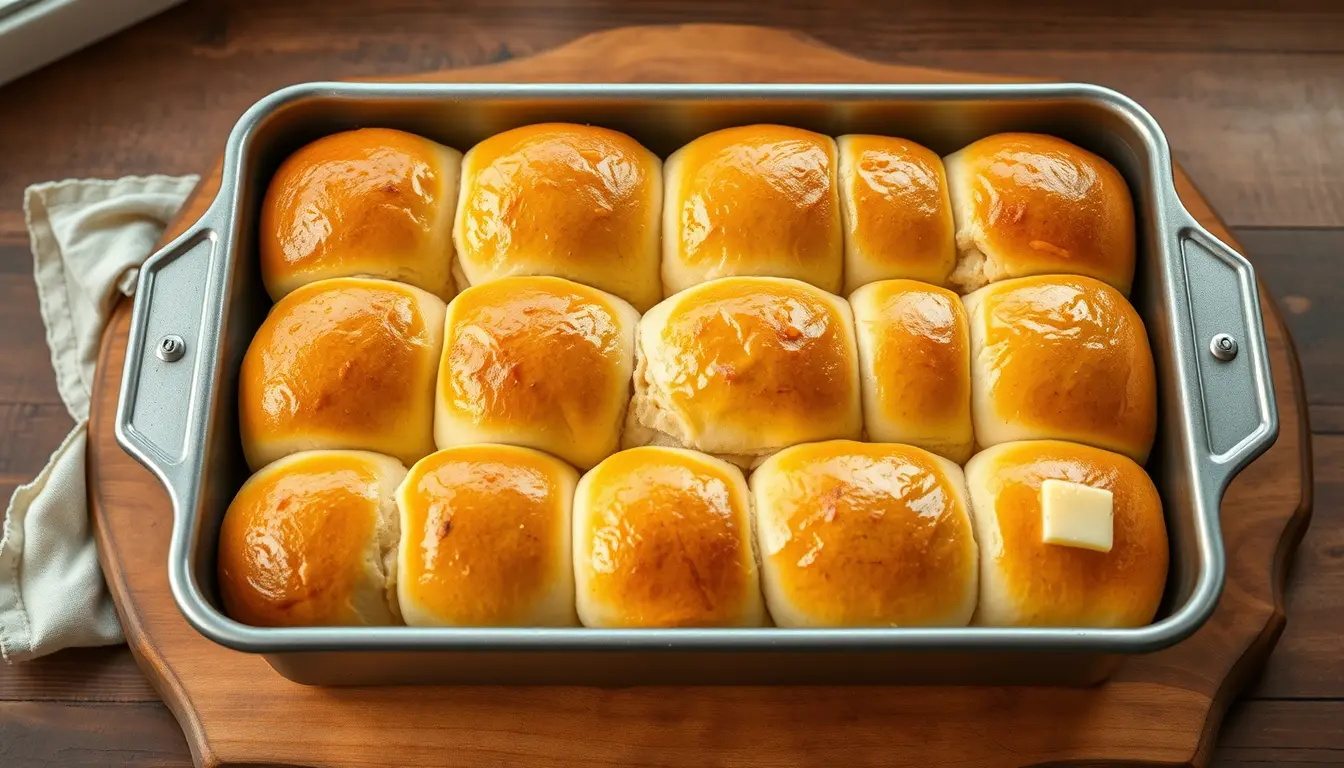
To divide dough for dinner rolls, weigh the whole batch after the first rise, divide that weight by the number of rolls you want, and cut pieces to that weight with a bench scraper. For classic dinner rolls, 55 to 65 g of dough per roll is a good size; 15 of them fit neatly in a 23 × 33 cm (9 × 13 in) pan. If the recipe doesn’t make the number you need, scale every ingredient by the same factor before you mix, rather than making the rolls bigger or smaller than suits the pan.
Weighing is what makes rolls look professional. Pieces that match bake at the same rate, so you don’t end up with pale rolls in the middle and dark ones at the edges.
Pick a roll size first
Decide on the size before you start, because it sets both the number of rolls and the baking time.
| Roll | Dough per roll | Typical layout |
|---|---|---|
| Slider or party roll | 40 to 45 g | 24 in a 23 × 33 cm pan, 4 by 6 |
| Dinner roll | 55 to 65 g | 15 in a 23 × 33 cm pan, 3 by 5 |
| Large dinner roll | 70 to 80 g | 12 in a 23 × 33 cm pan, 3 by 4 |
| Burger or sandwich bun | 85 to 110 g | 8 to 10 spaced on a baking sheet |
Rolls lose a little weight in the oven as water evaporates, often around 10%, so a 60 g piece of dough becomes a roll of about 54 g.
Dividing the dough
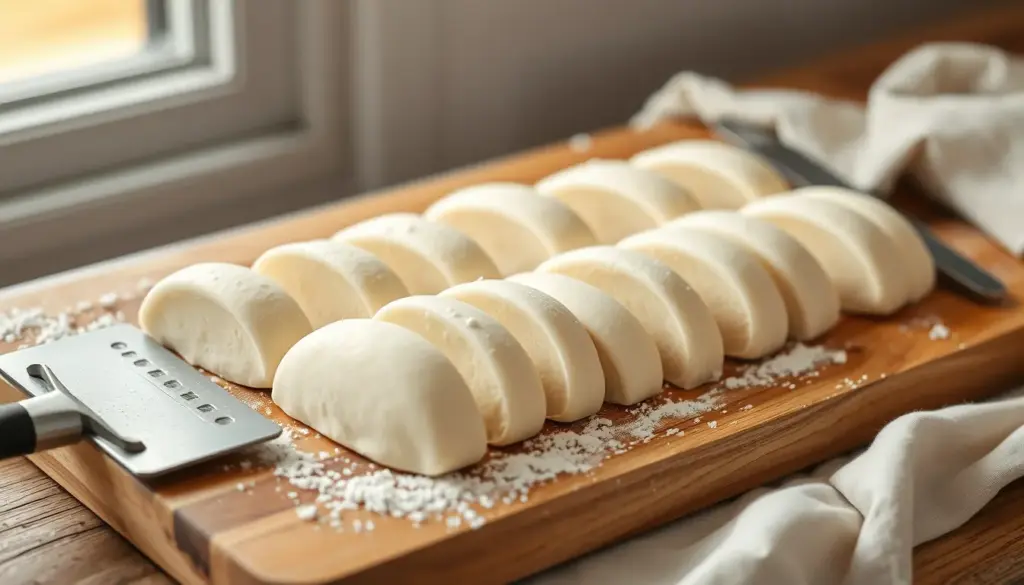
- After the first rise, turn the dough onto a lightly floured counter and press out the largest bubbles.
- Weigh the whole piece. Say it comes to 950 g once a little has stuck to the bowl.
- Divide by the number of rolls. For 15 rolls, that’s about 63 g each.
- Cut pieces with a bench scraper, weigh each one, and add or remove small bits until they match within a gram or two.
- Tuck any small add-on pieces underneath when you shape, so they disappear into the base.
Cut with a single press of the scraper rather than tearing. Torn dough is harder to shape smoothly. Work quickly, and cover the pieces you’ve weighed with a cloth so they don’t form a skin.
Scaling the recipe
If a recipe makes 12 rolls and you want 18, multiply every ingredient by 1.5. Doing it line by line is where mistakes creep in, especially with cups, spoons and eggs. The recipe scaler handles all of that. Set it to scale by servings, from 12 to 18, and paste the ingredient list.
For a recipe written in grams, it returns:
- 750 g bread flour (was 500 g)
- 450 g whole milk (was 300 g)
- 1½ large egg, with the note: beat 2 and use 75 g
- 75 g butter (was 50 g)
- 60 g sugar (was 40 g)
- 12 g salt (was 8 g)
- 11 g instant yeast (was 7 g)
For a cup-based recipe scaled down from 12 to 8 rolls, it gives 2⅓ cups of all-purpose flour, ⅔ cup of warm milk, 2 tbsp + 2 tsp of sugar, 2 tbsp + 2 tsp of melted butter, ⅔ egg (beat 1 and use 33 g), 1½ tsp of instant yeast and ⅝ tsp of salt.
The egg notes are where the scaler earns its keep. Rather than guessing at half an egg, you beat the eggs together and weigh out the amount it gives. How to halve or double a baking recipe covers the other things scaling can affect, such as pans and mixing.
Checking the formula in percentages
When you scale a roll recipe often, it helps to know its baker’s percentages. Enter the weights in the baker’s percentage calculator, with flour as 100%. The gram recipe above works out to milk at 60%, egg at 10%, butter at 10%, sugar at 8%, salt at 1.6% and instant yeast at 1.4%. With the formula in that form, you can build a batch from any flour weight without a scaler at all. Baker’s percentages explained simply shows how to read and use them.
Shaping round rolls
Shape each piece into a tight ball so the roll rises upwards instead of spreading.
- Flatten the piece slightly and fold the edges into the centre to make a rough ball.
- Turn it seam side down on an unfloured patch of counter.
- Cup your hand over it and move it in small circles, letting the counter grip the dough and tighten the surface.
- Place it in the pan seam side down.
For soft, pull-apart rolls with tender sides, set them about 1 cm apart so they rise into each other. For rolls with crust all round, space them 5 cm apart on a sheet.
Proofing and baking
Cover the rolls and let them rise until they look about half as big again and a gentle press springs back slowly. In a warm kitchen, that’s often 45 minutes to an hour for a yeasted dough.
Bake soft dinner rolls at 180 to 190 °C (350 to 375 °F). Rolls of about 60 g usually need 18 to 22 minutes, larger ones a few minutes more. They are done when they’re golden and the centre of a middle roll reads about 88 to 93 °C (190 to 200 °F). Brush with melted butter as they come out if you like a soft, shiny top.
Rolls in other pans
Not every kitchen has a 23 × 33 cm pan, and the dough doesn’t have to go into one. The aim is the same in any pan: rolls that just touch after proofing, with no big gaps.
- A 23 cm (9 in) round pan takes 8 to 9 rolls of about 60 g: seven around the edge and one or two in the middle.
- A 20 cm (8 in) square pan takes 9 rolls of about 60 to 65 g, three by three.
- A cast iron skillet of 25 cm (10 in) takes 10 to 12 rolls of about 55 g.
- A baking sheet takes any number if the rolls are spaced apart, though they bake with crust all round.
If your batch is larger than the pan, bake the extra rolls in a second pan or on a sheet. Squeezing them in makes the centre rolls bake slowly and stay pale.
Dividing and scaling mistakes
- Eyeballing the pieces. Small rolls bake before big ones are done. Weigh them.
- Scaling the rolls instead of the recipe. Making 12 rolls fill a pan meant for 15 leaves gaps, and the outer rolls brown too fast.
- Leaving pieces uncovered. A dry skin makes shaping harder and leaves streaks on the crust.
- Flouring the counter for shaping. The ball needs some grip to tighten. Use flour for dividing, not for rounding.
- Forgetting to adjust the pan. A larger batch needs a larger pan, or two.
Dinner roll questions
How do I make rolls the same size without a scale?
Shape the dough into an even log, then cut it in half, each half in half again, and so on. Halving repeatedly gives more even pieces than cutting a row of slices by eye. For 15 rolls, cut the log into thirds, then each third into five.
Can I use a loaf recipe for rolls?
Yes. Any dough that makes a soft sandwich loaf makes good rolls. A loaf recipe of about 900 g of dough gives 15 rolls of 60 g. They bake much faster than the loaf, so start checking early.
Can I shape the rolls the night before?
Yes. Shape them into the pan, cover well and refrigerate. In the morning, let them warm and rise for one to two hours before baking. How to freeze bread dough and pizza dough balls covers making them further ahead.