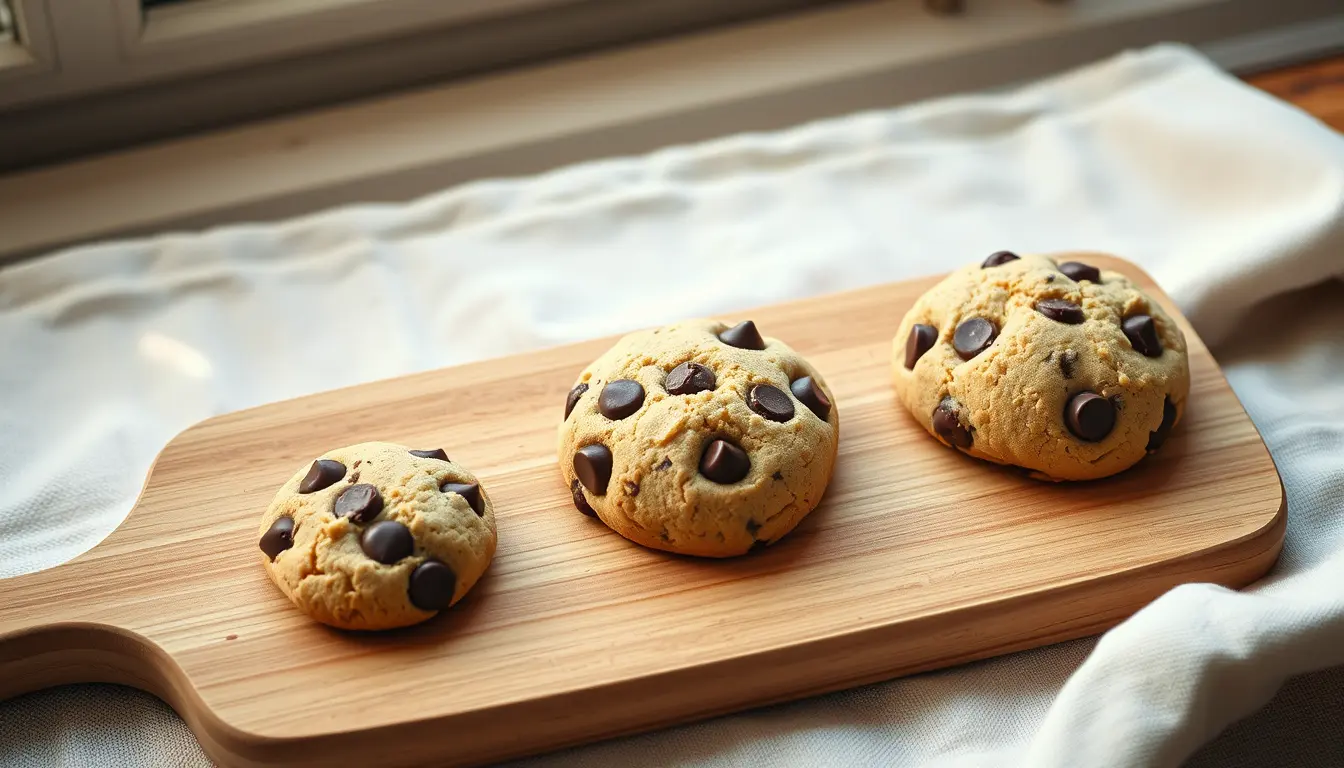
Cookie scoop sizes follow the numbering used for portion scoops, or dishers: the number tells you roughly how many level scoops fill a US quart. A smaller number means a larger scoop. A #40 holds about 1½ tablespoons, a #30 about 2 tablespoons, a #20 about 3 tablespoons and a #16 about ¼ cup. Because manufacturers round and shape their scoops differently, those capacities are approximate. The most reliable approach is to measure your own scoop once with water and weigh a few scoops of dough.
How scoop numbers work
A US quart is 4 cups, or about 946 ml. Divide that by the scoop number and you get the nominal capacity of one level scoop. That simple rule explains the whole system and why the numbers run backwards: more scoops per quart means each scoop is smaller.
| Scoop number | Nominal capacity | In spoons or cups |
|---|---|---|
| #100 | about 9.5 ml | about 2 tsp |
| #70 | about 13.5 ml | a little under 1 tbsp |
| #60 | about 16 ml | about 1 tbsp |
| #50 | about 19 ml | about 1¼ tbsp |
| #40 | about 24 ml | about 1½ tbsp |
| #30 | about 32 ml | about 2 tbsp |
| #24 | about 39 ml | about 2⅔ tbsp |
| #20 | about 47 ml | about 3 tbsp |
| #16 | about 59 ml | ¼ cup |
| #12 | about 79 ml | ⅓ cup |
The millilitre figures come straight from dividing a quart by the number. The spoon figures are rounded to the nearest practical measure, and real scoops vary by brand, so treat every figure in this table as approximate. For reference, the cups to grams converter puts 1 tbsp of water at 15 g, 2 tbsp at 30 g, 3 tbsp at 44 g and ¼ cup at 59 g, which makes the water test below easy to check on a scale.
Names instead of numbers
Many home scoops are sold as small, medium and large, with no number at all. There’s no standard for these names. A “medium” from one brand can be the size of a “large” from another. Some list the capacity in tablespoons or millilitres on the packaging; if yours doesn’t, measure it.
Measuring your own scoop
- Set a small glass on a kitchen scale and zero it.
- Fill the scoop with water, level, and release it into the glass.
- Read the weight. Water weighs about 1 g per ml, so 24 g means about 24 ml, close to a #40.
Then do the same with your cookie dough. Scoop three level portions, weigh them together and divide by three. That number is your real dough weight per cookie, and it’s the most useful figure of all, because cookie doughs vary in density. A dough full of chocolate chips and nuts weighs more per scoop than a smooth sugar cookie dough.
Scaling a recipe to your scoop
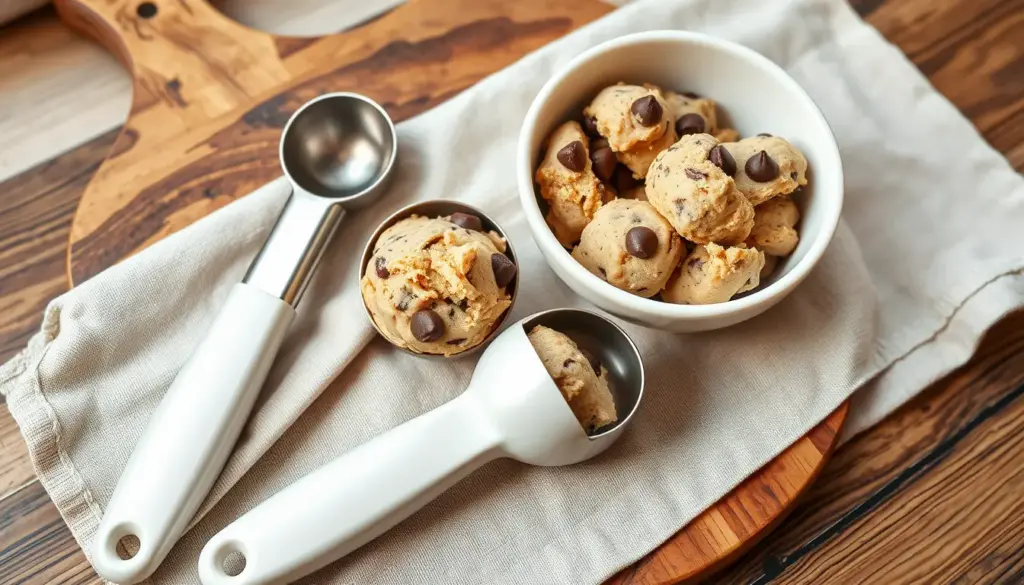
Once you know your scoop, you can work out how many cookies a recipe will make, and scale it if you want more or fewer. As a rule, the number of cookies changes in proportion to the scoop size. A recipe that makes 36 cookies with a #40 scoop makes about 27 with a #30 and about 18 with a #20, roughly, because the larger scoops hold more dough each.
If you’d rather keep your scoop and change the batch size, the recipe scaler does the arithmetic. Say a chocolate chip cookie recipe makes 36 cookies with your scoop, but you only want 24. Scaled from 36 to 24 servings, a factor of 0.667:
| Ingredient | Original | For 24 cookies |
|---|---|---|
| All-purpose flour | 2¼ cups | 1½ cups |
| Baking soda | 1 tsp | ⅝ tsp |
| Salt | 1 tsp | ⅝ tsp |
| Butter, softened | 1 cup | ⅔ cup |
| Granulated sugar | ¾ cup | ½ cup |
| Brown sugar, packed | ¾ cup | ½ cup |
| Large eggs | 2 | 1⅓ (beat 2, use 67 g) |
| Vanilla extract | 1 tsp | ⅝ tsp |
| Chocolate chips | 2 cups | 1⅓ cups |
The ⅝ tsp measures are awkward, so a scant ¾ tsp or a level ½ tsp plus a pinch both work. If you’d rather weigh, the cups to grams converter puts the 1⅓ cups of chocolate chips at 227 g and the 1½ cups of flour at 180 g. How to halve or double a baking recipe covers what to round and what to keep exact.
Baking time changes with size
Bigger cookies need longer in the oven, and not just a little. As an approximate guide at about 175 to 180 °C (350 °F):
- #60 or #70 (about 1 tbsp): roughly 8 to 10 minutes.
- #40 (about 1½ tbsp): roughly 10 to 12 minutes.
- #20 (about 3 tbsp): roughly 13 to 16 minutes.
- #16 (about ¼ cup): roughly 15 to 18 minutes.
These times depend on the dough and your oven, so bake one test cookie first. Look for set, golden edges and a centre that still looks slightly soft; cookies firm up as they cool on the tray.
Bigger cookies also spread more, so give them more room. Six large cookies per tray is usually enough; small ones can go twelve or more to a tray.

Weighing portions instead
A scale can do the scoop’s job too. Once you know your dough weighs, say, 30 g per scoop, you can weigh the whole batch, divide by 30 and know exactly how many cookies you’ll get before you start. Weighing is also the best way to match a recipe that gives a portion weight rather than a scoop size, which many bakery-style recipes do. Scoop a portion, check it on the scale, and add or remove a little dough until it matches; after a few cookies, your scoop and eye will be calibrated.
This matters most with large cookies, where a few grams more or less changes the bake time noticeably. Why bakers weigh ingredients instead of using cups explains the wider case for a scale.
Why use a scoop at all
Scoops make every cookie the same size, so they bake evenly and finish at the same time. Without one, small cookies burn while big ones stay raw in the middle. A scoop is also faster than two spoons and keeps your hands cleaner.
Scoops work for more than cookies. A #16 or #20 portions muffin and cupcake batter neatly, a #40 portions meatballs or truffles, and a small #70 or #100 is handy for filling macarons or portioning tiny cookies.
Scoop mistakes
- Heaping the scoop. A rounded scoop can hold far more than a level one, so the count and bake time drift.
- Trusting “medium” or “large”. These names aren’t standard, so measure.
- Keeping the original baking time with a larger scoop. The centres stay raw.
- Crowding the tray. Large cookies merge into one another.
Cookie scoop questions
Should I level the scoop or leave it rounded?
Level it against the side of the bowl for consistent cookies. If a recipe was tested with rounded scoops, it usually says so.
Why does my dough stick in the scoop?
Very soft or sticky doughs cling to the bowl of the scoop. Chilling the dough for 20 to 30 minutes, or dipping the scoop in water between portions, helps.
Can I freeze scooped cookie dough?
Yes. Freeze the portions on a tray, then bag them. Bake from frozen, adding a minute or two to the time.
How much does a #40 scoop of cookie dough weigh?
It depends on the dough, so weigh your own. Denser doughs with lots of mix-ins weigh noticeably more per scoop than smooth ones.