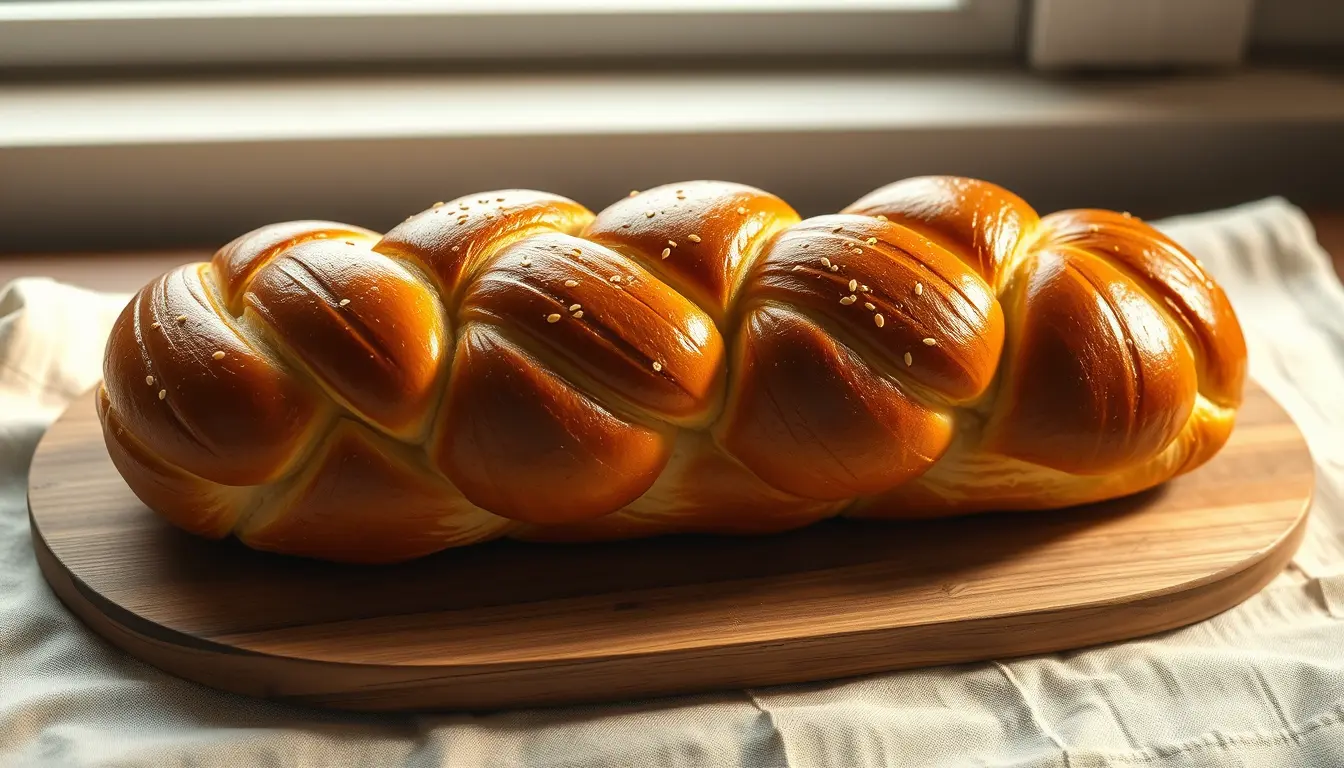
A good challah comes from a firm, egg-rich dough that holds a crisp braid, strands of equal weight rolled to the same length, two coats of egg wash and a moderate oven, around 175 to 180 °C (350 °F). The dough should be smooth and only slightly tacky, so the strands keep their shape instead of melting into each other as the loaf rises. Bake until deep golden and the base sounds hollow, which for a loaf of this size usually takes about 30 to 35 minutes.
What makes challah dough different
Challah is an enriched bread, but its enrichment is different from brioche. It usually relies on eggs and oil instead of butter and milk, which is part of why many challah recipes are dairy-free. The eggs add colour, richness and structure. Oil makes the crumb soft and keeps it fresh. Honey or sugar adds sweetness and helps the crust brown.
All that enrichment slows fermentation and softens the gluten, so challah dough is kept relatively firm. A firmer dough is also what makes braiding possible. Wet dough sticks to itself and spreads, blurring the pattern. For a broader look at how eggs, fat and sugar change a dough, see enriched doughs explained.
A formula for one large braided loaf
- 500 g bread flour
- 140 g water
- 150 g eggs (3 large)
- 17 g egg yolk (1 large yolk)
- 60 g neutral oil
- 60 g honey
- 9 g salt
- 7 g instant yeast
Here’s how the baker’s percentage calculator reads it when the water, eggs and yolk are all marked as liquids:
| Ingredient | Weight | Baker’s % |
|---|---|---|
| Bread flour | 500 g | 100% |
| Water | 140 g | 28% |
| Eggs | 150 g | 30% |
| Egg yolk | 17 g | 3.4% |
| Neutral oil | 60 g | 12% |
| Honey | 60 g | 12% |
| Salt | 9 g | 1.8% |
| Instant yeast | 7 g | 1.4% |
| Total | 943 g | 188.6% |
The calculator shows 61.4% hydration, counting the eggs fully as liquid. Eggs are only about three-quarters water, so the real water content is lower and the dough feels firmer than a lean dough at 61%. The oil and honey also loosen it slightly, which is why the dough ends up smooth and pliable rather than stiff.
Scaling the recipe
Challah recipes come in all sizes, and eggs make scaling awkward. The recipe scaler handles this. Take a large cup-based recipe for two loaves:
- 6 cups bread flour
- 1 cup warm water
- 3 large eggs
- ½ cup neutral oil
- ⅓ cup honey
- 2½ tsp salt
- 2¼ tsp instant yeast
Halve it with a factor of 0.5 and the scaler gives 3 cups flour, ½ cup water, ¼ cup oil, 2 tbsp + 2 tsp honey, 1¼ tsp salt and 1⅛ tsp yeast. For the eggs, it shows 1½ large eggs and suggests beating 2 and using 75 g, which is far easier than trying to split an egg by eye.
Halving yeast and salt along with the flour is fine for a dough like this. How to halve or double a baking recipe covers which ingredients round easily and which deserve a scale.
Going the other way, the weighed formula above scaled from 2 to 3 loaves (a factor of 1.5) becomes 750 g flour, 210 g water, 90 g oil, 90 g honey, 14 g salt and 11 g yeast, with 4½ eggs and 1½ yolks. For those part eggs, the scaler gives a weight to measure out of a beaten batch: 225 g from 5 whole eggs and 26 g from 2 yolks.
Mixing and the first rise
Mix everything except the salt, rest for 10 minutes, then add the salt and knead until the dough is smooth and elastic, about 8 to 10 minutes by hand or 6 to 8 in a mixer. Enriched doughs take longer than lean ones to develop. Cover and let it rise until roughly doubled, often 1½ to 2 hours at warm room temperature.
Dividing into strands
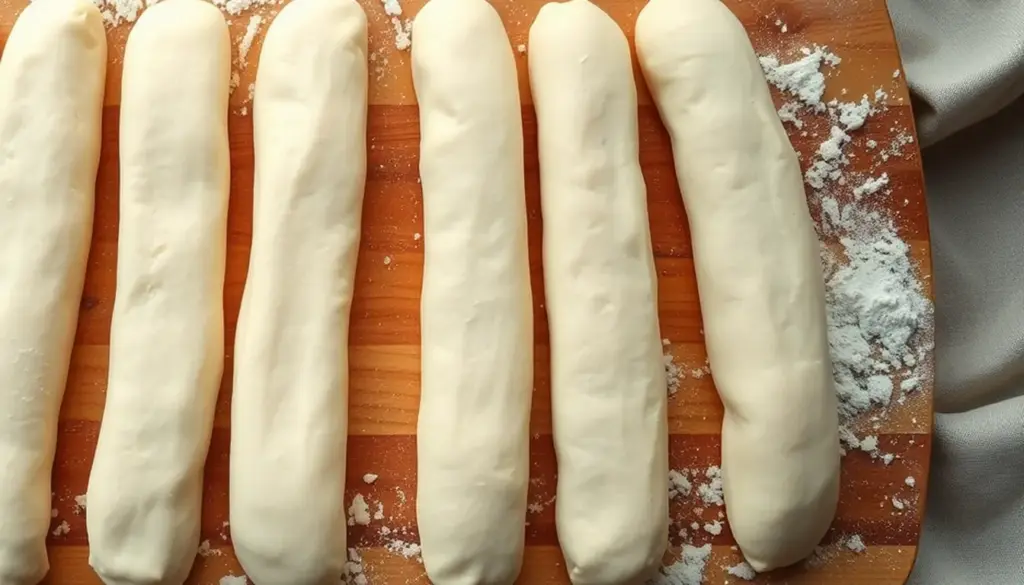
Weigh the dough and divide it evenly. The 943 g formula above makes six strands of about 157 g, or four strands of about 235 g, or three of about 314 g. Equal weights are the single biggest help in getting a neat, symmetrical braid. Round each piece, cover, and rest for 10 minutes.
Roll each piece into a rope. Start in the middle and work outward, aiming for strands about 40 cm (16 in) long for six strands, slightly shorter for fewer. Keep the middle a little thicker than the ends so the finished loaf tapers gracefully. If the dough springs back, rest it for 5 minutes and try again.
Braiding
Pinch the strands together firmly at the top and tuck the join under. Then choose a pattern:
- Three strands: a simple plait. Alternate bringing the right strand over the middle, then the left strand over the middle, until you reach the end.
- Four strands: take the far right strand over the strand next to it, under the next, and over the last. Repeat from the right each time.
- Six strands: to start, move the far right strand over to the far left, once only. Then repeat four moves: the second strand from the left goes over to the far right; the far left strand goes into the middle; the second strand from the right goes over to the far left; the far right strand goes into the middle. Six-strand braids take a few tries, so practise rather than worrying about perfection.
Braid loosely rather than tightly. Strands pulled tight have nowhere to expand and tear as the loaf rises in the oven. Pinch the ends together and tuck them under.
The second rise and egg wash
Set the braided loaf on a parchment-lined tray. Beat an egg with a pinch of salt and a spoonful of water, and brush the loaf gently. Cover loosely and let it rise for 45 to 75 minutes, until puffy and about one and a half times its size.
Just before baking, brush on a second coat of egg wash, working it into the gaps between the strands. The double coat gives the deep, even gloss challah is known for. Sprinkle with sesame or poppy seeds if you like.
Baking
Bake at 175 to 180 °C (350 °F) for about 30 to 35 minutes, until deep golden brown. Honey browns quickly, so check after 20 minutes and lay a loose sheet of foil over the top if it’s darkening too fast. An instant-read thermometer should show about 88 to 90 °C (190 to 195 °F) in the thickest part. Cool on a rack for at least 30 minutes before slicing.
Challah mistakes
- Too wet a dough. The braid blurs and spreads instead of standing tall.
- Uneven strands. One thick strand pulls the whole braid to one side.
- Braiding too tightly. The strands tear as the loaf expands.
- Only one coat of egg wash. The shine is patchier and duller.
- Overproofing the braid. The strands lose their definition and the loaf can sag.
- An oven that runs hot. The crust darkens before the middle is cooked.
Challah questions
Can I make challah with butter instead of oil?
Yes. Use the same weight of melted butter. The crumb will be slightly richer and the loaf will no longer be dairy-free.
Why does my braid split along one side?
The loaf was usually underproofed, or one strand was tighter than the others. Let the braid rise until clearly puffy before it goes in the oven.
Can I braid the dough the night before?
Yes. Cover the shaped loaf well and refrigerate it overnight. Let it warm and finish rising at room temperature for an hour or two the next day before the second egg wash.
What do I do with leftover challah?
Day-old challah makes excellent French toast and bread pudding, because the rich crumb soaks up custard without falling apart.