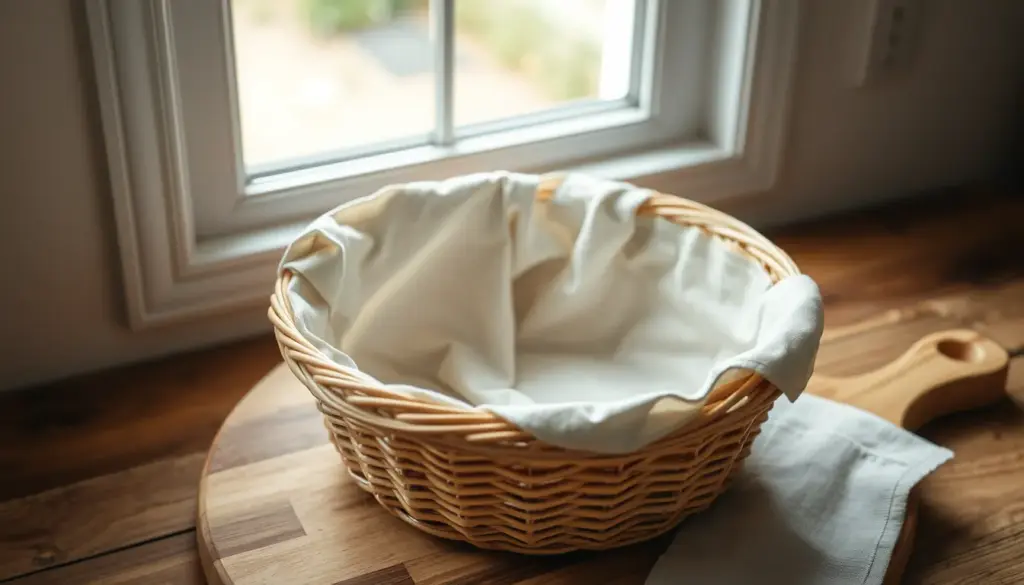
A banneton, also called a proofing basket or brotform, holds a shaped loaf during its final rise. It supports the sides so the dough grows up instead of out, draws a little moisture from the surface so the skin firms up, and, if it’s unlined cane, leaves those familiar rings of flour on the crust.
Three things decide whether one works well for you: the right size for your dough, the right flouring so the loaf lets go cleanly, and drying it properly after every bake. Get those right and a basket lasts for many years.
What the basket actually does
A shaped loaf of wet sourdough is soft. Left on a board, it slumps sideways over the hour or more of its final proof, especially overnight in the fridge. A basket gives it walls. When you turn it out, the dough holds the basket’s shape for the few seconds it takes to score and load it, and the skin is dry enough to cut cleanly.
The flouring matters as much as the basket. Flour fills the gaps between the dough and the surface, so the loaf releases instead of sticking. Some of it bakes onto the crust, which is where the pattern comes from.
Materials
| Material | How it feels | Good points | Watch out for |
|---|---|---|---|
| Rattan or cane | Ridged coils | Wicks moisture well, gives the classic ring pattern, lasts for years | Flour collects in the coils and needs drying out |
| Wood pulp | Smooth, slightly fibrous | Light, absorbent, easy to flour evenly | Can soften if it gets very wet; dry it thoroughly |
| Plastic | Smooth or ridged | Cheap and washable | Doesn’t absorb moisture, so dough sticks more easily |
| Basket with a cloth liner | Soft fabric surface | Most forgiving for wet doughs, easy to clean | No ring pattern on the crust |
For most home bakers, a cane basket with a removable linen liner is the most flexible choice. Use the liner for wet doughs, take it out when you want the pattern.
Choosing the size
The dough should fill the basket by roughly two thirds to three quarters after shaping, leaving room to rise without spilling over. These ranges are a starting point. Depth and wall angle vary between brands, so two baskets of the same diameter can hold quite different amounts.
| Shape and size | Typical dough weight |
|---|---|
| Round, 18 cm (7 in) | about 450 to 650 g |
| Round, 20 to 21 cm (8 in) | about 700 to 850 g |
| Round, 23 cm (9 in) | about 850 g to 1.1 kg |
| Oval, 25 cm (10 in) | about 500 to 750 g |
| Oval, 28 to 30 cm (11 to 12 in) | about 750 g to 1 kg |
| Oval, 35 cm (14 in) | about 1 to 1.4 kg |
Match the basket to the pot or stone you bake on, too. An oval loaf needs an oval pot or a flat stone, and a round 23 cm basket suits a pot about 26 cm across. Baking sourdough in a Dutch oven covers pot sizes.
Matching your recipe to the basket
If your favourite recipe makes more dough than your basket can take, change the recipe rather than forcing it in. Give the sourdough recipe builder the weight your basket suits, and it works out every ingredient from there.
Say you have a 25 cm oval basket and want a 650 g loaf at 72% hydration, with 2% salt, 20% starter at 100% hydration and 10% whole grain. The builder gives 303 g of bread flour, 34 g of whole grain flour, 232 g of water, 75 g of starter and 7.5 g of salt. With two of the same basket, set it to two loaves and the batch becomes 1,300 g: 605 g of bread flour, 67 g of whole grain, 463 g of water, 149 g of starter and 15 g of salt.
Getting a new basket ready
A brand-new cane or wood pulp basket is dry and slightly rough, and dough sticks to it more than to a used one. Before the first bake:
- Mist the inside very lightly with water. It should feel barely damp, not wet.
- Sift a thick layer of rice flour over the inside, tilting the basket so it reaches the sides.
- Tap out the loose flour and leave the basket to dry completely.
- Repeat once more if you have time.
This leaves a fine coat of flour bonded into the surface, which acts as a base layer for every bake after.
Flouring before each bake
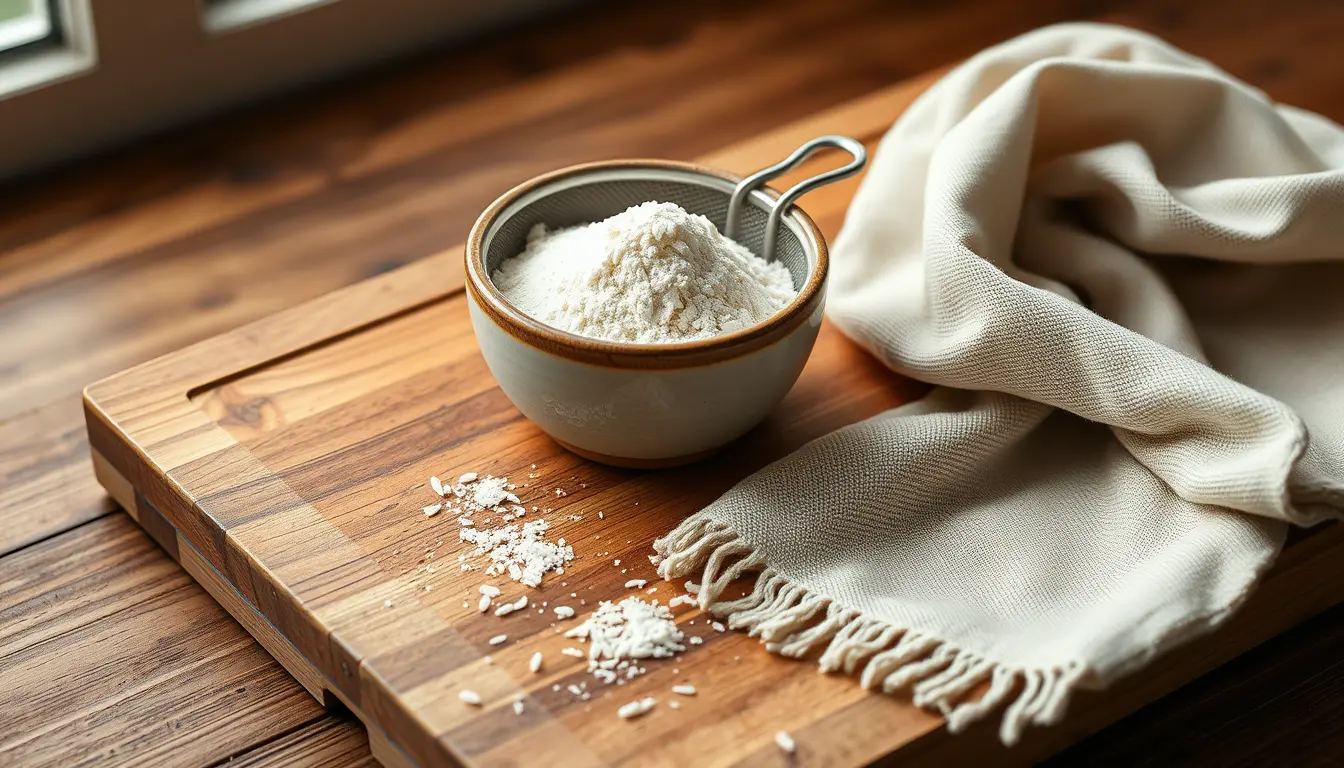
Dust the basket just before the dough goes in. Rice flour is the most dependable choice, since it stays dry and powdery against a wet dough. A small sieve or a shaker spreads it more evenly than a handful.
- For a dough around 70% hydration, a light, even coat is enough.
- For wetter dough, or a long overnight proof, use more, and press it gently into the ridges.
- For a clear ring pattern, use an unlined basket and a generous coat.
- For a crust with seeds or oats, sprinkle them into the basket, and press the top of the shaped dough onto a damp towel first so they stick.
Shaping matters as much as flour. A loaf with a tight, dry surface releases far more easily than a loose one; how to shape a sourdough boule walks through building that tension.
Proofing in the basket
Once the dough is in, cover the whole basket with a plastic bag, a shower cap or a reusable cover. In the fridge, an uncovered loaf forms a thick, dry skin that tears when it rises in the oven. At turn-out time, place a sheet of parchment over the basket, put a board or peel on top and flip the whole thing in one movement.
Cleaning and storing
Bannetons are easy to look after if you keep them dry.
- After each bake, tap the basket firmly upside down to knock out loose flour.
- Brush away any dough stuck in the ridges once it has dried. It flakes off much more easily than when wet.
- Leave the basket out to dry fully, ideally overnight, before putting it away. A warm, airy spot is ideal.
- Store baskets dry and uncovered, or stacked with a liner in between.
- Shake out cloth liners after each use and wash them now and then. Dry them completely.
Avoid soaking a cane or wood pulp basket, and don’t use soap. Moisture trapped in the fibres is what leads to mould.
Dealing with mould
A fuzzy patch or musty smell usually means the basket was put away damp. Let it dry fully, then brush the affected area hard with a dry, stiff brush. Leave it somewhere warm and dry for a day; some bakers set it in sunlight. Some manufacturers suggest drying a basket in a low oven, but cane and pulp can scorch, so follow the instructions that came with yours.
If the mould returns, or the basket keeps smelling musty after drying, replace it. Don’t proof dough in a basket with visible mould.
Banneton mistakes
- A basket that’s too big. The dough spreads to fill it and bakes wide and low.
- Wheat flour alone in an unlined basket. It absorbs moisture and glues the dough to the cane.
- Putting it away damp. The leading cause of mould.
- Washing it in the sink. Water soaks deep into the fibres and takes days to dry.
- Leaving the dough uncovered in the fridge. The surface dries, cracks and sticks.
Proofing basket questions
Why didn’t my loaf get the ring pattern?
The usual reasons are a liner left in, too little flour in the ridges, or a loaf that overproofed and spread. A firm, well-shaped loaf proofed in an unlined, well-floured basket gives the clearest rings.
Can I wash a banneton in the dishwasher?
Not cane or wood pulp ones, which can warp, split or stay damp for days. Plastic baskets usually can go in the dishwasher, and cloth liners can go in the washing machine. Check the maker’s guidance.
Do I need to flour a basket that has a liner?
Yes, but less. A light dusting of rice flour on the cloth is enough for most doughs. Without it, a wet dough can still stick to the fabric.