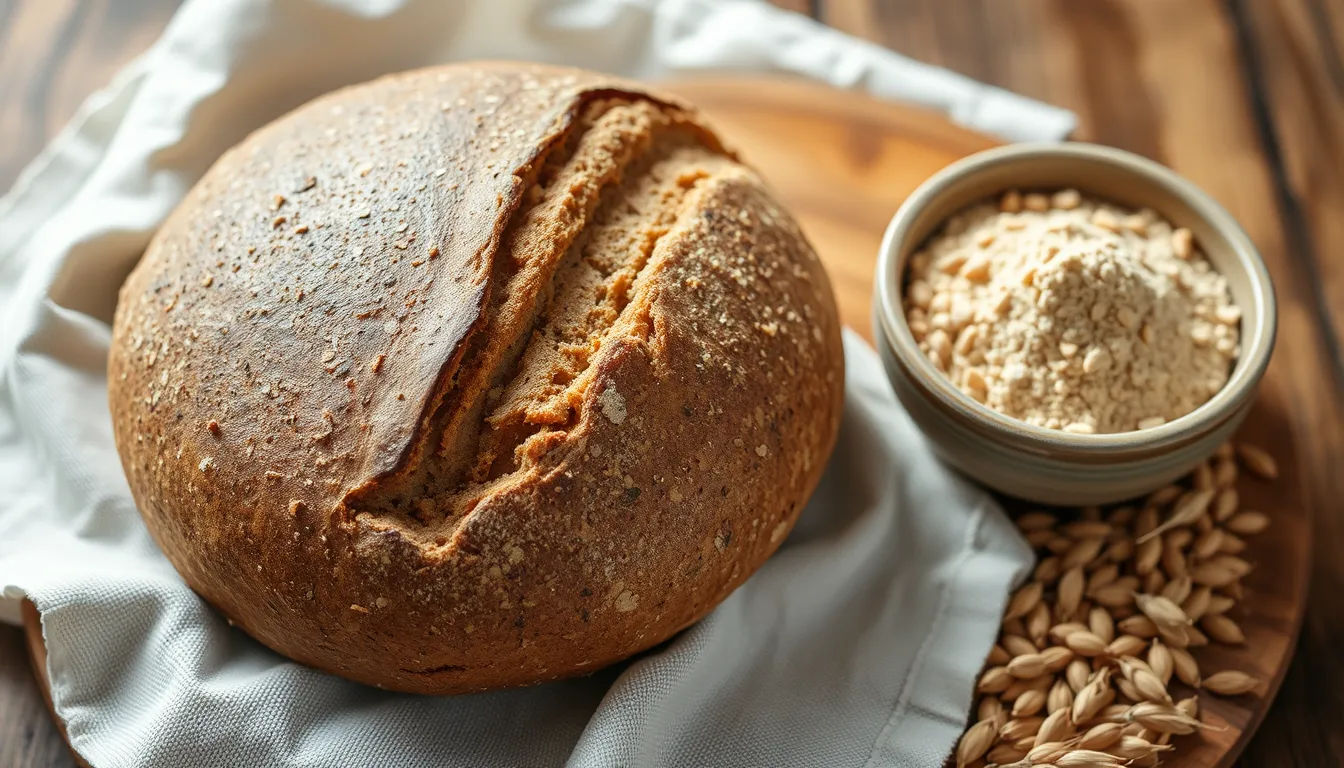
For a loaf that still behaves like a classic, open sourdough, most bakers stay at or below about 30% whole wheat, or about 20% rye, as a share of the total flour. Up to those levels you get more flavour and colour with only small changes to water and timing. Past them, the dough changes character. Whole wheat loaves get heavier and need clearly more water, and rye doughs turn sticky and fragile. Nothing is wrong with going further, but the method has to change with it.
Here is what each level does, why, and how to adjust the recipe as you add more.
What to expect at each level
Percentages here are of the total flour, including the flour inside the starter.
| Share of total flour | Whole wheat | Rye |
|---|---|---|
| 5% to 10% | A nuttier taste, no real change in handling | A clear flavour boost and slightly faster fermentation |
| 10% to 20% | More flavour and colour, a touch more water | Noticeably stickier, and the loaf starts to lose some height |
| 20% to 35% | A few points more water; ferments faster | Sticky, weaker dough and a tighter crumb |
| 35% to 60% | Denser, softer dough that needs gentle handling | Rye bread territory; a tin helps |
| Over 60% | A proper whole wheat loaf with a closer crumb | Paste-like dough, baked in a tin with rye methods |
Whole wheat and rye can be combined. A loaf with 15% whole wheat and 10% rye behaves roughly like one with 30% whole wheat, because rye has the stronger effect per gram.
Why whole grain changes the dough
Bran gets in the way
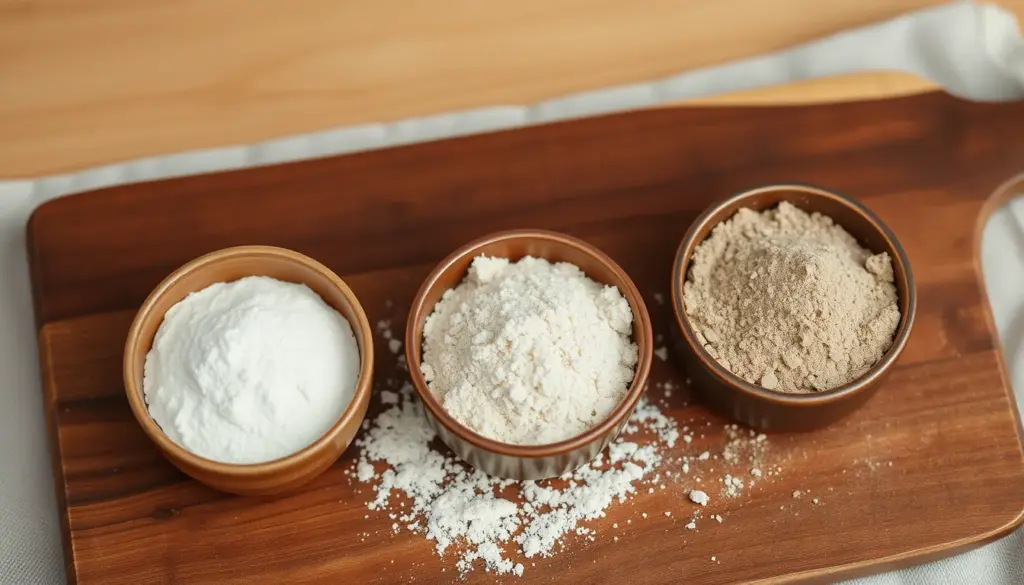
Whole wheat flour contains the bran and germ as well as the white inner part of the grain. The sharp flakes of bran cut through gluten strands as they form, and the oils in the germ make them slippery. The dough can’t trap gas as well, so the loaf rises less and the crumb closes up.
It drinks more water
Bran absorbs a lot of water, and it does so slowly. A dough that feels right when mixed can tighten up an hour later as the bran soaks up its share. That is why whole grain doughs need more water than white ones for the same feel.
Rye is different again
Rye contains proteins, but they don’t form a stretchy gluten network the way wheat’s do. Instead, rye is rich in gums called pentosans that hold large amounts of water and make the dough sticky and paste-like. Rye’s structure comes mostly from those gums and from starch, which is why high-rye breads are baked in tins and handled with wet hands rather than shaped like a boule.
Everything ferments faster
Whole grains carry more minerals and more food for the yeast and bacteria. Doughs with a large share of whole wheat or rye rise and sour faster than white ones.
Protein numbers can mislead
It is tempting to look at the protein on the bag and assume more means stronger. With whole grain, that doesn’t hold.
In the flour protein blend calculator, 300 g of bread flour at 12.7% blended with 200 g of whole wheat at 13.5% comes out at 13.02% protein, higher than the bread flour alone. Yet that 40% whole wheat dough will be weaker, because the bran interferes with the gluten. Blend 400 g of the same bread flour with 100 g of rye at 8.5% and the calculator gives 11.86%, a modest drop that hides a much bigger loss of structure.
Use the protein figure to compare white flours with each other. For whole grain, treat it as a rough guide and let the dough tell you the rest. Bread flour vs all-purpose flour explains what protein does in white flour, where the number is far more reliable.
Adding water as the whole grain goes up
Start with a white loaf you know: 450 g of flour, 320 g of water, 100 g of starter at 100% hydration and 10 g of salt. The sourdough hydration calculator counts the starter too and gives a true hydration of 74%, with 500 g of total flour.
Now replace 150 g of that flour with whole wheat, which makes 30% of the total flour. A reasonable target is about 78%. Enter it and the calculator asks for 340 g of water, 20 g more than before. Go further, to around 45% whole wheat, and aim for about 81%: now it wants 355 g, 35 g more than the white version.
As a starting point, add roughly 1 to 2 percentage points of hydration for every 10% of whole wheat. Rye needs a smaller increase than you might expect. It feels wetter and stickier than it really is, so raise the water in small steps and judge by how the dough behaves after an hour, not straight after mixing.
Check your own recipe with the starter included:
If the loaf still turns out heavy after the water is right, why is my sourdough dense? covers the other causes to rule out.
Timing changes too
Because whole grains speed up fermentation, the clock moves as well. The bulk fermentation estimator shows the effect for a dough with 20% starter at 24 °C (75 °F): about 4 h 45 min to 6 h 15 min with mostly white flour, 4 h 15 min to 5 h 45 min with up to 30% whole grain, 3 h 45 min to 5 h with mostly whole wheat, and 3 h 30 min to 4 h 45 min with mostly rye.
A whole grain dough left on a white-flour schedule can overferment without looking very different, so start checking earlier.
Handling tips for more whole grain
- Give the flour a head start. Mix the whole grain flour with the water and leave it for 30 to 60 minutes before adding the starter and salt. The bran softens and the dough is easier to judge.
- Fold gently and less often with rye. Rye doesn’t develop the way wheat does, so extra folds add little. Two sets are plenty for a dough with 20% to 30% rye.
- Use wet hands, not flour. Rye and high whole wheat doughs stick to everything, and extra flour makes them heavier.
- Consider a tin. Once rye passes about 40%, or whole wheat passes about 70%, a loaf tin gives far better shape than a free-form loaf.
- Bake a little longer. Wetter whole grain loaves need extra time for the centre to set.
- Wait before slicing high-rye bread. Rye crumb keeps setting for many hours; a loaf with over 50% rye is best cut the next day.
Mistakes that make whole grain loaves heavy
- Swapping flour without adjusting the water. The dough ends up stiff and tight.
- Adding all the extra water at once. Keep some back and add it once the bran has had time to absorb.
- Following white-flour timings. Whole grain doughs run ahead of the schedule.
- Expecting the same open crumb. A 50% whole wheat loaf has a softer, closer crumb, and that is the nature of the flour.
Whole grain questions
Should I sift out the bran?
You can, and some bakers sift whole wheat to soak the bran separately and add it back later. It gives a slightly lighter loaf. For everyday baking, a soak of the whole flour before mixing gives most of the benefit with less fuss.
Does whole grain flour go off?
Yes, faster than white flour. The oils in the germ turn rancid over time, giving a bitter, stale smell. Buy it in amounts you will use within a few months, and keep it somewhere cool, or in the freezer if you bake with it only occasionally.
Can I use whole grain in the starter but not the dough?
Yes, and it is an easy way to add flavour without changing the dough much. A starter or levain fed with rye brings some of its taste into the loaf while the dough itself stays mostly white and easy to handle.
Why does rye dough feel sticky even when it isn’t very wet?
The gums in rye hold water in a thick, tacky gel rather than letting it firm up into a smooth dough. It feels wetter than a wheat dough at the same hydration. Wet your hands and your scraper, and resist adding more flour.